
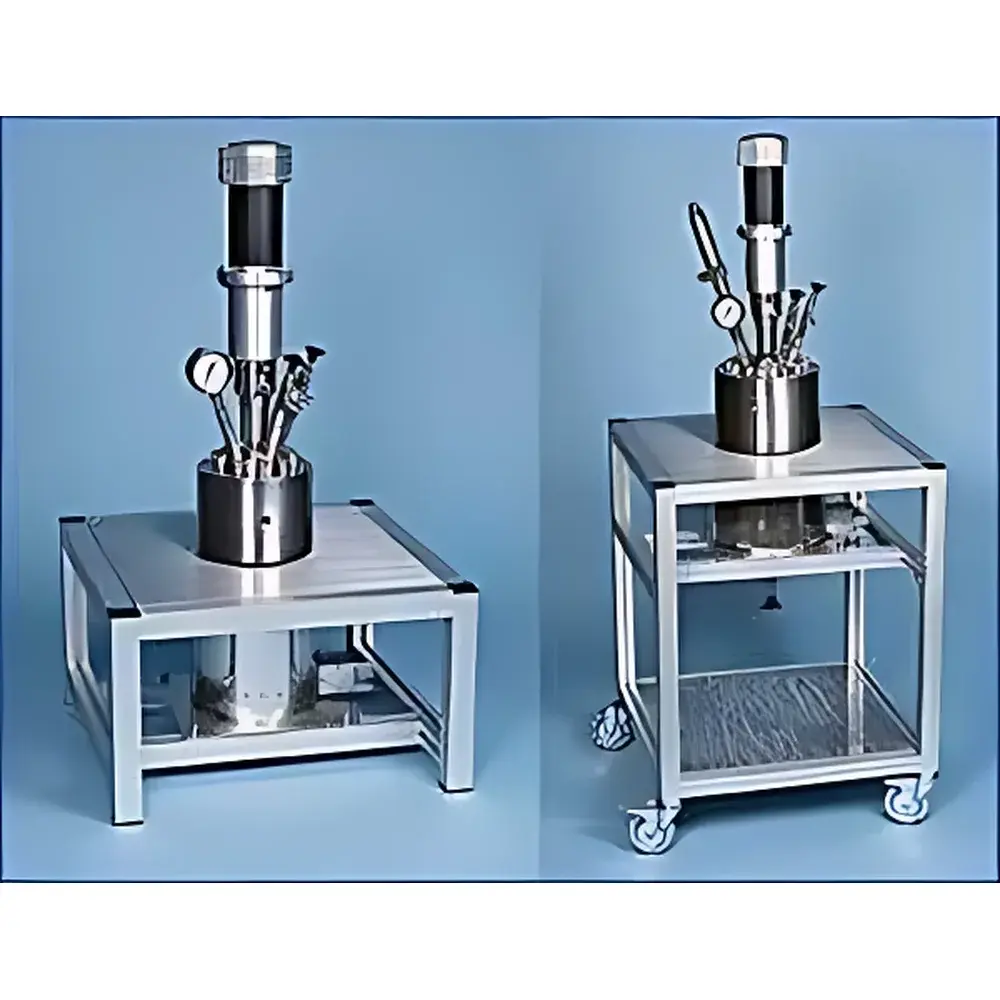
Brookfield 7.5L Laboratory-Scale High-Pressure Reactor
| Origin | Germany |
|---|---|
| Manufacturer Type | Authorized Distributor |
| Origin Category | Imported |
| Model | 7.5L Lab-Scale |
| Pricing | Available Upon Request |
| Effective Volume Range | 150 mL – 7.5 L |
| Max Operating Pressure | 350 bar |
| Max Operating Temperature | 350 °C |
| Construction Materials | Stainless Steel, Hastelloy®, Inconel®, Tantalum, Titanium |
| Heating System | Electric with PID Control |
| Magnetic Stirring | Up to 3000 rpm, 2000 bar / 650 °C rated |
| Mechanical Stirring (Optional) | Up to 200 rpm, 200 bar / 500 °C rated |
| Sealing | Dual Clamping + Automatic C-Ring Seal (Metallic) |
| Compliance | Designed for ASTM E2913, ISO 472, and GLP-compliant reaction workflows |
Overview
The Brookfield 7.5L Laboratory-Scale High-Pressure Reactor is an engineered platform for controlled high-pressure, high-temperature chemical synthesis, catalytic testing, and materials processing under inert or reactive atmospheres. Based on a robust clamped-vessel architecture compliant with ASME BPVC Section VIII Div. 1 design principles (as adapted for laboratory-scale pressure containment), it employs Couette-type magnetic coupling and metallic C-ring sealing to maintain integrity across extreme thermodynamic conditions—up to 350 bar and 350 °C. Unlike batch reactors relying on threaded closures or O-ring elastomers, this system integrates dual mechanical clamps and an automatic axial compression seal mechanism, eliminating torque-dependent gasket creep and enabling repeatable, leak-tight operation across repeated thermal cycles. Its modular vessel design supports interchangeable liner configurations—from 150 mL micro-inserts to the full 7.5 L working volume—facilitating method transfer from screening to pilot-scale parameter optimization without revalidation.
Key Features
- Modular pressure vessel system with scalable internal volumes (150 mL–7.5 L) using standardized flange interfaces and interchangeable liners.
- Dual-clamp closure mechanism with hex-key actuated tensioning, enabling rapid vessel access while maintaining ASME-aligned load distribution across the sealing interface.
- Automated C-ring metallic seal system fabricated from Inconel 718 or Hastelloy C-276, providing zero-permeability containment at temperatures exceeding 300 °C and pressures beyond 300 bar.
- Integrated electric heating jacket with multi-zone PID temperature control (±0.5 °C stability over full range), calibrated traceable to NIST standards.
- Magnetic drive stirrer rated for continuous operation at 3000 rpm under 2000 bar static pressure and up to 650 °C—compatible with corrosion-resistant shafts and sapphire-coated bearings.
- Optional mechanical stirring assembly with gas-tight feedthrough, rated for 200 rpm at 200 bar / 500 °C, suitable for polymerization, slurry-phase hydrogenation, and viscous heterogeneous catalysis.
- Digital torque and rotational speed monitoring via integrated Hall-effect sensors, with real-time RS-485 output for external SCADA integration.
- Configurable instrumentation ports (up to 8 × 1/4″ VCR or Swagelok®) for in situ probes: thermocouples (Type K or S), pressure transducers (0–400 bar range), gas dosing valves, and sampling loops.
Sample Compatibility & Compliance
This reactor accommodates aggressive chemistries—including halogenated solvents, supercritical CO₂, anhydrous HF, molten salts, and concentrated mineral acids—through material-selective construction options: 316L stainless steel (standard), Hastelloy C-22 (for oxidizing chloride media), Inconel 625 (high-temperature H₂S service), tantalum (for hydrofluoric acid resistance), and Grade 7 titanium (for seawater- and bromide-containing systems). All wetted surfaces are electropolished to Ra ≤ 0.4 µm and passivated per ASTM A967. The system conforms to ISO 472 (plastics—determination of thermal degradation behavior), ASTM E2913 (standard guide for high-pressure reaction calorimetry), and supports 21 CFR Part 11-compliant electronic recordkeeping when paired with validated data acquisition software.
Software & Data Management
The reactor interfaces with Brookfield’s ReactorControl Suite v4.2—a Windows-based application supporting automated ramp/soak profiles, multi-parameter logging (T, P, rpm, torque, power), and alarm-triggered safety shutdowns (e.g., overpressure >355 bar, T >355 °C, or stirrer stall detection). Audit trails include user ID, timestamp, parameter setpoints, and raw sensor values—all encrypted and exportable as CSV or PDF reports compliant with GLP/GMP documentation requirements. Optional OPC UA server enables integration into centralized lab infrastructure (e.g., DeltaV, LabArchives, or Empower).
Applications
- Catalyst screening for Fischer–Tropsch synthesis, ammonia decomposition, and CO₂ hydrogenation (e.g., methanol, formic acid).
- Hydrothermal synthesis of metal–organic frameworks (MOFs), perovskites, and quantum dot nanocrystals.
- High-pressure polymerization of ethylene, propylene, and cyclic olefins under Ziegler–Natta or metallocene catalysis.
- Supercritical fluid extraction (SFE) process development using scCO₂ or scH₂O.
- Corrosion testing of alloy candidates under simulated geothermal or sour-gas environments (H₂S/CO₂/H₂O mixtures).
- Thermal stability assessment of energetic materials and battery electrolytes per UN Test Series 3 and IEC 62660-2 protocols.
FAQ
What materials are available for the reactor body and internal components?
Standard construction uses ASTM A240 UNS S31603 stainless steel; optional alloys include Hastelloy C-22 (UNS N06022), Inconel 625 (UNS N06625), tantalum (ASTM B365 Gr. 1), and titanium Grade 7 (ASTM B338). Liners, stirrers, and seals are matched to the selected alloy family.
Is the system compatible with hazardous gas handling (e.g., H₂, NH₃, Cl₂)?
Yes—when equipped with double-block-and-bleed valve manifolds, gas-tight stirrer feedthroughs, and pressure-relief devices certified to PED 2014/68/EU, the reactor meets EN 14460:2020 requirements for hazardous gas containment.
Can the reactor be integrated into an automated reaction platform?
Absolutely—the system provides analog (4–20 mA) and digital (RS-485 Modbus RTU, Ethernet/IP) I/O for seamless integration with robotic liquid handlers, automated sampling stations, and centralized process control systems.
What calibration documentation is provided upon delivery?
Each unit ships with a Factory Calibration Certificate traceable to national metrology institutes (PTB, NPL, or NIST), covering pressure transducer linearity (±0.1% FS), thermocouple accuracy (±0.5 °C), and torque sensor repeatability (±0.3% FS).
Is remote operation supported during extended unattended runs?
Yes—via secure TLS 1.2–encrypted web interface, users can monitor live parameters, adjust setpoints, trigger emergency venting, and download session logs from any location with network access.



