
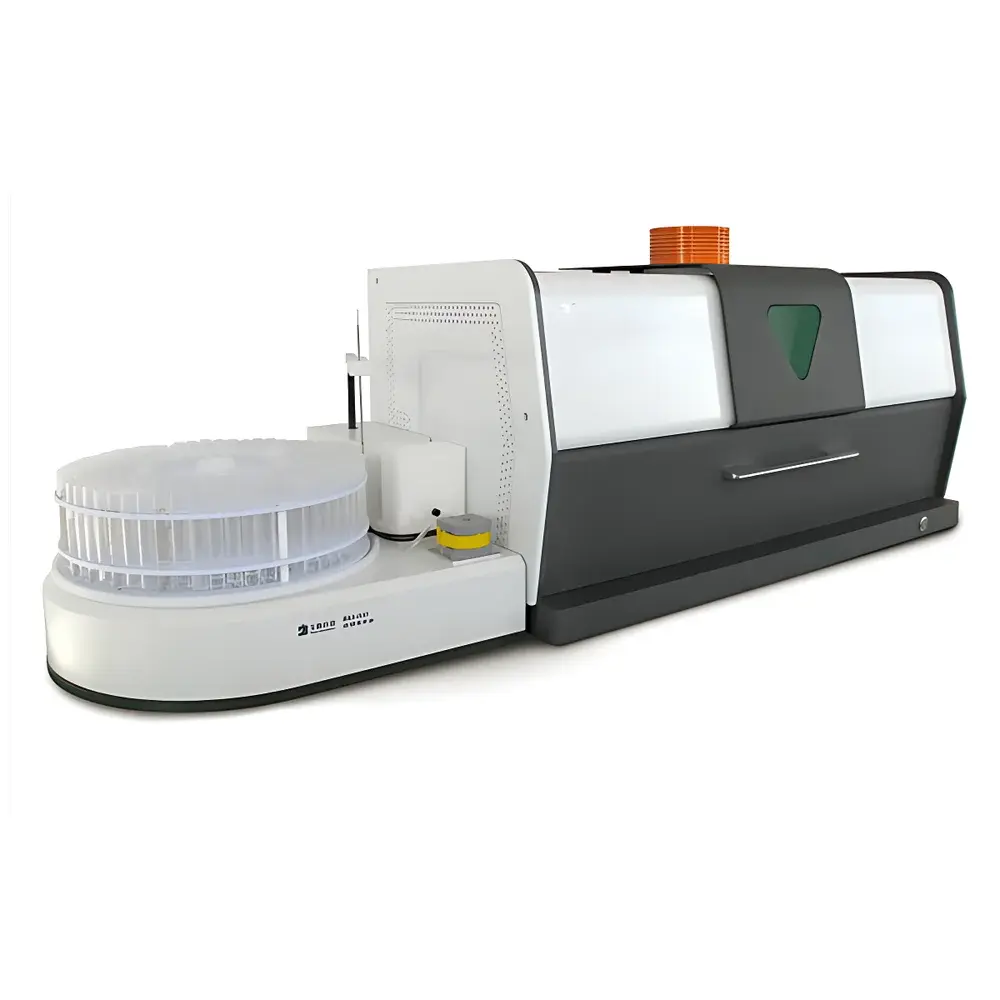
Brookfield BAF-2000 Dual-Channel Atomic Fluorescence Spectrometer
| Brand | Brookfield |
|---|---|
| Origin | Beijing, China |
| Manufacturer | Producer |
| Country of Origin | China |
| Model | BAF-2000 |
| Price | Upon Request |
| Detectable Elements | As, Se, Sn, Sb, Hg, Cd, Te, Bi, Ge, Zn, Au |
| Elemental Speciation Capability (Upgraded) | As, Hg, Se, Sb |
Overview
The Brookfield BAF-2000 Dual-Channel Atomic Fluorescence Spectrometer is a high-performance analytical instrument engineered for trace-level quantification of hydride-forming and cold-vapor elements in complex matrices. Based on the principle of atomic fluorescence spectroscopy (AFS), the system atomizes analyte species—typically via hydride generation (HG) for As, Se, Sb, Bi, Te, Sn, Pb, Ge, Cd and cold-vapor atomic fluorescence (CV-AFS) for Hg—then excites ground-state atoms with element-specific hollow cathode lamps (HCLs) and measures the intensity of characteristic fluorescent emission at defined wavelengths. This technique delivers exceptional sensitivity (sub-pg/mL detection limits for key elements), low spectral interference, and high selectivity—making it a preferred method for regulatory compliance testing in environmental, food safety, pharmaceutical, and clinical laboratories where stringent trace metal monitoring is mandated by ISO 17025, USP , EPA Method 1631/200.8, and GB/T 5009.11–2014.
Key Features
- Dual-channel simultaneous detection: Enables concurrent measurement of two elements (e.g., As and Hg) without sequential lamp switching—reducing analysis time by up to 40% and improving throughput for routine multi-element screening.
- Optimized optical path design: Features a non-dispersive, off-axis fluorescence collection geometry with minimized stray light and enhanced signal-to-background ratio—achieving ~30% higher sensitivity versus conventional AFS configurations and significantly improved long-term signal stability.
- Automated mercury lamp ignition and drift compensation: Integrates a pulsed high-voltage starter circuit for reliable, tool-free Hg lamp ignition; coupled with real-time HCL intensity monitoring and dynamic baseline correction algorithms to suppress lamp drift-induced signal drift over extended runs (>8 h).
- Auto-focused lamp alignment: Employs motorized XYZ positioning and beam profiling feedback to achieve optimal lamp-to-atomizer coupling—eliminating manual lamp adjustment and ensuring reproducible optical alignment across operator shifts and instrument lifecycles.
- Modular hydride generation system: Compatible with both continuous-flow and flow-injection HG modules; supports programmable reaction coil temperature control (30–95 °C) and gas–liquid separation optimization for volatile hydride-forming elements.
Sample Compatibility & Compliance
The BAF-2000 accommodates liquid samples ranging from 0.5 to 10 mL volume, including acid-digested environmental waters (drinking water, seawater, wastewater), microwave-assisted digests of foodstuffs (rice, seafood, infant formula), biological tissues (urine, blood, hair), herbal extracts, cosmetic emulsions, and metallurgical leachates. Sample introduction is fully compatible with standard polypropylene or quartz sample cups and automated autosamplers (optional). The instrument meets essential metrological requirements for accredited testing laboratories: full traceability to NIST SRM reference materials (e.g., SRM 1640a, 1643e), built-in performance verification protocols per ISO/IEC 17025 Clause 7.7, and audit-ready calibration log retention. Optional GLP/GMP-compliant software packages support 21 CFR Part 11 electronic signatures, user access levels, and immutable audit trails.
Software & Data Management
Controlled via Brookfield AFS Suite v3.2, the instrument software provides intuitive method setup, real-time spectral visualization, peak integration with customizable baseline algorithms (tangent skim, linear interpolation), and automatic calibration curve generation (linear, quadratic, or weighted least-squares). All raw data—including lamp current, detector voltage, integration time, and carrier gas pressure—are timestamped and stored in vendor-neutral .csv and .xlsx formats. Integrated QC tools include spike recovery calculation, duplicate analysis comparison, and control charting per ASTM D5847. Data export complies with LIMS interface standards (ASTM E1482, HL7) and supports direct upload to national reporting platforms such as China’s CNEMC and EU’s EIONET.
Applications
The BAF-2000 serves as a core analytical platform in regulatory and research settings requiring precise, cost-effective trace metal analysis. Key use cases include: monitoring arsenic in rice and drinking water per WHO and EU Directive 2020/2184; quantifying total mercury and methylmercury (after speciation upgrade) in fish tissue per FDA Fish Sampling Program; validating selenium content in dietary supplements against USP ; verifying cadmium and lead levels in cosmetics per SCCS/1623/20 guidelines; and supporting geological exploration through rapid Bi–Te–Sn assays in ore concentrates. Its robustness and low operational cost make it especially suitable for high-volume public health labs, university teaching laboratories, and contract testing facilities operating under ISO/IEC 17025 accreditation.
FAQ
What hydride-forming elements can the BAF-2000 quantify in routine operation?
As, Se, Sb, Bi, Te, Sn, Pb, Ge, Cd, and Zn—using sodium borohydride (NaBH₄) reduction under controlled acidity and temperature.
Is cold-vapor mercury analysis supported natively?
Yes—the system includes dedicated CV-AFS optics, SnCl₂ reduction module, and mercury-specific lamp housing with optimized vapor cell geometry.
Can the instrument be upgraded for elemental speciation analysis?
Yes—optional HG-AFS coupling with HPLC enables separation and detection of inorganic As(III)/As(V), monomethylarsonic acid (MMA), dimethylarsinic acid (DMA), and methylmercury (MeHg) following EPA Method 1632.
Does the software support multi-user environments with role-based access?
Yes—administrator, analyst, and reviewer roles are configurable with password protection, session logging, and electronic signature capability compliant with 21 CFR Part 11.
What maintenance intervals are recommended for optimal performance?
Lamp replacement every 500–800 h; quartz reaction tube cleaning after every 200 injections; annual PM including detector dark current calibration and optical alignment verification.




