
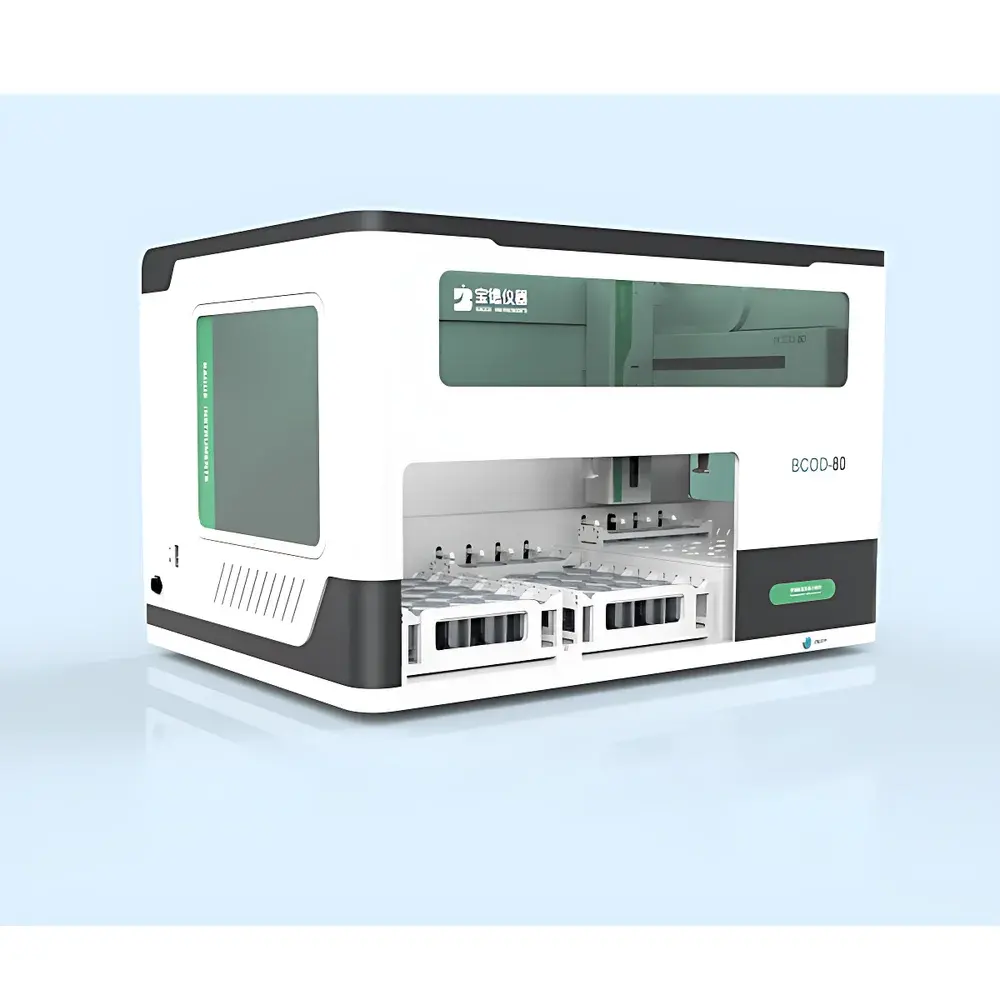
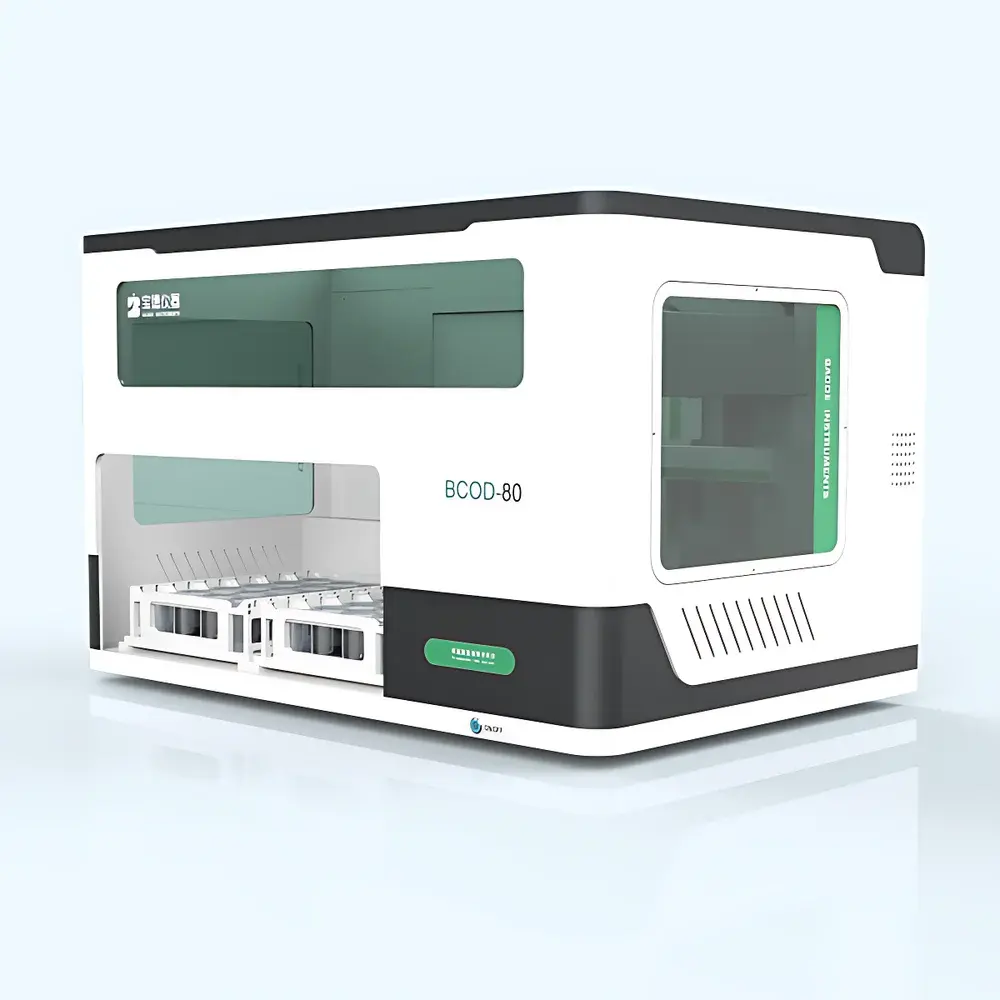
Brookfield BCOD-80 Fully Automated Four-Channel Permanganate Index Analyzer
| Brand | Brookfield |
|---|---|
| Origin | Beijing, China |
| Manufacturer Type | Original Equipment Manufacturer (OEM) |
| Country of Origin | China |
| Model | BCOD-80 |
| Pricing | Available upon Request |
Overview
The Brookfield BCOD-80 Fully Automated Four-Channel Permanganate Index Analyzer is a precision-engineered instrument designed for the quantitative determination of the permanganate index (CODMn) in aqueous samples. Based on standardized redox titration principles—specifically acidic and alkaline potassium permanganate oxidation—the BCOD-80 implements a robust, thermally controlled, multi-step analytical protocol compliant with internationally recognized water quality testing standards, including GB 11892–1989 and GB/T 5750.7–2006. The system operates by oxidizing organic and inorganic reductants in the sample under controlled temperature and pH conditions, followed by back-titration with standardized sodium oxalate solution. Endpoint detection is achieved via high-sensitivity photometric sensing, ensuring reproducible identification of the stoichiometric equivalence point. As a four-channel parallel processing platform, the BCOD-80 eliminates sequential bottlenecks inherent in single-channel systems, enabling throughput scalability without compromising analytical integrity.
Key Features
- Fully automated four-channel architecture supports concurrent analysis of up to four samples per cycle, reducing total assay time by ≥75% compared to manual or single-channel methods.
- Patented electric water-bath digestion module delivers rapid, uniform heating (±0.3 °C temperature stability across all zones) with programmable ramp/hold profiles, minimizing inter-channel thermal variance.
- High-precision syringe-type titration pump with ≤0.2% volumetric repeatability (RSD) and factory-calibrated flow path geometry—no daily recalibration required under routine operation.
- Optical endpoint detection system utilizing dual-wavelength photometry (525 nm/620 nm) to discriminate subtle absorbance shifts during MnO4− reduction, delivering endpoint resolution <0.02 mL.
- Integrated reagent management with low-level alerts, leak detection, and pressure monitoring to ensure uninterrupted sequence execution over extended unattended runs.
- Modular design facilitates field serviceability and compliance with ISO/IEC 17025 maintenance documentation requirements.
Sample Compatibility & Compliance
The BCOD-80 accommodates liquid samples ranging from 10 mL to 100 mL volume, with matrix compatibility spanning drinking water, surface water, groundwater, wastewater effluents, and low-salinity industrial process streams. For chloride concentrations exceeding 300 mg/L, the instrument automatically switches to alkaline permanganate oxidation mode per GB/T 5750.7–2006 Annex B, mitigating chloride interference through pH-controlled reaction kinetics. All hardware and firmware components are engineered to support audit-ready workflows aligned with GLP and ISO 17025 laboratory accreditation frameworks. Data generation adheres to ALCOA+ principles (Attributable, Legible, Contemporaneous, Original, Accurate, Complete, Consistent, Enduring, Available), and optional software modules provide 21 CFR Part 11-compliant electronic signatures and audit trail functionality.
Software & Data Management
The BCOD-80 operates under proprietary Windows-based control software featuring intuitive method configuration wizards, real-time titration curve visualization, and automatic calculation of CODMn (mg O2/L) using standard stoichiometric factors. Raw absorbance data, titrant consumption volumes, temperature logs, and system status events are stored in encrypted SQLite databases with configurable backup intervals. Export options include CSV, PDF analytical reports (with embedded metadata), and direct integration into LIMS via ASTM E1384-compliant HL7 or ODBC interfaces. Firmware updates are delivered via signed package files with SHA-256 verification to maintain cryptographic integrity.
Applications
The BCOD-80 serves as a primary analytical tool in environmental monitoring laboratories performing routine surveillance of source water quality, regulatory compliance reporting (e.g., China’s Environmental Quality Standards for Surface Water GB 3838–2002), and operational control in municipal drinking water treatment plants. Its dual-mode capability supports method validation studies comparing acidic vs. alkaline oxidation efficiencies in heterogeneous matrices. Additional use cases include research applications in hydrological nutrient cycling assessment, pre-treatment screening for advanced oxidation processes, and quality assurance testing in pharmaceutical manufacturing where purified water specifications reference permanganate oxidizability (e.g., USP ). Field deployment is supported through optional vibration-dampened transport enclosures and wide-range AC/DC power adaptability.
FAQ
What regulatory standards does the BCOD-80 comply with?
The instrument implements analytical protocols fully aligned with GB 11892–1989 and GB/T 5750.7–2006, and its data management architecture supports GLP, ISO/IEC 17025, and FDA 21 CFR Part 11 requirements when configured with optional compliance software.
Can the BCOD-80 analyze seawater or brackish water samples?
Samples with chloride concentration >300 mg/L must be analyzed using the alkaline permanganate method; the BCOD-80 automatically selects this mode and applies appropriate correction algorithms per standard methodology.
Is method validation documentation provided?
Yes—each unit ships with a Factory Acceptance Test (FAT) report, metrological traceability certificates for critical components (e.g., titration pump, temperature sensors), and a comprehensive Method Validation Guide covering linearity, LOD/LOQ, precision, and recovery studies.
How often does the titration pump require maintenance?
Under normal operating conditions (≤200 assays/week), scheduled maintenance—including seal inspection and fluid path cleaning—is recommended every 6 months; no daily calibration is necessary due to the pump’s mechanical stability and factory characterization.
Does the system support remote diagnostics?
Yes—optional Ethernet/Wi-Fi connectivity enables secure remote access for firmware updates, log retrieval, and real-time instrument health monitoring via TLS-encrypted channels.
Related Products







