
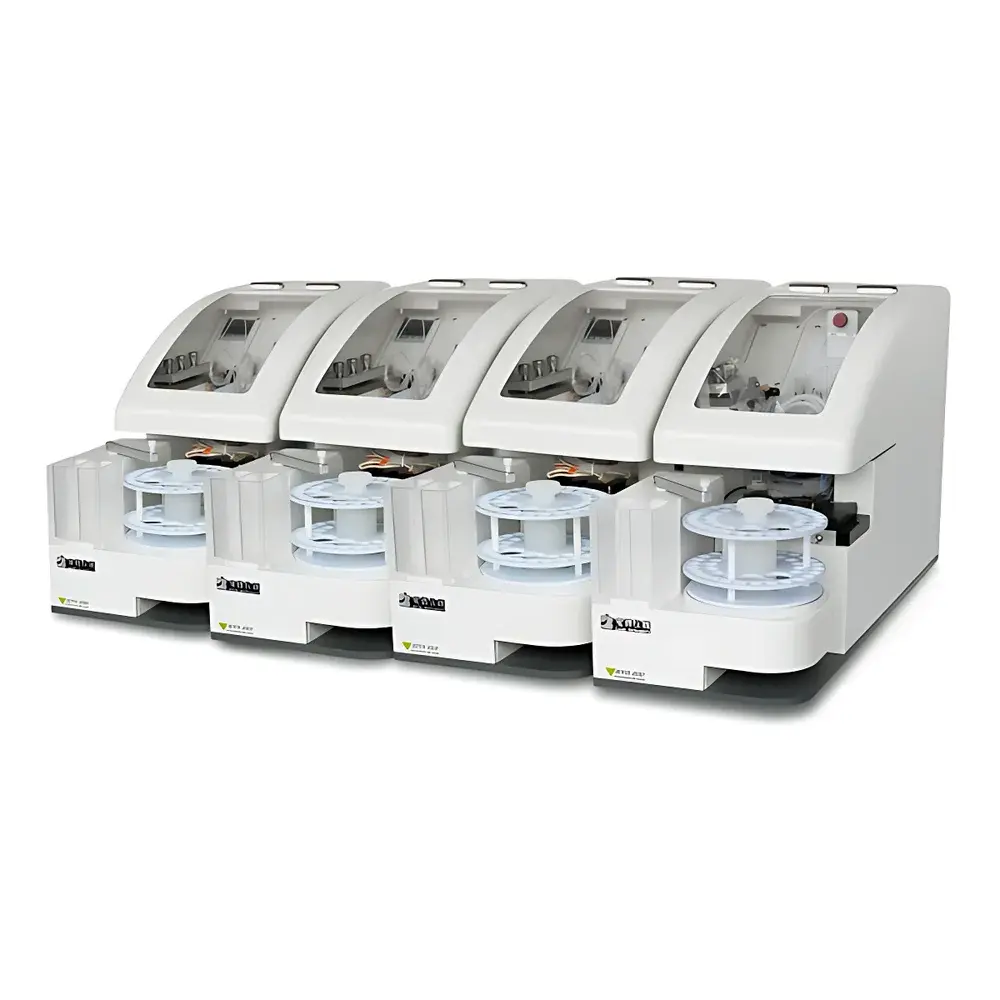
Brookfield BDFIA-8000 Fully Automated Flow Injection Analyzer
| Brand | Brookfield |
|---|---|
| Origin | Beijing, China |
| Manufacturer Type | Original Equipment Manufacturer (OEM) |
| Product Category | Domestic |
| Model | BDFIA-8000 |
| Pricing | Upon Request |
| Instrument Type | Flow Injection Analyzer |
Overview
The Brookfield BDFIA-8000 Fully Automated Flow Injection Analyzer is an integrated, benchtop analytical platform engineered for high-throughput, multi-parameter determination of inorganic and organic analytes in environmental, agricultural, food, and industrial matrices. It operates on the fundamental principles of flow injection analysis (FIA), combining precise segmented fluidic transport with on-line sample pretreatment modules and UV-Vis spectrophotometric detection. Unlike conventional batch or discrete analyzers, the BDFIA-8000 employs a continuous carrier stream to introduce discrete sample zones into a controlled chemical reaction environment—enabling reproducible mixing, timed derivatization, and optimized reaction kinetics prior to photometric measurement. This architecture delivers superior precision (RSD < 1.5% for routine calibration standards), reduced reagent consumption (typically 20–40% less than manual methods), and minimal operator intervention across extended unattended runs.
Key Features
- Integrated channel-based architecture: All critical functions—including autosampling, programmable on-line pretreatment (heating, distillation, liquid-liquid extraction, reduction, condensation), reaction coil management, and dual-beam UV-Vis detection—are housed within a single compact chassis.
- Intelligent fluidic control: Peristaltic pump modules with individually addressable rollers ensure precise flow rate regulation (0.1–5.0 mL/min, adjustable in 0.05 mL/min increments) and pulse-free delivery across up to eight independent analytical channels.
- Real-time system integrity monitoring: Built-in leak detection sensors, waste reservoir level tracking with overflow alarm, and optical liquid-level sensing at critical junctions prevent operational failure and support GLP-compliant audit trails.
- Modular pretreatment capability: Reaction-specific modules (e.g., cadmium column reduction for nitrate-to-nitrite conversion, acid distillation for cyanide liberation, UV digestion for total phosphorus oxidation) are software-selectable and automatically engaged per method sequence.
- Robust thermal management: Peltier-controlled heating zones (30–120 °C, ±0.3 °C stability) and active condensation units enable reliable volatile analyte recovery (e.g., phenols, cyanides) without manual glassware assembly.
Sample Compatibility & Compliance
The BDFIA-8000 accommodates aqueous extracts (filtered or digested), soil leachates, food homogenates, fertilizer solutions, and beverage filtrates—with matrix tolerance validated per ISO 15681-2 (phosphorus), ISO 6777 (cyanide), ASTM D1253 (residual chlorine), and EPA Method 354.1 (phenols). Sample introduction supports 1–5 mL volumes via programmable syringe-driven autosampler (96-well or 144-tube capacity). The system complies with ISO/IEC 17025:2017 requirements for analytical method validation and supports full traceability under FDA 21 CFR Part 11 when paired with compliant LIMS integration. All wetted components (PTFE, PFA, borosilicate glass, quartz cuvettes) resist corrosion from strong acids, alkalis, and oxidizing agents used in standard environmental protocols.
Software & Data Management
Controlled by BD-FIA Studio v3.2, the instrument’s software provides method editor with drag-and-drop module sequencing, real-time chromatogram visualization, automatic peak integration using derivative-based baseline correction, and customizable report templates aligned with ISO 17025 reporting clauses. Audit trail functionality logs all user actions, parameter changes, calibration events, and instrument status flags with time stamps and operator ID. Raw data (absorbance vs. time) and processed results are exportable in CSV, XML, and PDF formats; optional OPC UA interface enables bidirectional communication with enterprise-level laboratory information management systems (LIMS) and SCADA environments.
Applications
- Water quality testing: Simultaneous quantification of NH₃-N, NO₂⁻, NO₃⁻, PO₄³⁻, Cr(VI), CN⁻, phenol, SO₄²⁻, SiO₂, and surfactants in drinking water, wastewater effluents, groundwater, and boiler feedwater per ISO 5667 series and APHA Standard Methods.
- Soil and plant tissue analysis: Total N and P determination following Kjeldahl digestion or alkaline persulfate oxidation; extractable boron, fluoride, and sulfate from Mehlich-3 or CaCl₂ extractions.
- Food and beverage safety: Formaldehyde in fish products (AOAC 993.11), nitrite in cured meats, sulfite in wines, and total acidity in fruit juices.
- Agricultural inputs: Urea nitrogen in fertilizers, total alkalinity and hardness in irrigation water, and soluble calcium/magnesium in foliar sprays.
FAQ
What regulatory standards does the BDFIA-8000 support for environmental compliance?
It is validated for use with EPA Methods 354.1, 375.4, and 365.4, as well as ISO 15681-1/-2, ISO 6777, and ASTM D1253—covering key parameters required by national water quality monitoring programs.
Can the system be upgraded to accommodate new analytes or methods?
Yes. Hardware modularity allows addition of custom reaction manifolds (e.g., gas-diffusion modules for ammonium, electrochemical detectors for heavy metals); firmware and software updates are delivered quarterly via secure portal.
Is remote diagnostics and service support available?
All instruments include embedded Ethernet connectivity and TLS-encrypted remote access capability for certified field engineers, enabling predictive maintenance alerts and real-time troubleshooting without on-site visits.
How is calibration verification handled during long-term operation?
The system executes automated bracketing calibrations, drift correction via internal reference standards, and QC sample insertion at user-defined intervals—all logged with full metadata for GLP/GMP audits.





