
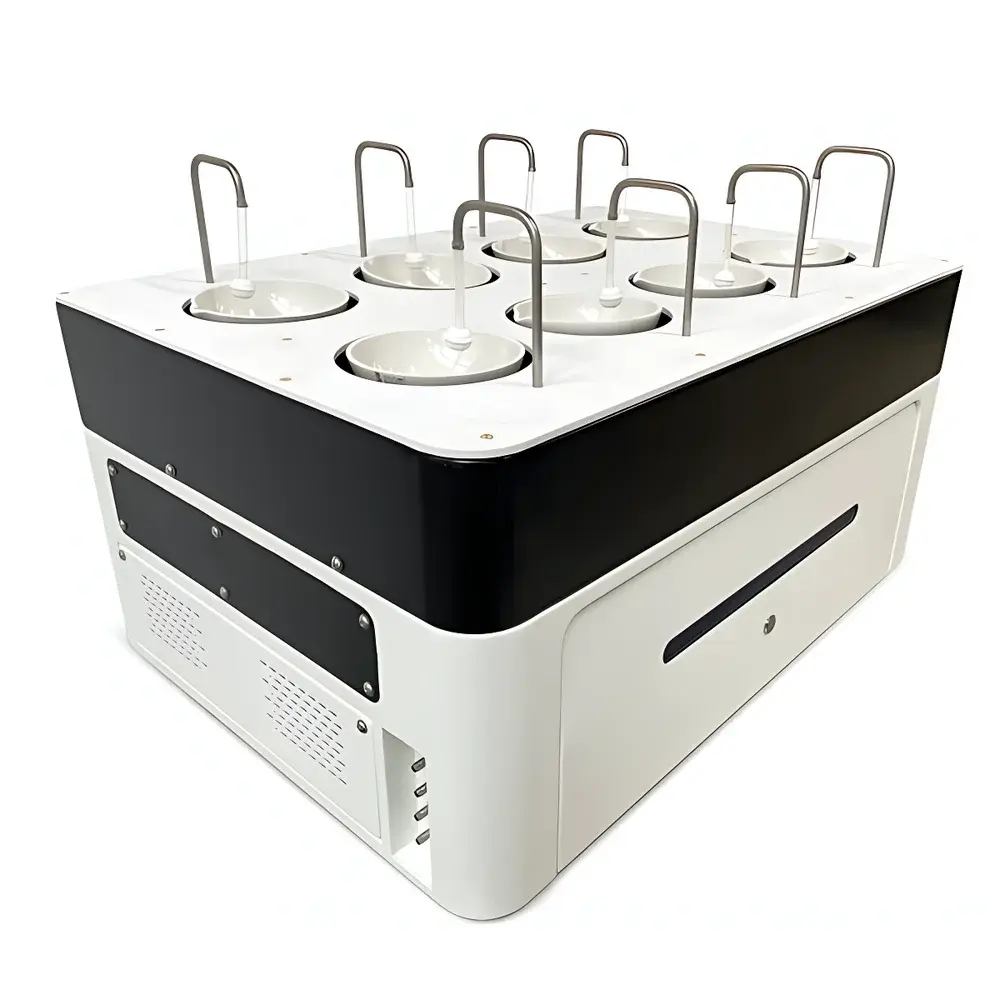
Brookfield BLC-8 Automated Total Alpha/Beta Water Sample Evaporator
| Brand | Brookfield |
|---|---|
| Origin | Beijing, China |
| Manufacturer | Producer |
| Country of Origin | Domestic (China) |
| Model | BLC-8 |
| Pricing | Upon Request |
Overview
The Brookfield BLC-8 Automated Total Alpha/Beta Water Sample Evaporator is an integrated, eight-channel laboratory instrument engineered for precise, unattended evaporation, concentration, and acid removal (‘acid fuming’) of large-volume aqueous samples prior to radiochemical analysis. It operates on the principle of controlled far-infrared radiant heating—providing uniform thermal energy transfer without direct contact—combined with programmable temperature regulation and gravimetric or volumetric endpoint detection. Designed in strict compliance with national standard methodologies for total alpha and beta activity determination (e.g., GB/T 5750.13–2023, GB/T 6769–2022, and HJ 898–2017), the system supports standardized sample preparation workflows required for regulatory reporting under environmental radiation monitoring, drinking water safety, and nuclear facility effluent surveillance protocols.
Key Features
- Eight independent evaporation channels with synchronized or staggered operation scheduling
- Far-infrared heating modules with adjustable power output (0–100% range) and real-time temperature feedback control
- Programmable constant-temperature evaporation mode (range: ambient to 200 °C, ±1 °C stability)
- Integrated high-precision mass sensing or optical level detection for endpoint determination during concentration
- Automated liquid handling via peristaltic pumps or syringe-driven dispensing, supporting sample volumes from 100 mL to 2 L per channel
- Industrial-grade PLC-based control architecture with emergency stop, overheat protection, and door interlock safety mechanisms
- Corrosion-resistant stainless-steel sample chamber and PTFE-coated components for compatibility with nitric, hydrochloric, and perchloric acid matrices
Sample Compatibility & Compliance
The BLC-8 accommodates a broad spectrum of aqueous matrices including surface water, groundwater, industrial wastewater, domestic sewage, rainwater, drinking water, natural mineral water, and airborne dust leachates. It meets functional requirements outlined in ISO/IEC 17025:2017 for method validation in accredited laboratories and aligns with analytical pre-treatment steps referenced in EPA Method 900.0, ASTM D7283–18, and IAEA Technical Reports Series No. 488. For regulated environments—including those governed by GLP, GMP, or national radiation protection regulations—the system supports audit-ready operation logs and user-access-controlled parameter locking, facilitating traceability and data integrity in accordance with FDA 21 CFR Part 11 principles where electronic records are implemented via compatible LIMS integration.
Software & Data Management
The instrument is operated via an embedded touchscreen HMI running deterministic real-time firmware. All run parameters—including heating ramp profiles, hold times, target mass/volume thresholds, and channel-specific pause/resume commands—are stored locally with timestamped execution records. Exportable CSV log files include start/stop timestamps, final mass/volume readings, thermal history per channel, and operator ID (if authenticated). Optional Ethernet or RS-485 connectivity enables remote status monitoring and centralized fleet management across multi-instrument lab environments. Software design prioritizes repeatability and procedural fidelity over graphical customization—no cloud dependency or subscription licensing is required.
Applications
- Preparation of water samples for gross alpha/beta radioactivity measurement by low-background gas proportional counting or liquid scintillation spectrometry
- Concentration of environmental air particulate (TSP, PM10, PM2.5) filter leachates for radionuclide screening
- Determination of dissolved solids (TDS) in potable water per ISO 29901 and APHA Standard Methods 2540B
- Acid digestion support for subsequent ICP-MS or gamma spectrometry analysis of uranium, thorium, and strontium isotopes
- High-throughput batch processing in national environmental monitoring networks and nuclear regulatory inspection programs
FAQ
Does the BLC-8 support automatic acid addition or only evaporation?
The BLC-8 is designed exclusively for evaporation, concentration, and acid fuming (volatilization of excess acid post-digestion). It does not include reagent dispensing capability for wet digestion steps.
Can it handle seawater or high-salinity brines without clogging or corrosion?
Yes—sample vessels and fluid pathways are constructed from 316 stainless steel and PTFE; however, routine cleaning after high-TDS samples is recommended to prevent salt crust accumulation on sensors.
Is calibration traceable to national metrology institutes?
Mass sensors are factory-calibrated using NIST-traceable weights; temperature modules are verified against PT100 reference probes certified to ISO/IEC 17025-accredited calibration labs.
What maintenance intervals are recommended for long-term operational reliability?
Heating elements and sensor surfaces require visual inspection every 200 operating hours; full preventive maintenance—including gasket replacement and firmware verification—is advised annually or after 1,000 cycles.



