
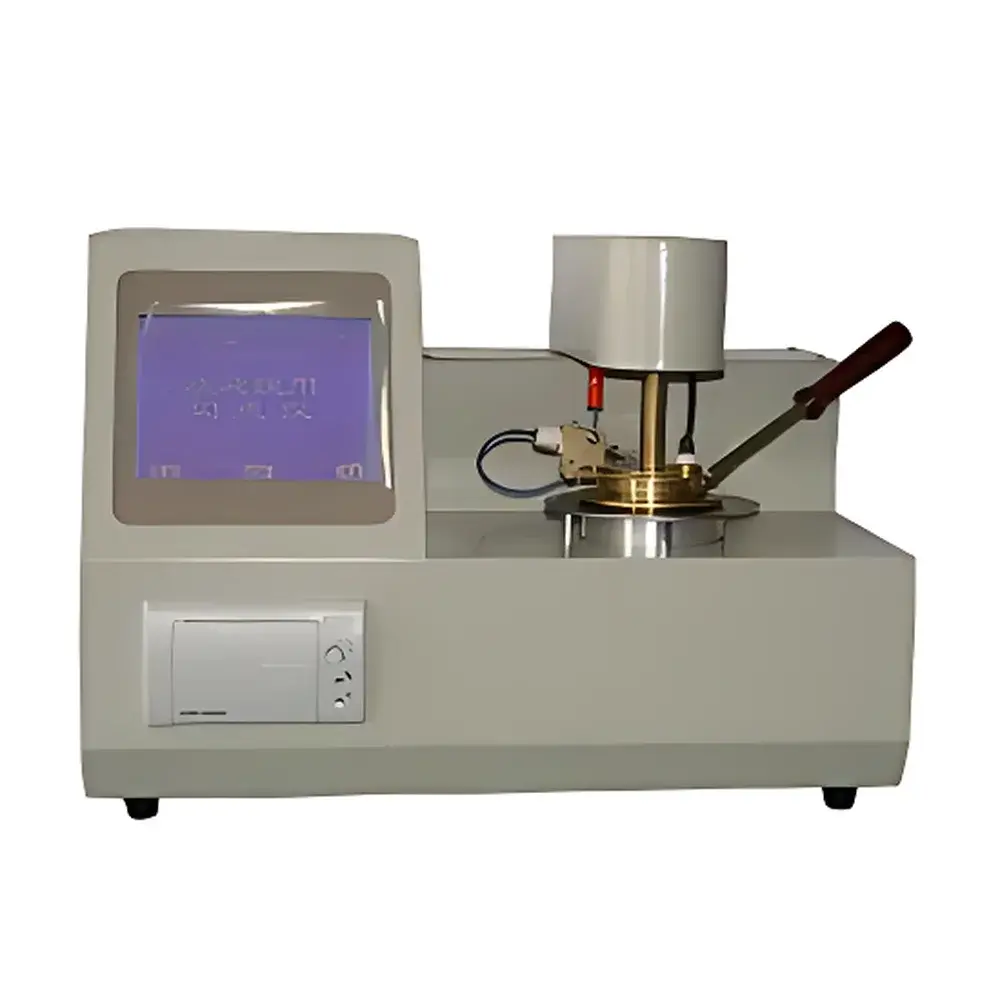
Brookfield BS100 Automated Closed-Cup Flash Point Tester
| Brand | Brookfield |
|---|---|
| Model | BS100 |
| Measurement Range | Ambient to 350 °C |
| Accuracy | ±1 °C (≤104 °C), ±2 °C (>104 °C) |
| Repeatability | ±2 °C |
| Temperature Resolution | 0.1 °C |
| Temperature Sensor | Imported Class A PT100 Platinum Resistance Thermometer |
| Ignition Detection | Thermocouple-based Flash Sensor |
| Power Supply | AC 220 V ±20%, 50 Hz ±10% |
| Power Consumption | 400 W |
| Dimensions | 440 × 280 × 290 mm |
| Weight | 18 kg |
| Operating Environment | 0–40 °C, ≤90% RH |
| Compliance | GB/T 261–2008, ISO 2719, ASTM D93 |
Overview
The Brookfield BS100 Automated Closed-Cup Flash Point Tester is a precision-engineered instrument designed for the standardized determination of flash point temperatures in petroleum products, lubricants, solvents, and related hydrocarbon-based liquids. It operates on the closed-cup equilibrium method—where a sample is heated under controlled conditions in a sealed test cup, and ignition is introduced via an electric spark or gas flame at defined temperature intervals—ensuring strict adherence to internationally recognized test protocols. The BS100 implements dynamic thermal regulation using adaptive PID control, enabling precise replication of prescribed heating rates per GB/T 261–2008, ISO 2719, and ASTM D93. Its architecture integrates real-time atmospheric pressure compensation via an onboard barometric sensor, automatically correcting flash point values to standard atmospheric reference (101.3 kPa), thereby eliminating manual correction errors and enhancing inter-laboratory comparability.
Key Features
- Modular multi-furnace architecture: A single main controller can independently manage up to four parallel test furnaces, enabling concurrent analysis of heterogeneous samples without cross-contamination or procedural interference.
- High-fidelity thermal sensing: Equipped with imported Class A PT100 platinum resistance thermometers (IEC 60751) and calibrated thermocouple-based flash detection, ensuring traceable temperature measurement and unambiguous ignition event recognition.
- Dual ignition options: Field-selectable electronic spark ignition or propane/gas flame ignition—configurable during setup to meet laboratory safety policies or regulatory preferences.
- Full-process automation: Fully automated sequence including temperature ramping, lid actuation, ignition timing, flash detection, audible/visual alarm triggering, forced-air cooling, and result reporting—minimizing operator intervention and procedural variability.
- Self-diagnostic system: Real-time monitoring of sensor integrity, thermal excursion limits, and mechanical actuator status; automatic test suspension and fault logging upon anomaly detection.
- Embedded thermal-printing subsystem: High-speed, heat-sensitive micro-printer with timestamped output, supporting both online printing and offline retrieval of completed reports.
- Intuitive HMI interface: 7-inch capacitive touchscreen with screen-saver functionality to mitigate LCD degradation under continuous operation; supports multilingual UI configuration (English default).
Sample Compatibility & Compliance
The BS100 is validated for use with refined fuels (e.g., diesel, jet fuel, naphtha), base oils, transformer oils, hydraulic fluids, and industrial solvents meeting ASTM D93 Category A/B/C specifications. It complies with mandatory testing requirements under ISO/IEC 17025-accredited laboratories and supports audit-ready documentation for GLP and GMP environments. Data integrity safeguards include time-stamped test records (255-entry non-volatile memory), immutable result logs, and firmware-level enforcement of standard-defined ramp profiles—ensuring full alignment with FDA 21 CFR Part 11 principles for electronic records and signatures where configured with optional audit trail software modules.
Software & Data Management
While the BS100 operates as a standalone instrument, its RS-232 and optional USB interfaces enable seamless integration into LIMS and ELN ecosystems. Exported data includes raw temperature/time series, detected flash point, atmospheric pressure at test time, operator ID, sample ID, and pass/fail status against method-defined criteria. All stored records retain ISO 8601-formatted timestamps and are retrievable via direct printout or serial dump. Firmware updates are performed via secure USB key, maintaining version traceability and cryptographic signature verification.
Applications
- Quality control in petroleum refining and distribution facilities for compliance with product specification limits (e.g., ASTM D975, EN 590).
- Research and development of fire-resistant hydraulic fluids and biodegradable lubricants requiring precise volatility profiling.
- Regulatory submission testing for aviation turbine fuels (ASTM D1655 Annex A1) and marine distillate fuels (ISO 8217).
- Educational laboratories conducting ASTM D93 methodology training and interlaboratory proficiency testing.
- Maintenance diagnostics for insulating oils in power transformers (IEC 60156 equivalent methodology).
FAQ
Does the BS100 support ASTM D93 Method A, B, and C?
Yes—the instrument’s adaptive heating algorithm dynamically selects ramp rate, ignition interval, and dwell time based on user-selected method mode, fully satisfying all three ASTM D93 variants.
Can test parameters be modified outside standard methods?
Yes—Custom Mode allows users to define non-standard ramp rates, ignition frequency, and endpoint criteria while retaining full sensor calibration integrity and data traceability.
Is atmospheric pressure correction applied automatically?
Yes—an integrated high-accuracy barometric sensor continuously measures ambient pressure and applies real-time flash point correction per ASTM E1–20 and ISO 2719 Annex B.
What maintenance is required for long-term accuracy?
Annual verification using NIST-traceable flash point standards (e.g., SRM 2721a) and visual inspection of cup sealing surfaces and ignition electrodes is recommended; no routine recalibration is needed between verifications.
How is data security ensured during export?
All exported datasets include embedded digital signatures and are encoded in plain-text CSV format with UTF-8 encoding—compatible with validated data review workflows in regulated QA/QC environments.





