
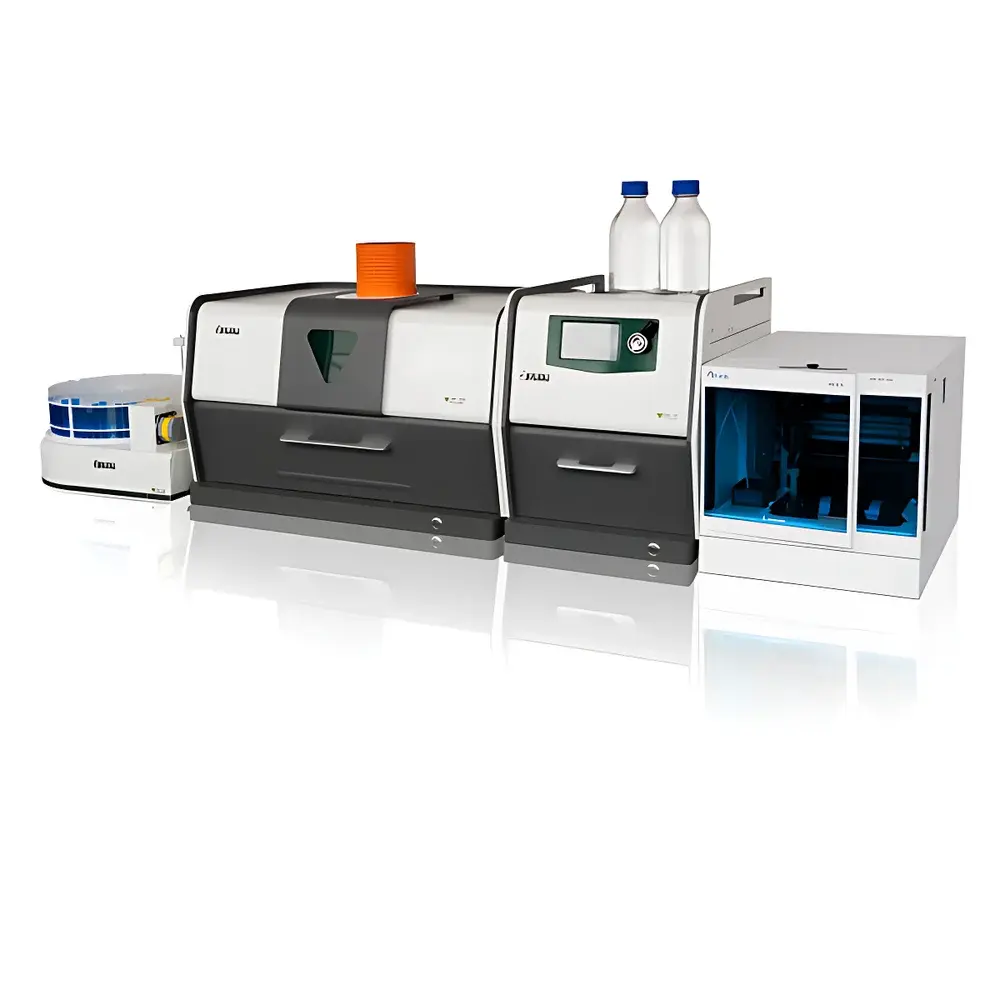
Brookfield BSA-100A Liquid Chromatography–Atomic Fluorescence Spectrometry Hyphenated System
| Brand | Brookfield |
|---|---|
| Origin | Beijing, China |
| Manufacturer Type | Direct Manufacturer |
| Country of Origin | Domestic (China) |
| Model | BSA-100A |
| Pricing | Upon Request |
| Target Analytes | Speciated trace heavy metals — including As(III), As(V), MMA(V), DMA(V), AsB, AsC, p-ASA, Roxarsone |
Overview
The Brookfield BSA-100A Liquid Chromatography–Atomic Fluorescence Spectrometry (LC-AFS) Hyphenated System is an integrated analytical platform engineered for elemental speciation analysis of trace heavy metals in environmental, food, clinical, and regulatory testing laboratories. It combines high-resolution liquid chromatography (LC) with hydride generation atomic fluorescence spectrometry (HG-AFS) to deliver selective, sensitive, and reproducible identification and quantification of metalloids and metals in their biologically and toxicologically relevant chemical forms. Unlike total-element analysis, which masks critical differences in bioavailability, metabolism, and toxicity, the BSA-100A enables unambiguous separation of species—such as inorganic arsenic (AsIII/AsV) from organic arsenobetaine (AsB)—prior to atomization and fluorescence detection. The system operates on the principle of post-column hydride/cold vapor generation: after LC elution, species-specific reagents (e.g., NaBH4/HCl for As/Se/Sb or SnCl2/HCl for Hg) convert target analytes into volatile hydrides or cold vapors, which are swept into a quartz cell and excited by a high-intensity hollow cathode lamp. The resulting atomic fluorescence signal is measured at element-specific wavelengths with sub-picogram detection limits.
Key Features
- Modular hyphenated architecture: Fully synchronized LC (isocratic or gradient-capable pump, 6-port switching valve, thermostatted column compartment) interfaced with BA-2000 dual-channel AFS detector via PTFE reaction coil and gas–liquid separator
- Species-selective hydride generation: Optimized for As, Se, Sb, Bi, Te, Pb and cold vapor generation for Hg, ensuring minimal inter-species conversion during online derivatization
- Dual-channel simultaneous detection: Enables real-time co-quantification of two elements (e.g., As and Se) or internal standard correction (e.g., AsV + Ge internal standard)
- Robust flow control: Precision syringe pumps and pressure-regulated nebulization ensure stable retention time (<±0.3% RSD) and peak area reproducibility (<1.5% RSD, n=10)
- Chemical-resistant fluid path: All wetted components constructed from PEEK, FEP, and quartz to prevent adsorption or catalytic degradation of labile species (e.g., MeHg, SeCys)
- Compliance-ready hardware: Integrated event logging, user-access-level permissions, and audit trail capability aligned with GLP/GMP and FDA 21 CFR Part 11 requirements
Sample Compatibility & Compliance
The BSA-100A accepts aqueous extracts from solid and liquid matrices—including soil leachates, rice flour digests, seafood homogenates, urine, serum, and plant tissues—following standardized extraction protocols (e.g., EPA Method 1632 for methylmercury, ISO 17294-2 for arsenic speciation). Sample introduction is compatible with common LC columns: anion-exchange (Hamilton PRP-X100), cation-exchange (Dionex IonPac CS5A), and reversed-phase (C18 with ion-pairing reagents). The system meets performance criteria defined in ASTM D6722 (speciated mercury in water), EN 16802 (arsenic species in food), and Chinese National Standard GB 5009.11-2023 (arsenic speciation in foods). All calibration standards are traceable to NIST SRM 3102a (inorganic As), NIST SRM 2670a (urine for Hg speciation), and IRMM-804 (certified Se species reference material).
Software & Data Management
Control and data acquisition are managed via Brookfield SpeciSoft™ v3.2, a validated Windows-based application compliant with 21 CFR Part 11 Annex 11 requirements. The software provides method editor for gradient programming, peak integration using second-derivative baseline correction, species identification via retention time matching against certified reference standards, and linear/non-linear calibration curve fitting (1/x weighted least squares). Raw data files (.bsa) are stored with embedded metadata (operator ID, instrument state, column lot, reagent batch), and all changes to processing parameters are recorded in an immutable audit trail. Export options include CSV, PDF analytical reports, and LIMS-compatible XML formats for laboratory information management system integration.
Applications
- Food safety monitoring: Quantification of toxic inorganic arsenic in rice, infant formula, and seaweed; differentiation of Roxarsone residues from natural AsB in poultry feed
- Environmental compliance: Speciation of antimony in landfill leachate per EU Water Framework Directive; methylmercury bioaccumulation assessment in fish tissue
- Clinical toxicology: Urinary As speciation for occupational exposure screening; blood Hg speciation in dental amalgam studies
- Pharmaceutical quality control: Selenium species profiling in dietary supplements containing SeMet or SeCys
- Regulatory research: Development and validation of speciation methods for inclusion in pharmacopoeial monographs (USP , EP 2.4.20)
- Academic research: Mechanistic studies on As methylation pathways in human hepatocytes; Se redox speciation in plant uptake experiments
FAQ
What sample preparation methods are recommended prior to LC-AFS analysis?
Solid samples require enzymatic or mild acid extraction (e.g., 0.1 M HNO3 at 60°C for 30 min), followed by centrifugation, filtration (0.22 µm nylon), and pH adjustment to match mobile phase conditions. Extraction efficiency must be verified using species-specific spike recovery (target: 85–115%).
Can the BSA-100A quantify thiol-bound metal species such as As(GS)3 or Hg-Cysteine complexes?
Yes—when coupled with a thiol-compatible column (e.g., ZORBAX SB-C8 with 10 mM 2-mercaptoethanol in mobile phase) and stabilized post-column reduction, the system detects and quantifies low-molecular-weight As/Se/Hg thiol adducts with demonstrated linearity down to 0.05 ng/mL.
Is method validation support available for regulatory submissions?
Brookfield provides full ICH Q2(R2)-aligned validation packages—including specificity, linearity (r² ≥ 0.999), LOD/LOQ (based on 3σ/10σ of blank), precision (intra-day/inter-day RSD ≤ 3.5%), and accuracy (spike recovery 92–108%)—alongside IQ/OQ/PQ documentation templates.
Related Products



