
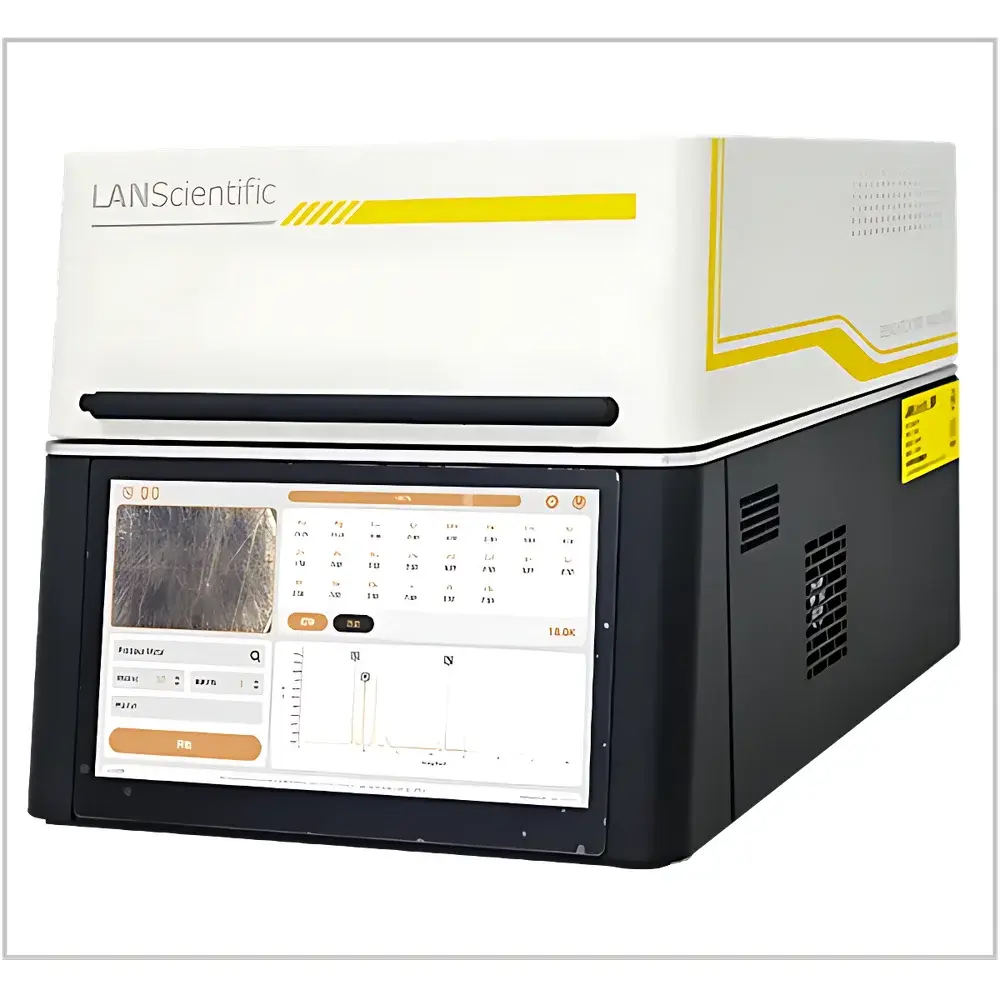
LANScientific ScopeX PG6 Desktop Energy Dispersive X-Ray Fluorescence Spectrometer
| Brand | LANScientific |
|---|---|
| Origin | Jiangsu, China |
| Manufacturer Type | Manufacturer |
| Regional Classification | Domestic |
| Model | ScopeX PG6 |
| Form Factor | Benchtop/Floor-Standing |
| Instrument Type | Conventional ED-XRF |
| Industry-Specific Application | Non-Ferrous Metals |
| Elemental Range | Al (13) to U (92) |
| Detection Limit | ppm-level |
Overview
The LANScientific ScopeX PG6 is a benchtop energy dispersive X-ray fluorescence (ED-XRF) spectrometer engineered for high-precision, non-destructive elemental analysis of precious and non-ferrous metals. Operating on the fundamental principle of X-ray fluorescence—where primary X-rays excite atoms in a sample, inducing emission of characteristic secondary X-rays—the ScopeX PG6 delivers quantitative and qualitative compositional data across 70+ elements (Al to U) without chemical digestion, grinding, or coating. Its integrated architecture eliminates external PC dependencies, embedding a quad-core industrial control computer and an 11.6-inch capacitive touchscreen directly into the instrument housing. Designed specifically for high-throughput environments such as jewelry manufacturing facilities, bullion refineries, assay offices, and regulatory testing laboratories, the ScopeX PG6 meets the operational demands of GLP-compliant quality control workflows while maintaining full compliance with IEC 61000-6-3 (EMC), IEC 61000-6-4 (emissions), and radiation safety standards per GBZ 188-2014 and IEC 62495.
Key Features
- Integrated hardware platform: Built-in quad-core industrial PC and 11.6″ HD capacitive touchscreen enable standalone operation—no external peripherals required.
- Large-sample chamber: Accommodates irregularly shaped items up to Ø150 mm × H100 mm, supporting coins, bars, rings, ingots, plated components, and scrap fragments.
- Non-destructive analysis: Zero sample preparation; no acid dissolution, pressing, or vacuum requirements—preserves sample integrity and enables repeat measurement.
- Radiation safety system: Dual-interlocked high-voltage cutoff, software-enforced lid interlock, leakage-proof metal enclosure, and real-time beam shutter control ensure full compliance with occupational radiation exposure limits (≤1 µSv/h at 5 cm).
- One-touch automated workflow: Predefined methods for Au, Ag, Pt, Pd, Rh, Cu, Ni, Zn, and alloy matrices initiate acquisition, peak deconvolution, matrix correction, and reporting with a single tap.
- Wireless reporting: Integrated Bluetooth 5.0 module supports direct pairing with certified thermal printers for immediate hardcopy generation of ISO/IEC 17025–aligned reports.
Sample Compatibility & Compliance
The ScopeX PG6 accepts solid metallic samples in native form—including castings, stamped pieces, electroplated substrates, solder joints, and recycled scrap—without size limitation beyond chamber geometry. It is validated for use with karat gold (9K–24K), sterling silver (925), platinum group alloys (Pt–Ir, Pt–Ru), and base-metal matrices (Cu–Zn, Cu–Sn, Ni–Cr). Method development adheres to ASTM E1621 (Standard Guide for XRF Analysis of Metals), ISO 22036 (Soil and Waste – XRF Analysis), and USP (Elemental Impurities – Procedures). All calibration standards are traceable to NIST SRM 1250 (Multi-Element Alloy) and CRM-certified reference materials from BAM (Germany) and IRMM (Belgium). Audit-ready data files include full spectral metadata (tube voltage/current, live time, detector temperature, pulse processing parameters) to support FDA 21 CFR Part 11 compliance when deployed in regulated GMP environments.
Software & Data Management
The proprietary ScopeX OS v4.2 provides role-based access control (administrator, operator, reviewer), electronic signature capability, and immutable audit trails for all method changes, calibration events, and report exports. Quantitative analysis employs fundamental parameter (FP) algorithms with empirical matrix corrections for inter-element absorption/enhancement effects. Spectral deconvolution utilizes peak fitting with Gaussian–Lorentzian hybrid functions and background modeling via iterative SNIP algorithm. Data export formats include CSV (for LIMS integration), PDF/A-1b (archival reports), and .spc (binary spectrum files compatible with third-party chemometric tools). Local storage retains ≥10,000 test records with timestamped operator ID, GPS-tagged location (optional), and full spectral snapshots—enabling retrospective reprocessing and trend analysis.
Applications
- Gold refining & assaying: Rapid verification of doré bar composition prior to electrolytic refining; real-time monitoring of slag and anode slimes.
- Jewelry manufacturing QC: Incoming raw material screening (e.g., 18K gold wire), in-process plating thickness validation (Au/Ni/Cu multilayers), and final product certification against ISO 9202 (Jewellery – Marking of precious metals).
- Recycling & valuation: On-the-spot purity assessment of second-hand gold items for pricing transparency; detection of surface enrichment masking low-purity cores.
- Regulatory testing labs: High-volume screening for restricted elements (Pb, Cd, Hg, As) per EU RoHS Directive Annex II and CPSC 16 CFR Part 1303.
- Central bank vaults & minting facilities: Authentication of coinage alloys and counterfeit detection via minor/trace element fingerprinting.
FAQ
Does the ScopeX PG6 require annual recalibration by a certified technician?
No—field recalibration is performed internally using built-in reference sources and certified check standards; only biannual verification by an accredited metrology lab is recommended for ISO/IEC 17025 accreditation.
Can it quantify gold plating thickness on brass substrates?
Yes—using FP-based thin-film mode with dual-layer modeling (Au layer + Cu/Zn substrate); typical precision: ±0.05 µm for layers >0.1 µm.
Is spectral data export compatible with LabWare LIMS?
Yes—CSV output includes all required fields (sample ID, element, concentration, uncertainty, method ID, timestamp) and maps directly to LabWare’s ELN import schema.
What is the minimum detectable mass for trace arsenic in 24K gold?
At 100 s live time, LOD is 12 ppm (k = 3, 99.7% confidence) under He purge atmosphere.
How does the instrument handle heterogeneous samples like soldered e-waste fragments?
Automated multi-point mapping (up to 9 locations per sample) with statistical aggregation ensures representative bulk composition reporting, minimizing particle-size bias.






