
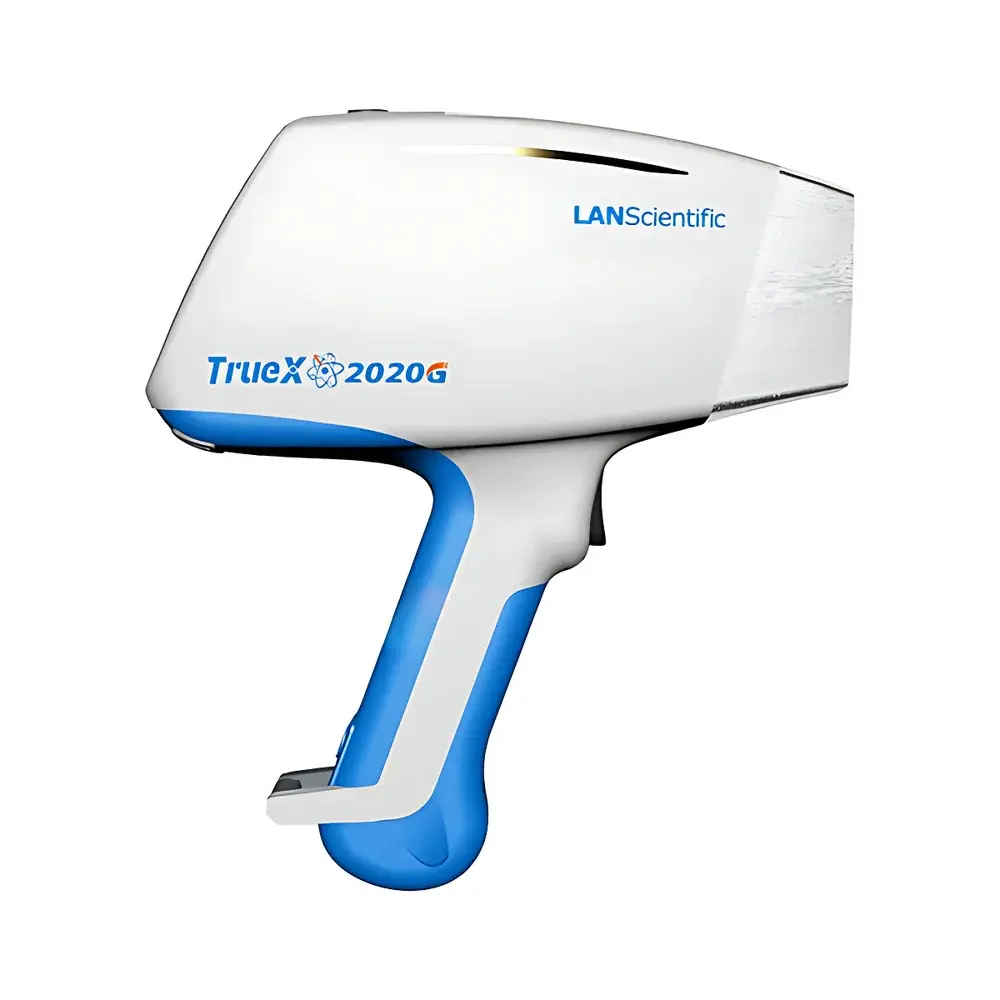
TrueX 2020G Portable Energy Dispersive X-Ray Fluorescence (EDXRF) Spectrometer by LANScientific
| Brand | LANScientific |
|---|---|
| Origin | Jiangsu, China |
| Manufacturer Type | Original Equipment Manufacturer (OEM) |
| Regional Classification | Domestic (China) |
| Model | TrueX 2020G |
| Form Factor | Handheld / Portable |
| Instrument Type | Conventional EDXRF Spectrometer |
| Application Scope | General-Purpose Elemental Analysis |
| Elemental Range | Al (13) to U (92) |
| Quantitative Detection Range | 1 ppm – 99.99 wt% |
| Energy Resolution | < 140 eV at Mn Kα |
| Repeatability (RSD) | ≤ 0.1% for major elements under standardized conditions |
Overview
The TrueX 2020G is a handheld energy dispersive X-ray fluorescence (EDXRF) spectrometer engineered for rapid, non-destructive elemental analysis in precious metal recycling and secondary metallurgy environments. Based on fundamental XRF physics—where primary X-rays excite inner-shell electrons in sample atoms, resulting in characteristic secondary (fluorescent) X-ray emission—the instrument quantifies elemental composition by measuring the energy and intensity of emitted photons. Its optimized X-ray tube (Ag anode), high-resolution silicon drift detector (SDD), and real-time spectrum deconvolution algorithms enable reliable detection of light elements (Al–S) through heavy metals (Pb–U), including Au, Ag, Pt, Pd, Rh, Ru, Ir, Cu, Ni, Zn, Sn, and Pb in complex alloy matrices. Designed for field-deployable operation, the TrueX 2020G eliminates the need for sample dissolution, acid digestion, or vacuum/purge gas—making it compliant with ISO 17025-aligned workflows where minimal sample handling supports traceability and audit readiness.
Key Features
- Lightweight ergonomic design (≤ 1.5 kg) with integrated rechargeable Li-ion battery supporting > 8 hours continuous operation
- Optimized excitation geometry delivering stable count rates and low background noise for enhanced signal-to-noise ratio
- Real-time spectral processing using embedded firmware with peak deconvolution, matrix correction (Fundamental Parameters algorithm), and inter-element interference compensation
- Pre-calibrated factory methods for common precious metal alloys (e.g., Au-Cu-Ag, Pt-Ir, Pd-Ni), with user-creatable custom calibrations via PC-based configuration software
- IP54-rated housing with reinforced magnesium alloy casing, drop-tested to 1 m onto concrete per MIL-STD-810G
- Integrated Bluetooth 5.0 module enabling wireless pairing with certified thermal printers and mobile data loggers without driver installation
Sample Compatibility & Compliance
The TrueX 2020G accommodates heterogeneous solid samples including scrap jewelry, catalytic converter fragments, electronic waste (PCBs, connectors), dental alloys, refinery anodes, and plated substrates. Surface geometry, grain size, and coating thickness influence measurement precision; therefore, ASTM E1621–22 (Standard Guide for XRF Analysis of Metals) recommends flat, homogeneous areas ≥ 10 mm in diameter and surface roughness < 1 µm Ra for optimal reproducibility. The instrument complies with IEC 61000-6-3 (EMC emissions) and IEC 61000-6-2 (immunity), and meets EU RoHS Directive 2011/65/EU requirements for restricted substances in analytical instrumentation. While not FDA 21 CFR Part 11–certified out-of-the-box, its data export protocol (CSV, PDF, XML) supports integration into validated LIMS environments under GLP/GMP frameworks when paired with documented SOPs and audit trail procedures.
Software & Data Management
Instrument control and reporting are managed via the proprietary TrueX Manager desktop application (Windows 10/11 compatible). It enables method creation, calibration curve validation (linearity R² ≥ 0.9995), limit of detection (LOD) calculation per element, and statistical process control (SPC) charting across batch sequences. All measurements are timestamped, geotagged (via optional external GPS), and stored with operator ID, sample ID, and environmental metadata (temperature, humidity). Export formats include ISO/IEC 17025-compliant PDF reports with digital signature fields, raw spectrum files (.trf), and structured CSV for downstream integration with ERP or CRM systems. Firmware updates are delivered via secure HTTPS portal with version-controlled changelogs and rollback capability.
Applications
- Precious metal scrap sorting and grade verification at buy-back centers and smelter intake bays
- In-process quality assurance during gold electroplating bath monitoring and alloy melt homogeneity checks
- Non-destructive assay of antique coins, bullion bars, and hallmark-verified jewelry prior to refining
- Compliance screening for regulated elements (e.g., Cd, Pb, Hg) in jewelry per EU REACH Annex XVII
- Field-based due diligence for responsible sourcing programs (e.g., RMI, LBMA Responsible Gold Guidance)
- Technical support for pawnbrokers and auction houses requiring rapid valuation of mixed precious metal lots
FAQ
What is the minimum detectable thickness for gold plating analysis?
For Au/Ni/Cu/steel multilayers, detection down to ~0.1 µm Au thickness is achievable under optimized geometry and counting time (≥ 30 s), subject to substrate absorption effects.
Does the instrument require annual recalibration?
No scheduled recalibration is mandated; however, daily verification using certified reference materials (CRMs) such as NIST SRM 5182 (Au-Cu alloy) is recommended per ISO/IEC 17025 Clause 7.7.2.
Can the TrueX 2020G quantify chlorine or sulfur in solder alloys?
Yes—Cl (Z=17) and S (Z=16) are within the Al–U elemental range and detectable at ≥ 100 ppm levels in clean, flat solder surfaces with 60-s acquisition.
Is spectral data export compatible with third-party chemometric software?
Raw spectra are exportable in .trf format; conversion to .csv or .txt is supported via TrueX Manager, enabling import into Unscrambler®, MATLAB®, or Python-based PCA/PLS libraries.
How is measurement uncertainty estimated for gold purity reporting?
Expanded uncertainty (k=2) is calculated per GUM (JCGM 100:2008) using type-A (repeatability) and type-B (calibration CRM uncertainty, detector resolution, tube stability) components—typically ±0.05 wt% for Au in 99.9% pure standards.





