
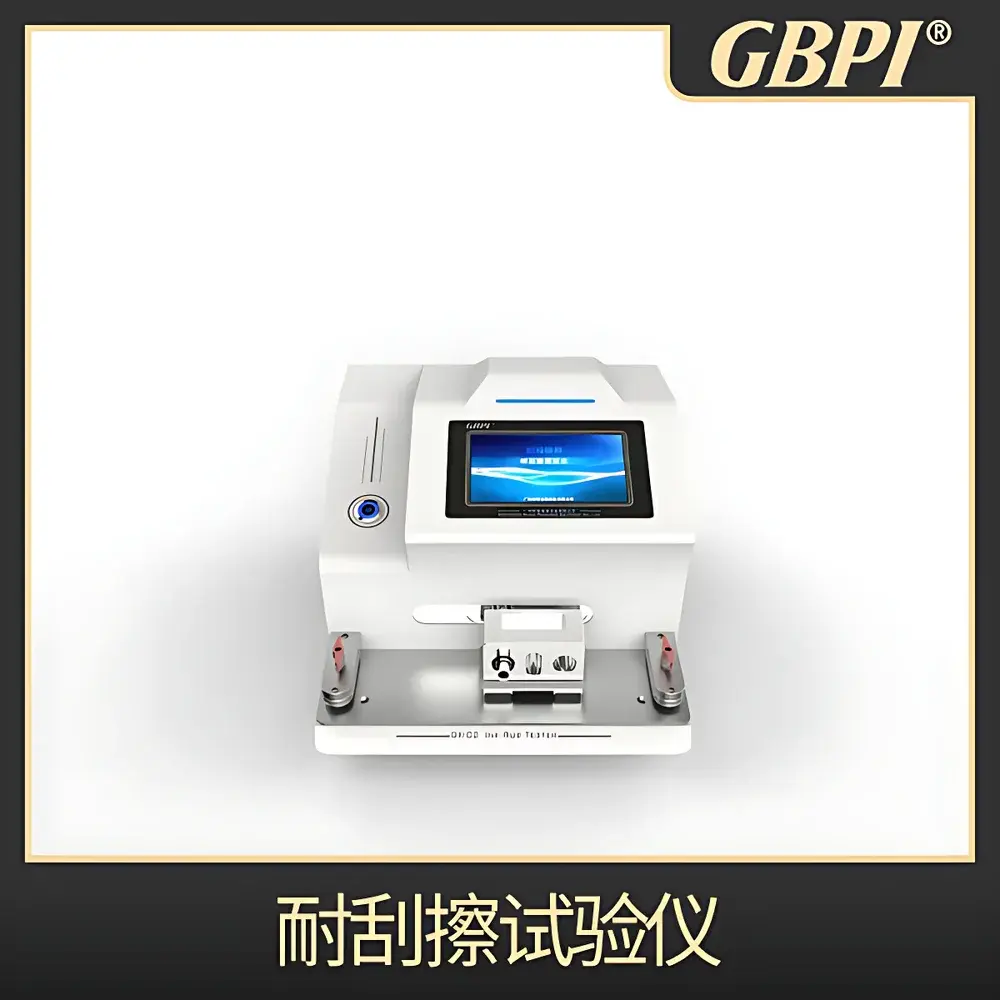
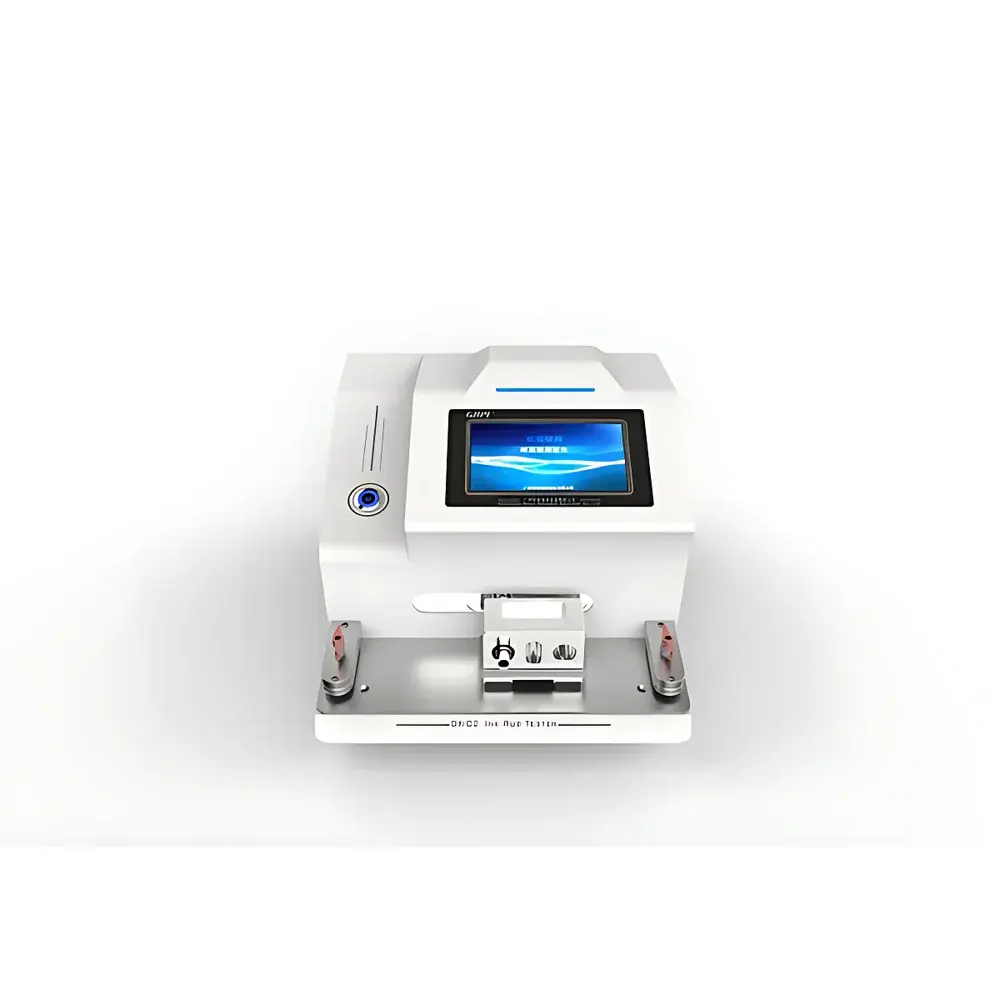
Brookfield GX-C2 Scratch Resistance Tester
| Brand | GBPI |
|---|---|
| Origin | Guangdong, China |
| Manufacturer Type | Direct Manufacturer |
| Region of Origin | Domestic (China) |
| Model | GX-C2 |
| Price Range | USD 7,000 – 14,000 |
| Instrument Category | Coefficient of Friction Tester |
| Maximum Scratching Force | 20 ± 0.2 N |
| Force Resolution | 0.2 N |
| Maximum Operating Temperature | 150 °C |
| Scratching Speed | 0–43 cycles/min |
| Scratching Area | 240 mm (L) × 50 mm (W) |
| Cycle Count Range | 1–999,999 |
| Specimen Dimensions | 320 mm (L) × 50 mm (W) |
| Overall Dimensions | 440 mm × 400 mm × 200 mm |
| Power Consumption | 430 W |
| Input Power | AC 220 V, 50 Hz |
Overview
The GBPI GX-C2 Scratch Resistance Tester is an electromechanically controlled tribological instrument engineered for quantitative evaluation of surface coating integrity under controlled linear abrasive stress. It operates on the principle of standardized reciprocating scratching—applying a defined normal load via a precision-calibrated indenter across a specimen surface at adjustable frequency and cycle count. Designed in strict accordance with GB/T 7707–2008 (equivalent to ISO 1518–1 for gravure ink abrasion resistance), the system delivers repeatable mechanical stress profiles essential for assessing print durability, photopolymer plate longevity, and functional coating robustness in packaging, publishing, and industrial finishing applications. Its thermally stabilized base allows elevated-temperature testing up to 150 °C, enabling accelerated aging studies of temperature-sensitive coatings without compromising force fidelity or positional repeatability.
Key Features
- Integrated 7-inch color touchscreen HMI for intuitive parameter setup, real-time status monitoring, and immediate test initiation—no external PC required.
- Full automation sequence: auto-zeroing, load application, stroke execution, cycle counting, and end-of-test shutdown—all executed with single-button activation.
- High-precision ground ball screw drive mechanism ensures sub-micron positional repeatability and minimal mechanical hysteresis over extended operational lifetimes (>50,000 cycles per maintenance interval).
- Programmable scratching parameters: normal force (20 ± 0.2 N), stroke frequency (0–43 cpm), total cycles (1–999,999), and dwell time—all independently configurable to align with ASTM D5178, ISO 20566, or internal QC protocols.
- Onboard thermal regulation subsystem maintains chamber ambient stability within ±2 °C across the full 25–150 °C operating range, critical for evaluating thermally activated coating failure modes.
- Embedded thermal printer generates traceable, timestamped test reports compliant with GLP documentation requirements—including operator ID, date/time stamp, parameter set, and pass/fail flag based on user-defined visual or instrumental endpoint criteria.
Sample Compatibility & Compliance
The GX-C2 accommodates rigid and semi-rigid planar substrates up to 320 mm × 50 mm, including offset printing plates (PS plates), laminated films, metallized foils, UV-cured varnishes, and solvent-based ink layers. Specimens may be butt-jointed for longitudinal extension where standard width constraints apply. All mechanical components conform to ISO 9001–certified manufacturing processes, and the instrument’s force calibration protocol follows traceable NIST-equivalent reference standards (via GBPI’s in-house metrology lab, accredited to CNAS CL01:2018). Test outputs meet data integrity requirements for regulated environments: audit trails are retained for ≥12 months; parameter changes require dual-operator authentication; raw cycle-count and force-log files are exportable in CSV format for third-party statistical analysis (e.g., Minitab, JMP).
Software & Data Management
While the GX-C2 operates autonomously via embedded firmware, optional USB-host connectivity enables direct data transfer to Windows-based laboratory information management systems (LIMS). Firmware v3.2+ supports FDA 21 CFR Part 11–compliant electronic signatures when paired with validated identity verification modules. All test records include immutable metadata: firmware version, calibration certificate expiry, environmental sensor logs (temperature/humidity), and hardware serial traceability. Exported datasets retain native time-stamped force vs. cycle resolution (100 Hz sampling), permitting post-hoc waveform analysis of delamination onset, friction coefficient drift, or sudden adhesion loss events.
Applications
- Quantitative assessment of gravure and flexographic ink layer adhesion per GB/T 7707–2008 and ASTM D2197.
- Predictive modeling of PS plate service life through controlled abrasion-to-failure cycling under simulated press conditions.
- QC screening of anti-scratch hard coats on optical films, touchscreens, and automotive trim components.
- Comparative evaluation of crosslinked polymer film performance under thermal stress (e.g., PET/ALU laminates at 85 °C).
- Root-cause analysis of coating cohesion failure versus interfacial adhesion loss using synchronized visual inspection windows and force transient analysis.
FAQ
Does the GX-C2 support dynamic load modulation during a test cycle?
No. The GX-C2 applies a constant normal force (20 ± 0.2 N) throughout each test sequence. Variable-load profiling requires the GX-C3 series with servo-controlled actuation.
Is third-party calibration certification included with delivery?
A factory-issued calibration report (traceable to national standards) is supplied. Full ISO/IEC 17025 accreditation by an external body is available as an add-on service.
Can the instrument be integrated into a networked lab environment?
Yes—via optional Ethernet module (GX-C2-NET), supporting Modbus TCP communication for centralized test queue management and remote diagnostics.
What maintenance intervals are recommended for long-term accuracy?
Ball screw lubrication and load cell verification are advised every 6 months or after 25,000 cycles—whichever occurs first. Maintenance logs are auto-recorded in the system audit trail.
Are consumables such as indenters or counterfaces standardized across GBPI models?
Yes. The GX-C2 uses ISO 1518–compliant steel hemispherical indenters (Ø 1.0 mm, Ra ≤ 0.05 µm), fully interchangeable with GX-C1 and GX-C3 platforms.
Related Products



