
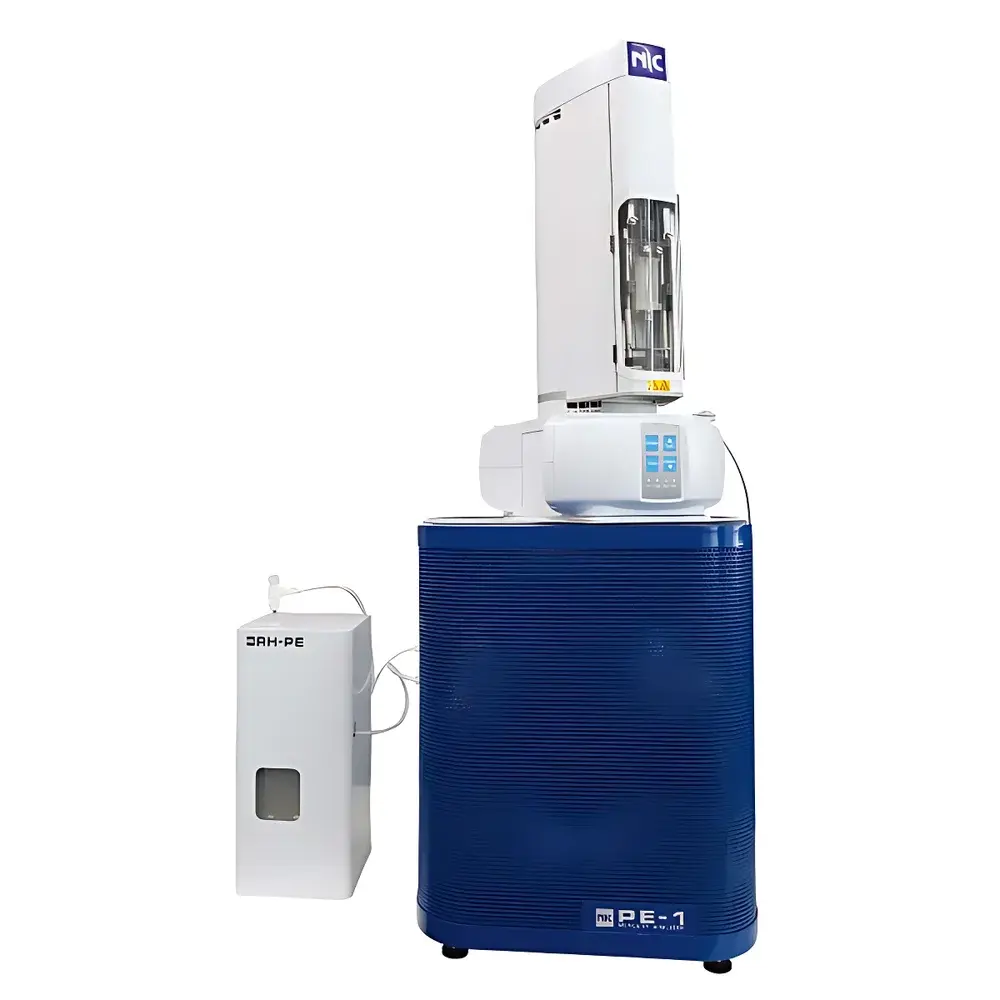
Brookfield PE-1000 Automated Pyrolytic Mercury Analyzer for Petroleum Matrices
| Brand | Brookfield |
|---|---|
| Origin | Beijing, China |
| Manufacturer Type | Direct Manufacturer |
| Origin Category | Domestic (China) |
| Model | PE-1000 |
| Instrument Type | Benchtop Laboratory Analyzer |
| Measurement Principle | Cold Vapor Atomic Fluorescence Spectrometry (CVAFS) |
| Detection Limit | 0.01 ppb |
| Sample Introduction | Automated Liquid Injection with Silanized Needle |
| Pyrolysis Temperature | >800 °C |
| Compliance Standards | ASTM D6350-14, ISO 6879-2, JLPGA-S-07 |
Overview
The Brookfield PE-1000 is a benchtop, fully automated pyrolytic mercury analyzer engineered for ultra-trace quantification of total mercury in liquid petroleum matrices—including crude oil, condensates, naphthas, and refined hydrocarbon fractions. It employs a validated, two-stage analytical workflow: high-temperature catalytic pyrolysis followed by gold amalgamation and cold vapor atomic fluorescence spectrometry (CVAFS). This integrated approach eliminates matrix-induced interferences common in complex hydrocarbon samples, delivering reliable ppt-level (parts-per-quadrillion) detection sensitivity and measurement reproducibility required for regulatory compliance and process control in upstream, midstream, and refinery laboratories.
Key Features
- Patented NIC pyrolysis furnace with real-time temperature regulation (>800 °C), ensuring complete thermal decomposition of all organic mercury species and preventing carbon black formation—critical for long-term system integrity and data stability.
- Automated liquid injection via precision syringe with silanized needle surface, minimizing mercury adsorption on metallic surfaces and eliminating operator-dependent variability in sample introduction.
- Gold amalgamation trap for selective pre-concentration and purification of elemental mercury vapor; enables effective removal of halogenated and sulfur-containing interferents prior to CVAFS detection.
- CVAFS optical detection module with sub-ppb limit of detection (0.01 ppb) and linear dynamic range spanning three orders of magnitude (0.01–100 ppb), calibrated per NIST-traceable standards.
- Sealed 2-mL crimp-top vial sampling system with integrated vortex mixing, preserving sample integrity by preventing volatile mercury loss and ensuring homogeneous subsampling.
Sample Compatibility & Compliance
The PE-1000 is optimized for direct analysis of undiluted, non-aqueous liquid hydrocarbons without derivatization or chemical digestion. Its robust thermal oxidation architecture accommodates high-boiling, viscous, and sulfur-rich feedstocks typical of heavy crudes and residua. When paired with the optional RH-PE gas-phase interface module, the system extends its scope to gaseous matrices—including natural gas, sour gas streams, and liquefied petroleum gas (LPG)—enabling trace mercury monitoring at pipeline custody transfer points and amine unit inlets. Method validation aligns with ASTM D6350-14 (Standard Test Method for Determination of Mercury in Crude Oil and Liquid Petroleum Products), ISO 6879-2 (Petroleum products — Determination of mercury — Part 2: Cold vapor atomic fluorescence spectrometry after pyrolysis), and JLPGA-S-07 (Japan Liquefied Petroleum Gas Association specification for mercury in LPG).
Software & Data Management
PE1000Win software provides a validated, audit-ready environment compliant with GLP and GMP requirements. The GUI features animated system status visualization, real-time temperature/pressure monitoring, and sequence-based batch processing. Pre-configured heating protocols are available for specific sample classes (e.g., light distillates vs. vacuum residues), reducing method development time. All analytical events—including injection timing, pyrolysis ramp profiles, amalgam trap desorption cycles, and fluorescence intensity integration—are timestamped and logged with full electronic signature support. Data export conforms to ASTM E1482 and supports 21 CFR Part 11-compliant user access controls, audit trails, and secure archiving.
Applications
- Upstream: Mercury screening of crude oil prior to transportation to prevent catalyst poisoning in refining units.
- Midstream: Monitoring mercury content in natural gas and LPG at custody transfer stations per API RP 1172 and ISO 14687.
- Refinery QC/QA: Verification of mercury removal efficiency in amine treaters, molecular sieve beds, and activated carbon guard beds.
- Environmental Compliance: Supporting reporting under EPA Method 7473 (for solid matrices when adapted) and EU Directive 2013/39/EU for hydrocarbon-associated mercury emissions.
- R&D: Kinetic studies of mercury speciation during thermal cracking and hydrotreating processes.
FAQ
What sample volume is required for analysis?
Typical injection volume ranges from 10–100 µL, depending on expected mercury concentration and desired detection sensitivity.
Can the PE-1000 analyze solid or slurry samples?
No—the instrument is designed exclusively for liquid petroleum matrices; solids require prior solvent extraction or acid digestion using external preparation methods.
Is calibration traceable to NIST standards?
Yes—calibration solutions are prepared from NIST SRM 3133 (Mercury in Aqueous Solution) and verified through multi-point linearity assessment per ISO/IEC 17025 requirements.
How often does the gold amalgamation trap require replacement?
Under routine operation (≤100 injections/week), the trap maintains performance for ≥1,000 analyses; lifetime is monitored via system diagnostics and breakthrough testing.
Does the system support remote diagnostics and firmware updates?
Yes—PE1000Win includes secure remote access capability via encrypted TLS connection, enabling proactive technical support and version-controlled firmware deployment.







