
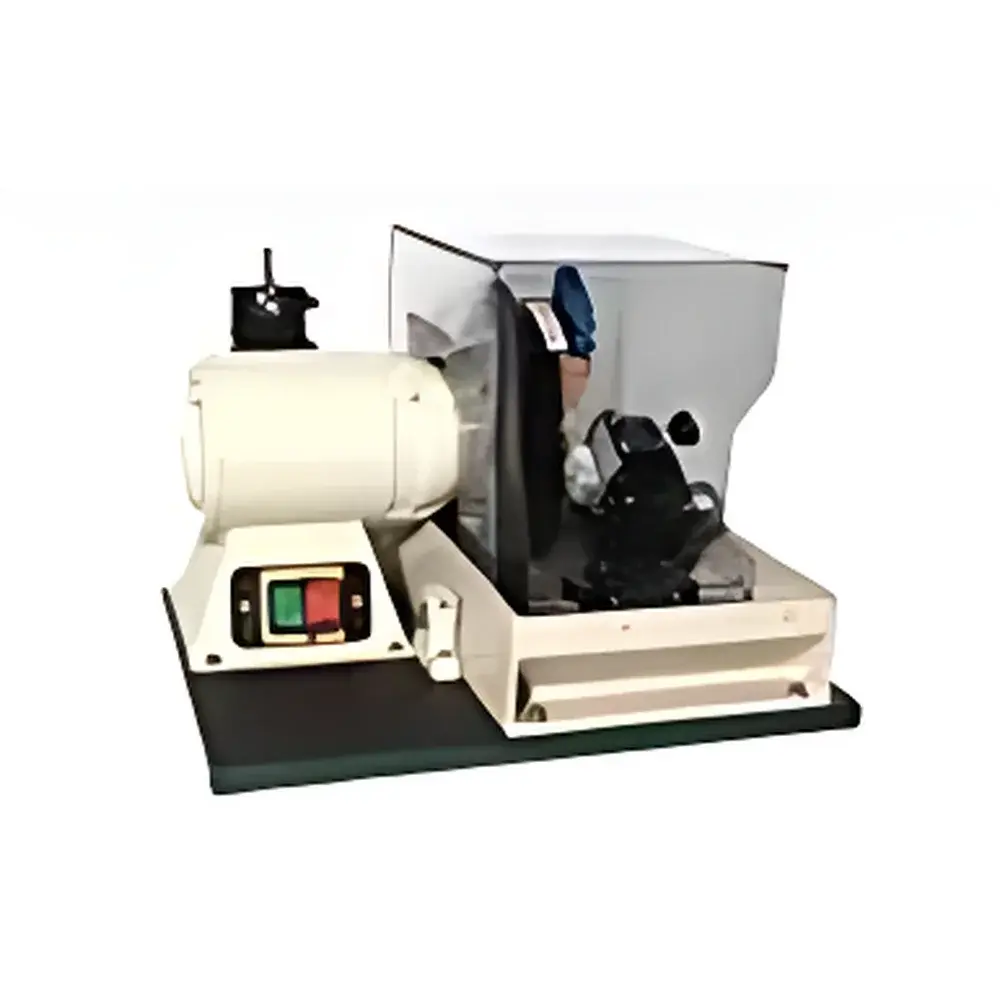
BROT J0223 Vertical Geological Microtome
| Brand | BROT |
|---|---|
| Origin | France |
| Model | J0223 |
| Blade Diameter | 175 mm |
| Motor | 3-phase, 1 kW |
| Cooling Capacity | 30 L circulating system |
| Thickness Adjustment Range | 0–30 mm |
| Thickness Resolution | 0.01 mm |
| Sample Holder | Vacuum chuck |
| Vacuum System | Integrated, solvent-resistant electric vacuum pump |
| Collection Tray | Polypropylene waste and dust reservoir |
| Compliance | Designed for ISO/IEC 17025-compliant sample prep environments |
Overview
The BROT J0223 Vertical Geological Microtome is a precision-engineered instrument designed for the controlled sectioning of hard, brittle geological specimens—including igneous, metamorphic, and sedimentary rocks—into thin, planar slices suitable for petrographic analysis, thin-section preparation, and subsequent grinding/polishing workflows. Unlike conventional rotary or sliding microtomes optimized for soft biological tissues, the J0223 employs a vertically oriented, gravity-assisted cutting architecture combined with a high-stiffness steel frame and pneumatically damped piston descent to ensure mechanical stability during high-force rock sectioning. The system operates on the principle of controlled linear displacement: the specimen, rigidly secured via vacuum adhesion to a reusable holder, is advanced incrementally toward a stationary 175 mm diameter diamond-impregnated or tungsten-carbide blade. This configuration minimizes lateral shear stress and preserves structural integrity in heterogeneous, mineralogically anisotropic samples. Its primary functional objective is reproducible production of slices within the 100–350 µm thickness range—targeting the optimal starting thickness for standard optical petrography thin sections (typically reduced to 30 µm post-grinding).
Key Features
- Vertical cutting geometry with manually actuated, buffer-damped piston descent—enabling precise operator control over feed rate and minimizing vibration-induced microfracturing.
- Vacuum-based specimen immobilization using a corrosion-resistant stainless-steel chuck; compatible with both permanent and temporary mounting media (e.g., epoxy, cyanoacrylate, low-melting-point wax).
- High-torque 3-phase 1 kW motor driving a 175 mm diameter blade spindle, engineered for sustained operation under abrasive load conditions typical of silicate-rich matrices.
- Integrated 30 L closed-loop coolant circulation system with adjustable spray nozzles directing water directly onto the blade cutting edge—reducing thermal degradation and extending blade life.
- Micrometer-adjustable thickness setting with 0.01 mm resolution and ±0.01 mm repeatability across full 30 mm stroke range; calibrated against traceable NIST-traceable reference standards.
- Polypropylene waste collection tray positioned beneath the cutting zone to capture slurry, fines, and coolant—facilitating safe disposal and preventing cross-contamination between samples.
- Full vacuum subsystem including solvent-resistant electric vacuum pump, pressure regulator, and leak-tested manifold—designed for long-term reliability in wet lab environments.
Sample Compatibility & Compliance
The J0223 accommodates specimens up to Ø100 mm × 30 mm in height, mounted on standard 76 × 52 mm glass or metal holders. It supports a broad spectrum of geological materials: consolidated sandstones, granites, basalts, schists, and even partially altered volcanic tuffs. Specimen preparation protocols align with ASTM D3403 (Standard Practice for Petrographic Examination of Aggregates), ISO 14688-1 (Geotechnical investigation and testing — Identification and classification of soil), and USP (Microscopic Identification of Particulate Matter) where applicable. The instrument’s construction—stainless steel fasteners, powder-coated carbon steel frame, and non-corrosive fluid pathways—ensures compliance with GLP laboratory infrastructure requirements. All vacuum and coolant interfaces are rated for continuous use with deionized water and mild aqueous cleaning agents, supporting routine maintenance per ISO/IEC 17025 clause 6.4.
Software & Data Management
The J0223 is a fully manual, hardware-centric system with no embedded digital controller or software interface. Thickness settings, vacuum pressure, and coolant flow are adjusted via calibrated mechanical dials and analog gauges—eliminating firmware dependencies and ensuring deterministic operation under electromagnetic interference-prone environments (e.g., near XRF or SEM suites). For laboratories requiring auditability, thickness parameters and operational logs (e.g., blade usage hours, coolant change dates) are recorded manually in bound lab notebooks or integrated into LIMS platforms via standardized SOP templates. The design inherently satisfies FDA 21 CFR Part 11 principles for manual instruments: all critical adjustments are physically locked after calibration, and procedural consistency is enforced through documented training and periodic performance verification per internal QA protocols.
Applications
- Preparation of rock slabs for transmitted light microscopy and cathodoluminescence imaging.
- Sectioning of drill core segments for stratigraphic correlation and diagenetic feature mapping.
- Production of polished thin sections for electron microprobe (EPMA) and scanning electron microscopy (SEM-EDS) analysis.
- Controlled slicing of cemented sediments and concrete aggregates prior to porosity/permeability testing.
- Standardized specimen reduction in geochemical reference material certification workflows (e.g., RM-8010, BHVO-2).
FAQ
What types of rock specimens are compatible with the J0223?
The system is validated for consolidated lithologies with unconfined compressive strength up to 250 MPa, including granitoids, quartzites, and basaltic flows. Highly fractured or clay-rich shales require pre-impregnation with low-viscosity epoxy prior to mounting.
Is blade replacement performed in situ?
Yes—the 175 mm blade carrier is tool-free and features positive-lock clamping; blade alignment is verified using the included optical centering gauge before each installation.
Can the vacuum chuck accommodate irregularly shaped samples?
Only when stabilized within custom-machined aluminum jigs or cast in cylindrical epoxy mounts; flat-bottomed contact surface is mandatory for uniform vacuum seal integrity.
What maintenance intervals are recommended for the coolant system?
Coolant solution must be replaced every 90 operating hours or quarterly—whichever occurs first—to prevent bacterial growth and nozzle clogging; filtration cartridges are inspected biweekly.
Does the J0223 meet CE or UL safety certification?
The unit complies with IEC 61000-6-2 (EMC immunity) and IEC 61000-6-4 (EMC emissions); full CE marking applies to the French-assembled configuration supplied with EU-spec power input and emergency stop circuitry.



