
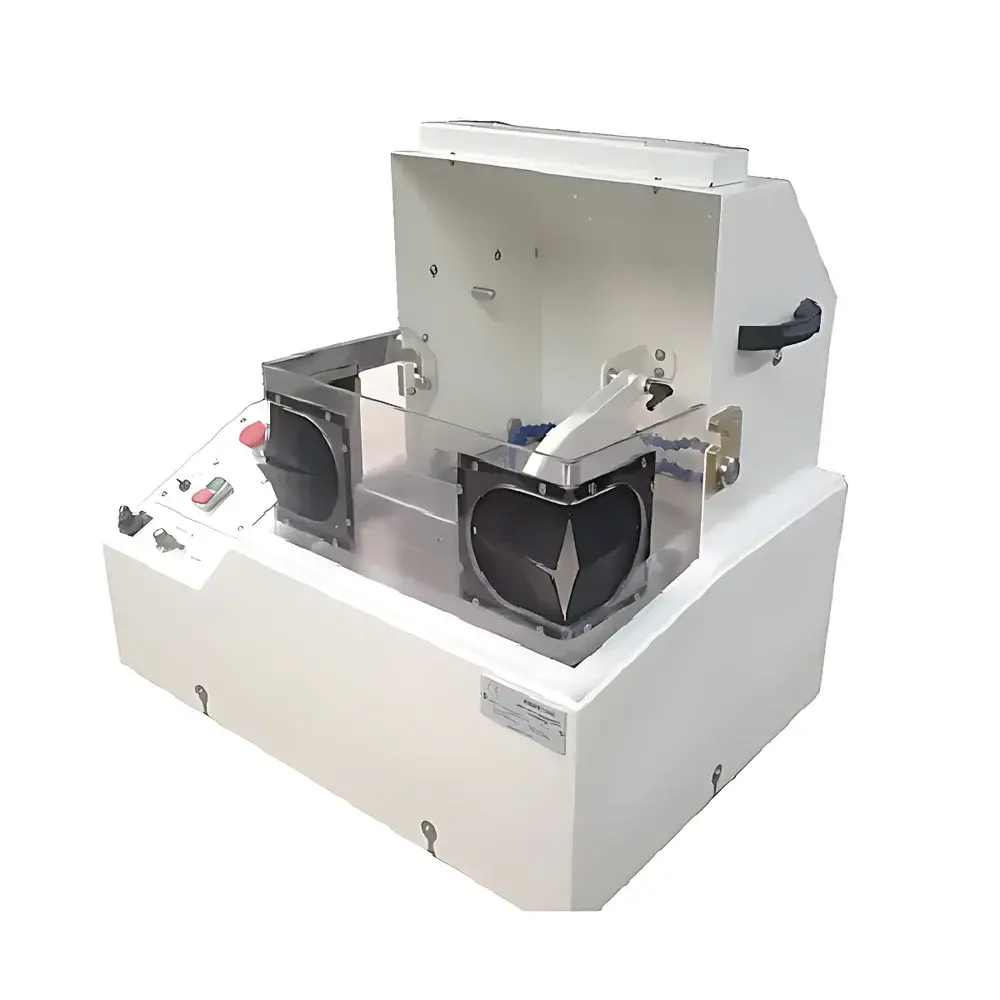
BROT-LAB Model 1.02.05 Benchtop Precision Rock Cutting System
| Brand | BROT-LAB |
|---|---|
| Origin | France |
| Manufacturer Type | Authorized Distributor |
| Country of Origin | Imported |
| Model | 1.02.05 |
| Instrument Type | Precision Cutting Machine |
| Motor | IP55, 550 W, 230 V AC, Single-Phase |
| Rotational Speed | 3000 rpm |
| Spindle Shaft Diameter | Ø20 mm (h6 tolerance) |
| Effective Working Area | 385 mm × 350 mm |
| Diamond Blade Diameter | Ø200 mm |
| Overall Dimensions (W×D×H) | 850 mm × 600 mm × 740 mm |
| Net Weight | 80 kg |
| Cooling | External Water Supply (Inlet Ø12 mm, Outlet Ø32 mm) or Optional Internal Recirculating Pump System with Sediment Recovery |
| Safety | Emergency Stop Button, Splash Guard, Adjustable Rear Shield, Front Spray Arm with Channel, Vibration-Damped Frame with Stainless Steel Tray, LED Illuminated Cutting Zone |
| Compliance | CE-marked, Designed per EN 60204-1 (Electrical Safety), EN ISO 12100 (Risk Assessment), and EN 62061 (Functional Safety for Machinery) |
Overview
The BROT-LAB Model 1.02.05 is a CE-compliant, benchtop precision rock cutting system engineered for reproducible sample preparation in geotechnical laboratories, petrographic research facilities, and materials testing centers. It employs high-torque, brushless motor-driven diamond blade cutting under controlled rotational dynamics (3000 rpm) to produce standardized cylindrical cores, prismatic specimens, and planar sections from heterogeneous geological samples—including igneous, metamorphic, and sedimentary rocks—without inducing thermal cracking or microstructural distortion. Its modular architecture separates the control panel from the wet cutting zone, enabling unobstructed visual monitoring while maintaining operator safety and compliance with ISO/IEC 17025 pre-analytical requirements. The machine is not intended for metal or polymer machining; its mechanical and hydraulic design is optimized specifically for abrasive mineral matrices.
Key Features
- IP55-rated 550 W single-phase motor with integrated thermal and overload protection, ensuring stable operation under continuous load cycles typical in core sectioning workflows.
- High-rigidity Ø20 mm h6 spindle assembly with precision-ground bearings, minimizing runout (<0.03 mm TIR) and preserving blade concentricity over extended service life.
- 385 mm × 350 mm effective worktable with vibration-damping isolation mounts and stainless steel corrosion-resistant tray, accommodating irregular rock blocks up to 300 mm in height.
- Dual-mode cooling: configurable external tap-water supply (Ø12 mm inlet / Ø32 mm outlet) or optional recirculating pump system with sediment separation tank—critical for remote lab deployments or water-restricted environments.
- Ergonomic front spray arm with adjustable channel directs coolant precisely at the cut interface, suppressing airborne silica dust and extending diamond blade longevity.
- Integrated LED task lighting with independent dimming control enhances visibility during fine-sectioning operations without UV emission or thermal interference.
- Emergency stop button compliant with EN 60204-1 Category 0, located within immediate reach on both control panel and side housing.
Sample Compatibility & Compliance
The Model 1.02.05 accepts raw rock specimens ranging from unconsolidated sandstone to highly abrasive granites and basalts. Its Ø200 mm diamond blade (supplied standard) features segmented sintered bond geometry optimized for dry-to-wet transition cutting, achieving surface finish Ra ≤ 3.2 µm on quartz-rich samples. The system supports ASTM D4543 (Standard Practice for Preparing Rock Core Specimens for Testing), ISO 14688-1 (Geotechnical Investigation and Testing — Identification and Classification of Soil), and USP (Mechanical Testing of Solid Dosage Forms) when adapted for pharmaceutical excipient tablet sectioning via custom fixturing. All electrical components meet EN 62061 SIL2 functional safety requirements, and mechanical guarding satisfies EN ISO 13857 clearance distances for hands and fingers.
Software & Data Management
This is a manually operated, non-CNC cutting platform with no embedded firmware or digital control interface. All operational parameters—including feed rate, immersion depth, and dwell time—are set mechanically via calibrated micrometer-adjustable specimen holders and manual handwheel positioning. As such, it generates no electronic audit trail; however, its physical repeatability (±0.1 mm positional accuracy across 100+ cuts) enables full traceability when paired with laboratory notebooks compliant with GLP (Good Laboratory Practice) and FDA 21 CFR Part 11–aligned documentation protocols. Optional accessories—including motorized XYZ stage upgrades and digital caliper-integrated clamping fixtures—are available through BROT-LAB’s certified integration partners for semi-automated workflows.
Applications
- Preparation of ASTM D2938-compliant direct tensile test specimens from rock cores.
- Sectioning of drill core samples for thin-section microscopy (petrography) and SEM-EDS analysis.
- Generation of parallel-faced slabs for triaxial compression testing per ISRM suggested methods.
- Cutting of concrete, asphalt, and refractory brick specimens where dimensional fidelity and edge integrity are critical.
- Controlled kerf-width slicing (minimum 0.8 mm) for isotopic sampling in geochemical labs requiring mass-balance preservation.
FAQ
Is the Model 1.02.05 compatible with automated feed systems?
No—it is a manually positioned, operator-controlled system. Automation requires third-party retrofitting via ISO 9409-1-50-4-M6 mounting interfaces.
What diamond blade specifications are recommended for dolomite samples?
A 10–12% diamond concentration, medium-hardness metal bond blade with trapezoidal segment geometry is advised; BROT-LAB supplies OEM-certified replacements (PN: DB-200M-DOL).
Can the internal recirculation option be retrofitted post-purchase?
Yes—the base unit includes pre-threaded ports and structural reinforcement points; field installation requires BROT-LAB Field Service certification.
Does the machine comply with OSHA silica exposure standards?
When used with continuous water suppression and local exhaust ventilation (LEV), it reduces respirable crystalline silica (RCS) emissions below 25 µg/m³ (8-hr TWA), satisfying OSHA 1926.1153 requirements.
What maintenance intervals are specified for the spindle bearing assembly?
Lubrication-free sealed bearings require inspection every 1,200 operating hours; replacement is recommended after 6,000 hours or visible axial play (>0.05 mm).



