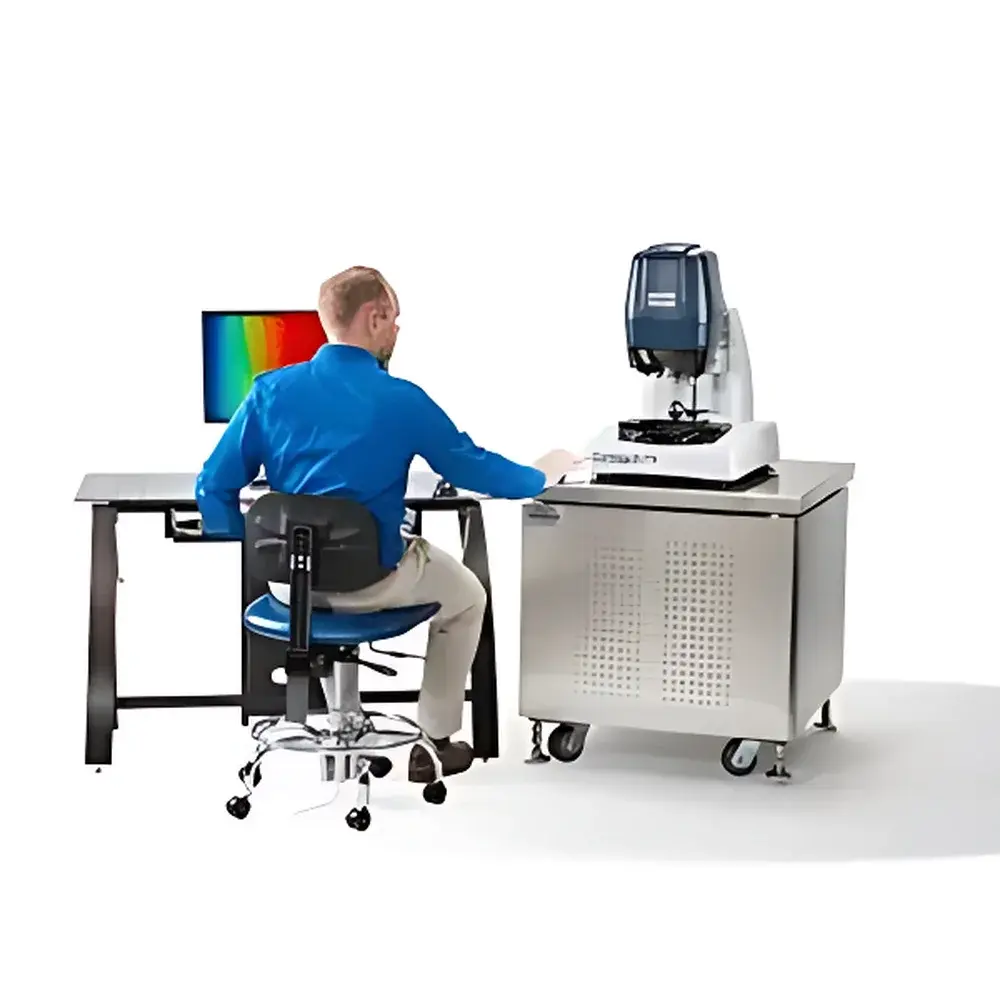
Bruker Contour Elite 3D Optical Microscope
| Brand | Bruker |
|---|---|
| Origin | USA |
| Model | Contour Elite |
| Product Type | Non-contact Profilometer / Surface Roughness Analyzer |
| Measurement Principle | White-light Interferometry (WLI) based on proprietary Wyko® technology |
| Software Platform | Vision64® |
| Configuration Options | Contour Elite K (benchtop, enhanced stability), Contour Elite I (fully automated benchtop with integrated vibration isolation), Contour Elite X (floor-standing configuration with active or passive vibration isolation platform) |
| Compliance | Designed for GLP/GMP environments |
Overview
The Bruker Contour Elite 3D Optical Microscope is a high-precision, non-contact surface metrology system engineered for quantitative topographic characterization of micro- to macro-scale surfaces. Built upon Bruker’s proprietary Wyko® white-light interferometry (WLI) architecture—refined over three decades—the Contour Elite delivers sub-nanometer vertical resolution and nanometer-level repeatability across diverse material classes including metals, semiconductors, ceramics, polymers, and thin-film coatings. Unlike confocal or focus-variation systems, WLI leverages coherence scanning to generate interference fringes at the point of zero optical path difference, enabling absolute height measurement without reliance on intensity-based focusing algorithms. This principle ensures traceable, calibration-backed dimensional accuracy aligned with ISO 25178-2 (areal surface texture) and ISO 4287 (profile-based roughness) standards. The system operates in ambient laboratory conditions without vacuum or conductive coating requirements, making it suitable for both R&D labs and high-throughput QC environments.
Key Features
- Proprietary Wyko® white-light interferometric optics delivering <1 nm vertical resolution and <0.1% linearity error over 10 mm vertical range
- Vision64® software platform with intuitive graphical workflow builder, drag-and-drop analysis templates, and context-aware tooltips for rapid method development
- Three configurable platforms: Contour Elite K (stabilized benchtop), Contour Elite I (fully automated benchtop with integrated passive vibration isolation), and Contour Elite X (floor-mounted system with optional active vibration cancellation)
- Multi-modal imaging capability—including true-color RGB surface rendering, phase contrast enhancement, and defect highlighting—without compromising metrological integrity
- Motorized turret supporting up to six objective lenses (2.5× to 100×), enabling seamless magnification switching and field-of-view optimization from 0.1 mm² to >10 mm²
- Automated stage navigation with programmable multi-site acquisition, stitching of large-area maps (>100 mm × 100 mm), and real-time drift compensation
Sample Compatibility & Compliance
The Contour Elite accommodates samples ranging from 10 mm × 10 mm wafers to 300 mm full-diameter semiconductor substrates, as well as irregularly shaped components up to 200 mm in diameter and 100 mm in height. Its non-contact nature eliminates mechanical loading artifacts, preserving delicate structures such as MEMS cantilevers, photoresist patterns, and bio-coated surfaces. System validation protocols support IQ/OQ/PQ documentation per ASTM E2921 and ISO/IEC 17025 guidelines. When deployed with Vision64® GxP Edition, the instrument meets data integrity requirements for regulated industries: electronic signatures, role-based user permissions, immutable audit trails, and 21 CFR Part 11–compliant electronic records are fully implemented.
Software & Data Management
Vision64® serves as both acquisition engine and analytical hub, integrating surface topography, roughness, step height, curvature, and volumetric wear calculations within a single interface. Batch processing supports standardized reporting (PDF, CSV, XML) with customizable templates compliant with internal SOPs or external regulatory submissions. Raw interferogram data is stored in Bruker’s native .ZFO format—losslessly compressible and compatible with third-party analysis tools via open API. Data export includes full metadata: objective ID, scan parameters, environmental logs (temperature/humidity timestamps), and calibration certificate references. Networked deployment enables centralized license management and remote monitoring through secure HTTPS endpoints.
Applications
The Contour Elite addresses critical measurement needs across multiple sectors: semiconductor process control (CMP uniformity, etch depth, lithography overlay); medical device surface finish verification (stent strut roughness, implant coating adhesion); precision machining QA (tool wear mapping, surface integrity assessment); academic materials science (grain boundary topography, thin-film stress-induced buckling); and additive manufacturing (powder bed fusion surface fidelity, post-processing effectiveness). Its ability to resolve sub-10 nm steps on steep sidewalls (<85° slope) and quantify areal parameters (Sa, Sq, Sdr) per ISO 25178 makes it indispensable for next-generation microfabrication and nanoscale quality assurance.
FAQ
What vertical resolution can the Contour Elite achieve under standard operating conditions?
Vertical resolution is typically ≤0.1 nm RMS when measured on silicon reference standards under controlled lab conditions (22 ± 1°C, <40% RH). Actual performance depends on objective magnification, integration time, and sample reflectivity.
Does the system require periodic recalibration by Bruker service engineers?
While factory calibration remains valid for 12 months, Bruker recommends annual verification using NIST-traceable step-height standards. Vision64® includes built-in calibration validation routines accessible to trained users.
Can the Contour Elite measure transparent or highly reflective surfaces?
Yes—WLI inherently handles transparent layers (e.g., glass-on-silicon) and mirrors via dual-surface fringe detection. Optional polarization filters and anti-reflection lens coatings further enhance signal fidelity on challenging optically dense or specular samples.
Is Vision64® compatible with LIMS or MES integration?
Via RESTful API and OPC UA connectivity, Vision64® supports bidirectional data exchange with laboratory information management systems (LIMS) and manufacturing execution systems (MES), including automated job dispatching and result ingestion.
What training and documentation resources are available post-installation?
Bruker provides on-site installation qualification, operator certification workshops, and access to the Vision64® Knowledge Base—a searchable repository of application notes, video tutorials, and troubleshooting guides updated quarterly.