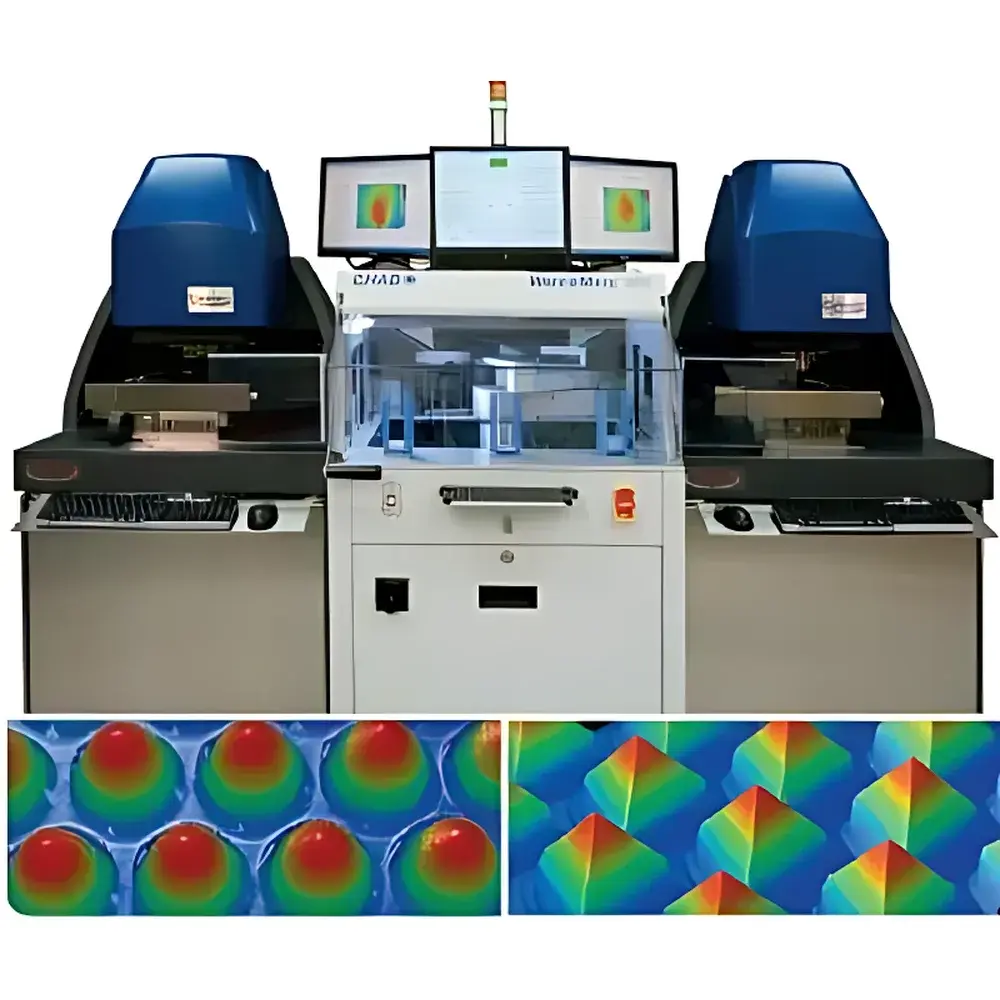
Bruker Contour-GT Series Advanced Non-Contact Optical Profilometer
| Brand | Bruker |
|---|---|
| Origin | USA |
| Model | Contour-GT |
| Measurement Principle | White Light Interferometry (WLI) |
| Application Domain | R&D and Production QC/QA in Semiconductor, LED, Solar, Ophthalmic, and Medical Device Manufacturing |
| Compliance Framework | Supports ISO 25178-2:2012, ISO 4287, ASTM E1316, and GLP/GMP-aligned data integrity workflows |
| Software Platform | Bruker Vision64™ (64-bit, multi-threaded analysis engine) |
| Optical Resolution | Sub-micron lateral resolution |
| Vertical Resolution | <0.1 nm (typical) |
| Scan Range | Up to 10 mm vertical, 100 mm lateral (configurable with motorized stages) |
| Field of View | 0.1–10 mm² (objective-dependent) |
| Data Acquisition Speed | Up to 120 frames/sec (full-field WLI) |
Overview
The Bruker Contour-GT Series represents a benchmark in non-contact 3D surface metrology for precision engineering and advanced materials research. Engineered around patented white light interferometry (WLI), this optical profilometer delivers traceable, high-fidelity topographic characterization without physical contact—eliminating sample damage, probe wear, or stylus-induced artifacts common in contact profilometry. Unlike confocal or focus-variation systems, WLI leverages coherence envelope detection from broadband illumination to resolve surface height with sub-nanometer vertical repeatability and sub-micron lateral definition. The system is purpose-built for demanding environments where quantitative surface texture, step height, roughness (Sa, Sq, Sz), curvature, film thickness (via thin-film interference modeling), and form error must be measured in accordance with ISO 25178-2:2012 (areal surface texture), ISO 4287 (profile-based parameters), and ASTM E1316 (non-destructive evaluation standards). Its architecture integrates a thermally stable granite base, active vibration isolation, and air-bearing scanning stages—ensuring measurement stability across extended acquisition sequences and multi-site wafer mapping.
Key Features
- Patented high-speed white light interferometry optics with auto-focus and dynamic range optimization for steep slopes (>70°) and discontinuous surfaces
- Vision64™ software platform: 64-bit, multi-threaded analysis engine enabling real-time 3D reconstruction, batch processing of hundreds of fields-of-view, and customizable scripting via Python API
- Modular objective turret supporting 2.5× to 150× magnifications; optional long-working-distance and ultra-long-working-distance objectives for encapsulated or deep-trench samples
- Motorized XYZ stage with programmable positioning accuracy ≤±0.5 µm, enabling automated wafer-level metrology and cross-wafer uniformity reporting
- Integrated environmental monitoring (temperature, humidity) with compensation algorithms to maintain measurement traceability under lab-grade ambient fluctuations
- Compliance-ready audit trail: Full electronic record of instrument configuration, operator ID, calibration status, raw interferograms, and processed results—aligned with FDA 21 CFR Part 11 and EU Annex 11 requirements
Sample Compatibility & Compliance
The Contour-GT accommodates diverse sample geometries—from 2-mm MEMS devices to 300-mm semiconductor wafers—without requiring conductive coating or vacuum environments. It measures transparent films (e.g., SiO₂ on Si), reflective metals (Al, Cu), dielectric stacks, polymer coatings, and bioengineered surfaces (e.g., corneal implants). All measurements adhere to ISO/IEC 17025-accredited calibration protocols using NIST-traceable step-height standards. The system supports full compliance documentation packages for regulated industries, including IQ/OQ/PQ validation templates, uncertainty budgets per GUM (Guide to the Expression of Uncertainty in Measurement), and raw data export in HDF5 and ASCII formats for third-party statistical process control (SPC) integration.
Software & Data Management
Vision64™ provides an extensible framework for both routine QC and exploratory research. Pre-configured analysis modules include ISO 25178-compliant areal parameter calculation (Sdr, Sk, Spk), thin-film thickness extraction (with dispersion modeling), grain boundary detection, and defect segmentation using machine-learning-assisted thresholding. Data management includes role-based access control, encrypted database storage, and version-controlled report generation with embedded metadata (timestamp, instrument ID, environmental logs). Raw interferogram stacks are retained in lossless format, enabling retrospective re-analysis as new algorithms emerge—critical for long-term R&D reproducibility and regulatory audit readiness.
Applications
- Semiconductor: Trench depth, gate oxide uniformity, CMP endpoint verification, and BEOL interconnect roughness
- LED & Photonics: Mesa etch depth, quantum well layer flatness, and phosphor coating homogeneity
- Solar: Textured silicon surface characterization, anti-reflective coating thickness, and laser scribing quality assessment
- Ophthalmic Devices: Corneal implant surface finish, IOL haptic geometry, and hydrogel lens hydration-induced topography shifts
- Medical Devices: Microfluidic channel depth fidelity, stent strut edge sharpness, and additive-manufactured implant surface porosity quantification
FAQ
What distinguishes WLI from other optical surface measurement techniques?
White light interferometry provides superior vertical resolution and phase stability compared to confocal microscopy or focus variation—especially for low-reflectivity, transparent, or highly sloped surfaces—due to its reliance on coherence envelope localization rather than intensity-based focusing.
Can the Contour-GT measure through transparent substrates?
Yes; with appropriate objective selection and algorithmic separation of front-surface and substrate-interface reflections, it can quantify film thickness and underlying topography simultaneously—validated per ASTM F1780 for optical thin films.
Is the system compatible with cleanroom Class 100 environments?
All Contour-GT configurations meet ISO 14644-1 Class 5 (Class 100) particulate limits when operated with optional HEPA-filtered enclosures and static-dissipative stage components.
How is calibration maintained across extended use?
Bruker provides annual traceable calibration services using NIST SRM 2130 (step height standards) and SRM 2160 (roughness standards), with in-house verification routines embedded in Vision64™ for daily performance checks.
Does the software support automated pass/fail decision logic for production lines?
Yes; custom rule sets can be defined per measurement site—including tolerance windows, spatial filtering, and statistical outlier rejection—with real-time SPC charting and MES-compatible output via OPC UA or RESTful API.