
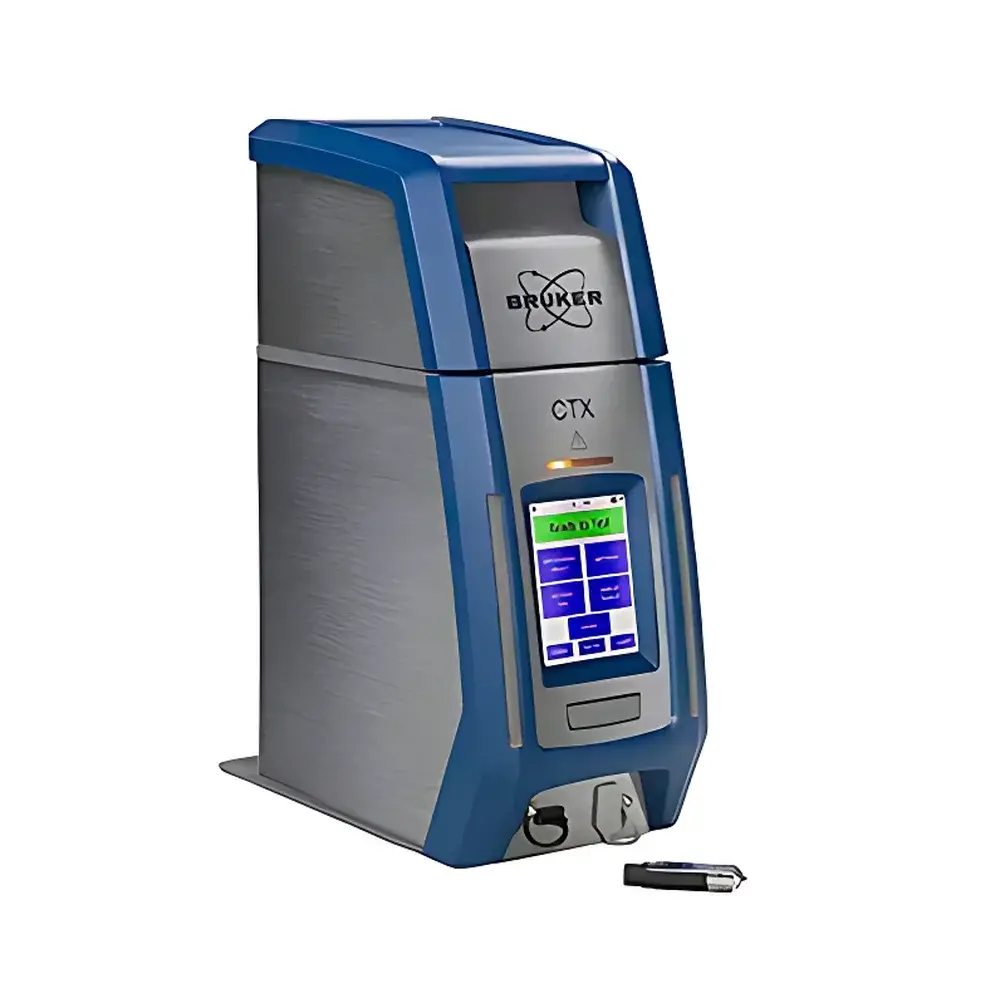
Bruker CTX Portable Energy Dispersive X-Ray Fluorescence Spectrometer
| Brand | Bruker |
|---|---|
| Origin | Germany |
| Manufacturer Type | Authorized Distributor |
| Origin Category | Imported |
| Model | CTX |
| Application | Benchtop Portable ED-XRF |
| Industry Use | General Purpose |
| Elemental Range | Mg–U (standard), Ti–U (optimized), Cl–U (optional) |
| Operating Temperature | –10 °C to +40 °C (14 °F to 104 °F) |
| Energy Resolution | ≤145 eV at Mn Kα |
| Detector | Silicon Drift Detector (SDD) |
| Safety Features | Dual Interlock System, Visual Status Indicators (Amber/Red LEDs), Sample Presence Sensor, Password Protection, Pre-Operation Radiation Alert, Rear-Mounted Power Switch |
| Power Supply | Rechargeable Li-ion Battery or 110/220 VAC Adapter |
| Beam Geometry | SharpBeam™ Optimized Collimation |
| Detector Protection | TITAN DetectorShield™ |
| Sample Handling | Sealed Sample Tray, Compatible with Cups, Bags, and Custom Containers |
| Calibration | Factory-Preloaded Application-Specific Methods (Food Safety, Soil Health, Alloy ID, Fuel Sulfur, Precious Metals, Geochemistry) |
Overview
The Bruker CTX is a self-contained, benchtop portable energy dispersive X-ray fluorescence (ED-XRF) spectrometer engineered for high-precision elemental analysis outside the conventional laboratory environment. Unlike handheld XRF devices, the CTX integrates a fixed geometry, shielded sample chamber, and automated excitation control—enabling reproducible quantification of solid, powdered, and liquid samples without operator-dependent positioning or open-beam exposure. Its core measurement principle relies on primary X-ray excitation of sample atoms, followed by detection of characteristic secondary (fluorescent) X-rays using a high-resolution silicon drift detector (SDD). The resulting spectrum is processed via fundamental parameter (FP) algorithms and empirically validated calibrations to deliver quantitative results traceable to international reference materials. Designed for regulatory-compliant operation in field labs, customs checkpoints, manufacturing floors, and environmental monitoring sites, the CTX meets stringent radiation safety requirements—including dual mechanical/electrical interlocks and real-time beam status indication—making it suitable for environments where open-beam portable XRF is restricted under local occupational health regulations.
Key Features
- SharpBeam™ collimated X-ray optics enabling high signal-to-noise ratio at low tube power (reducing thermal load and extending source lifetime)
- TITAN DetectorShield™ — a proprietary physical barrier that prevents contamination and mechanical damage to the SDD window during routine use with powders or volatile samples
- Sealed, spill-resistant sample tray with configurable inserts for cups, pouches, Petri dishes, and custom containers — eliminating cross-contamination and simplifying method transfer from lab to field
- Dual interlock system compliant with IEC 61010-1 and EN 62471, requiring both chamber closure and software authorization before X-ray generation
- Integrated visual status indicators: amber LED signals “X-ray Ready”, red LED confirms active irradiation — visible from all viewing angles due to front-panel illuminated display
- Password-protected user access levels supporting multi-user environments with audit-ready session logging
- Onboard radiation notification sequence activated at system boot, satisfying ALARA (As Low As Reasonably Achievable) procedural documentation requirements
- Flexible power architecture: operates up to 8 hours on rechargeable Li-ion battery or continuously via universal AC adapter (110/220 VAC, 50/60 Hz)
Sample Compatibility & Compliance
The CTX accommodates heterogeneous sample forms—including pressed pellets, loose powders, slurries, films, and liquids—in standardized or application-specific containers. Its sealed chamber design eliminates the need for vacuum or helium purge, allowing direct analysis of hydrated or volatile matrices without spectral distortion from atmospheric absorption. Method validation follows ISO 18503:2017 (XRF for soil and sediment analysis), ASTM D7756 (sulfur in marine fuels), and USP / (elemental impurities in pharmaceuticals). For regulated industries, the system supports 21 CFR Part 11-compliant data integrity features when paired with Bruker’s S1 EQUINOX software, including electronic signatures, immutable audit trails, and role-based permissions. All factory calibrations are certified against NIST SRM standards and documented per GLP/GMP Annex 11 requirements.
Software & Data Management
Controlled via Bruker’s S1 EQUINOX platform, the CTX provides intuitive workflow-driven operation—from sample registration and method selection to real-time spectral visualization and report generation. The software includes preconfigured application modules for food safety (Fe, Ca, Pb, Cd in dairy and cereals), agricultural testing (Zn, Cu, Mn, Ni in soils and plant tissue), precious metal assaying (Au, Ag, Pt, Pd fineness determination), and marine fuel compliance (S quantification per IMO MARPOL Annex VI). Quantitative results include uncertainty estimates derived from counting statistics and matrix correction residuals. Data export supports CSV, PDF, XML, and LIMS-compatible formats. Optional Bluetooth-enabled thermal printing allows immediate hardcopy output of QA/QC certificates at point-of-use.
Applications
- Food & Feed Quality Control: Rapid screening of nutritional fortificants (e.g., Fe, Ca in infant formula) and toxic elements (As, Cd, Pb) at critical control points (CCPs) aligned with HACCP protocols
- Agricultural & Environmental Monitoring: Field-deployable assessment of soil heavy metals (Cr, Ni, Zn), nutrient cations (K, Mg, Ca), and remediation efficacy tracking across seasonal cycles
- Geochemical Exploration: On-site analysis of drill cuttings, stream sediments, and ore concentrates for pathfinder elements (e.g., U, Mo, REEs) with detection limits sub-ppm for key analytes
- Customs & Border Security: Non-destructive verification of alloy composition (stainless steel grades, Ti alloys), conflict mineral screening (3TG: Ta, Sn, W, Au), and restricted substance compliance (RoHS, CPSIA)
- Precious Metal Refining: Accurate karat determination of gold jewelry, catalytic converter recycling (Pt/Pd/Rh recovery yield estimation), and bullion assay verification
- Marine Fuels Testing: Sulfur content quantification in residual and distillate fuels per ISO 8217 and IMO 2020 sulfur cap enforcement requirements
FAQ
Is the CTX certified for use in regulated laboratories?
Yes—the CTX complies with ISO/IEC 17025 requirements for calibration traceability and analytical validity when operated with documented SOPs and validated methods. Full 21 CFR Part 11 functionality is available through S1 EQUINOX v4.5+ with appropriate IT infrastructure.
Can the CTX analyze light elements such as sodium or magnesium?
The standard configuration detects elements from Mg (Z=12) upward. Enhanced light-element performance (down to Na or even F) is achievable with optional vacuum or helium purge accessories and specialized calibration packages.
How is instrument performance verified between calibrations?
Built-in drift correction uses internal reference sources and daily QC checks with certified check standards (e.g., NIST SRM 2711a). Automated reporting logs all QC events with pass/fail thresholds defined per ISO 17025 Clause 7.7.
Does the CTX require annual radiation safety inspection?
While the CTX is classified as a “radiation-generating device” under most jurisdictions, its fully interlocked, zero-exposure design typically exempts it from routine third-party radiation surveys—provided local regulatory authority accepts manufacturer certification and internal logbook maintenance per IAEA SSG-46 guidelines.




