
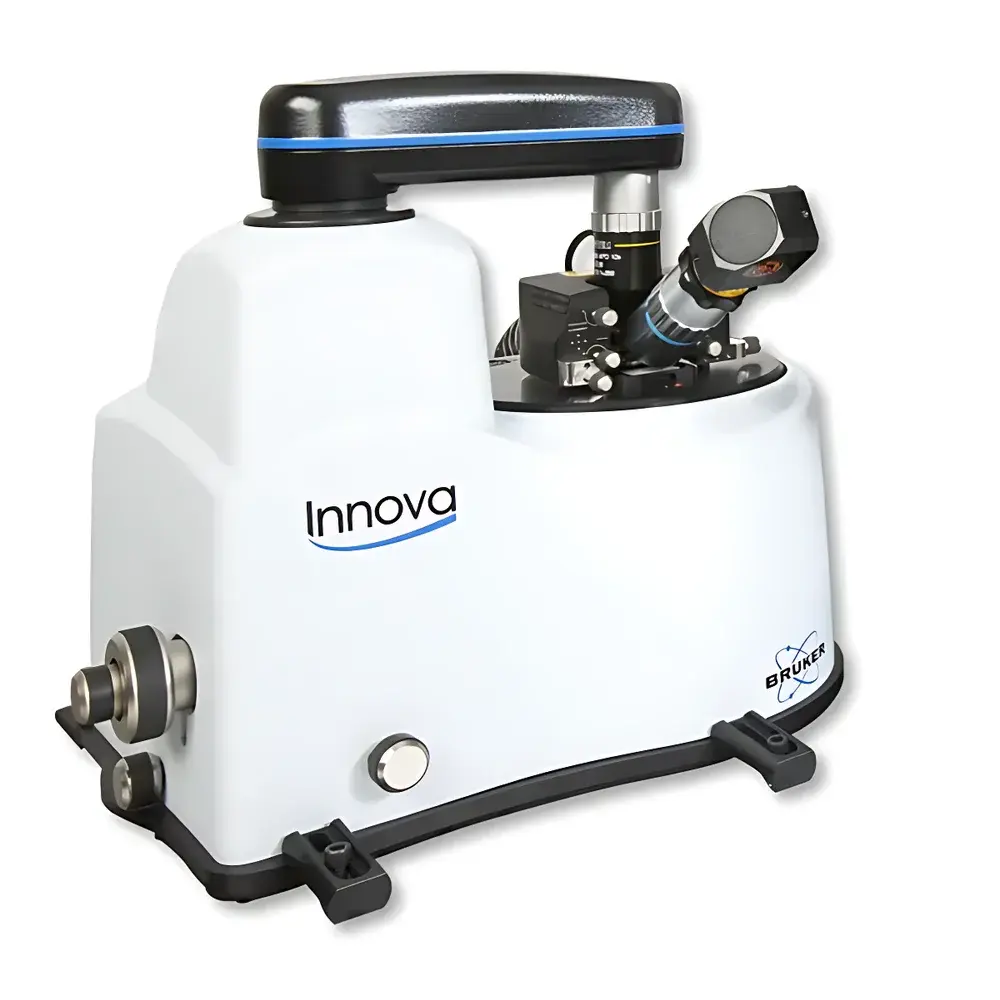
Bruker Innova Scanning Probe Microscope (SPM)
| Brand | Bruker |
|---|---|
| Origin | USA |
| Model | Innova |
| Instrument Type | Atomic Force Microscope (AFM) |
| Positioning Detection Noise | <2 µm (with standard 10× objective) |
| Sample Dimensions | 50 mm × 50 mm × 18 mm (X × Y × Z) |
| Z-Axis Stage Travel | 18 mm |
| Closed-Loop Scanner Range | XY > 90 µm, Z > 7.5 µm |
| Open-Loop Scanner Range | XY > 5 µm, Z > 1.5 µm |
| Optical Field of View | 1.24 mm × 0.25 mm (motorized zoom, 10× objective) |
| Optical Resolution | <2 µm (10×), <0.75 µm (50×) |
| Controller | 20-bit DAC, 100 kHz ±10 V ADCs |
| Software | SPMLab™ v7.0 (Windows® XP) |
Overview
The Bruker Innova Scanning Probe Microscope (SPM) is a high-performance atomic force microscope engineered for precision nanoscale surface characterization across physics, materials science, and life science laboratories. Operating on the fundamental principle of probe–surface interaction force detection—via cantilever deflection measured by optical beam bounce—the Innova delivers true atomic-resolution imaging in ambient, liquid, or controlled environmental conditions. Its core architecture integrates a proprietary closed-loop piezoelectric scanner with sub-nanometer positional fidelity and noise performance comparable to open-loop systems, resolving the long-standing trade-off between accuracy and stability. Designed for research-grade reproducibility and methodological flexibility, the Innova serves as a foundational platform for quantitative topography, mechanical property mapping (e.g., modulus, adhesion), electrical characterization (KPFM, CAFM), and dynamic modes (TappingMode™, PeakForce Tapping®). The system is fully compatible with Bruker’s suite of SPM accessories—including environmental enclosures, electrochemical cells, and temperature-controlled stages—enabling compliance with experimental requirements defined under ISO/IEC 17025 and ASTM E2539 standards for nanoscale measurement traceability.
Key Features
- Proprietary closed-loop XY–Z scanner delivering >90 µm lateral and >7.5 µm vertical range with <0.1% linearity error and real-time position feedback—ensuring dimensional accuracy without post-scan correction.
- Integrated coaxial color CCD optical microscope with motorized zoom and programmable focus; field-of-view adjustable from 1.24 mm × 0.25 mm (10× objective) to sub-micron resolution (<0.75 µm with 50× objective), enabling rapid region-of-interest identification and precise tip–sample alignment.
- Motorized Z-axis sample stage with 18 mm travel range, facilitating seamless transition between coarse approach and fine scanning—critical for multi-sample workflows and large-area correlative microscopy.
- Open-access sample stage design with standardized mounting interface (e.g., 50 mm × 50 mm × 18 mm max sample volume), supporting custom fixtures, in situ cells, and third-party accessories without mechanical interference.
- 20-bit digital controller with 100 kHz sampling rate and ±10 V analog I/O channels, providing high-fidelity signal acquisition and low-latency feedback control essential for advanced spectroscopy and custom pulse sequences.
- Full multimodal SPM capability—including Contact Mode, TappingMode™, Phase Imaging, Force Volume, Lateral Force Microscopy (LFM), and Kelvin Probe Force Microscopy (KPFM)—all accessible via unified SPMLab™ software interface.
Sample Compatibility & Compliance
The Innova accommodates rigid and soft samples ranging from semiconductor wafers and 2D materials (graphene, TMDCs) to biological specimens (fixed cells, protein monolayers, hydrogels) and polymeric thin films. Its modular stage design supports vacuum-compatible and fluid-cell configurations per ASTM D7618 (for polymer surface analysis) and ISO 11348 (for aquatic toxicity assessment using biofilm substrates). All hardware and firmware comply with CE and FCC electromagnetic compatibility directives. Data acquisition and metadata logging conform to GLP/GMP-aligned practices, with optional audit-trail-enabled software upgrades meeting FDA 21 CFR Part 11 requirements for regulated environments.
Software & Data Management
SPMLab™ v7.0 provides an integrated environment for instrument control, real-time visualization, offline analysis, and report generation. It supports batch processing of multi-channel datasets (topography, phase, amplitude, current, potential), cross-sectional profiling, roughness parameter calculation (Ra, Rq, Rz per ISO 4287), and statistical surface analysis. Raw data is stored in Bruker’s proprietary .spm format—fully documented and convertible to open formats (e.g., Gwyddion, ImageJ-compatible TIFF stacks). Export options include CSV, MATLAB (.mat), and HDF5 for integration into institutional data repositories and FAIR-compliant workflows.
Applications
- Quantitative nanomechanical mapping of polymer blends and block copolymers using PeakForce QNM®.
- In situ electrochemical AFM of battery electrode interfaces during cycling (Li-ion, solid-state).
- High-resolution topographic and dielectric characterization of ferroelectric domains in PZT and HfO₂-based thin films.
- Time-lapse imaging of protein adsorption kinetics and cell membrane dynamics in physiological buffer.
- Traceable calibration of step-height standards per NIST SRM 1960 and ISO 5436-1.
- Correlative AFM–optical microscopy of plasmonic nanostructures using integrated fluorescence overlay.
FAQ
What scanning modes does the Innova support?
The Innova natively supports Contact Mode, TappingMode™, Phase Imaging, Force Modulation, Lateral Force Microscopy (LFM), Magnetic Force Microscopy (MFM), Kelvin Probe Force Microscopy (KPFM), and Conductive AFM (CAFM). Additional modes can be implemented via user-defined scripts in SPMLab™.
Is the Innova compatible with Windows 10 or later?
While SPMLab™ v7.0 was originally validated on Windows® XP, Bruker provides certified driver and software updates for Windows 10 (64-bit) and Windows 11 through its Nano Surfaces Support Portal, including virtual machine deployment options for legacy method continuity.
Can the Innova perform automated tip exchange?
The system does not include robotic tip changers; however, its open-stage architecture and standardized cantilever holders enable rapid manual tip replacement—typically completed in under 90 seconds with minimal realignment.
What is the typical maintenance schedule for the Innova?
Annual calibration of scanner linearity and optical alignment is recommended. Piezo hysteresis compensation routines are performed automatically during startup; no consumables require scheduled replacement beyond standard cantilevers and optical filters.
Does Bruker offer application-specific training and method development support?
Yes—Bruker Nano Surfaces provides on-site and remote application workshops, SOP development assistance, and collaborative feasibility studies aligned with ISO/IEC 17025 method validation guidelines.





