
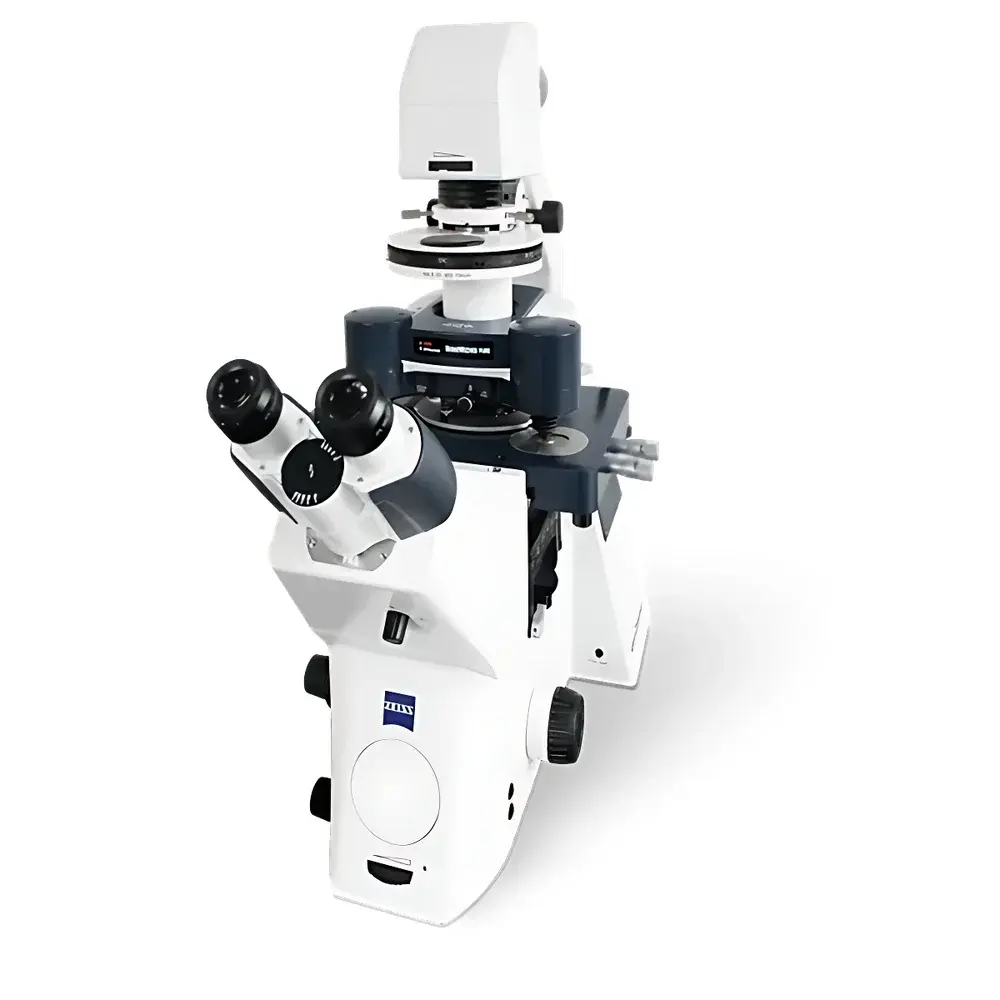
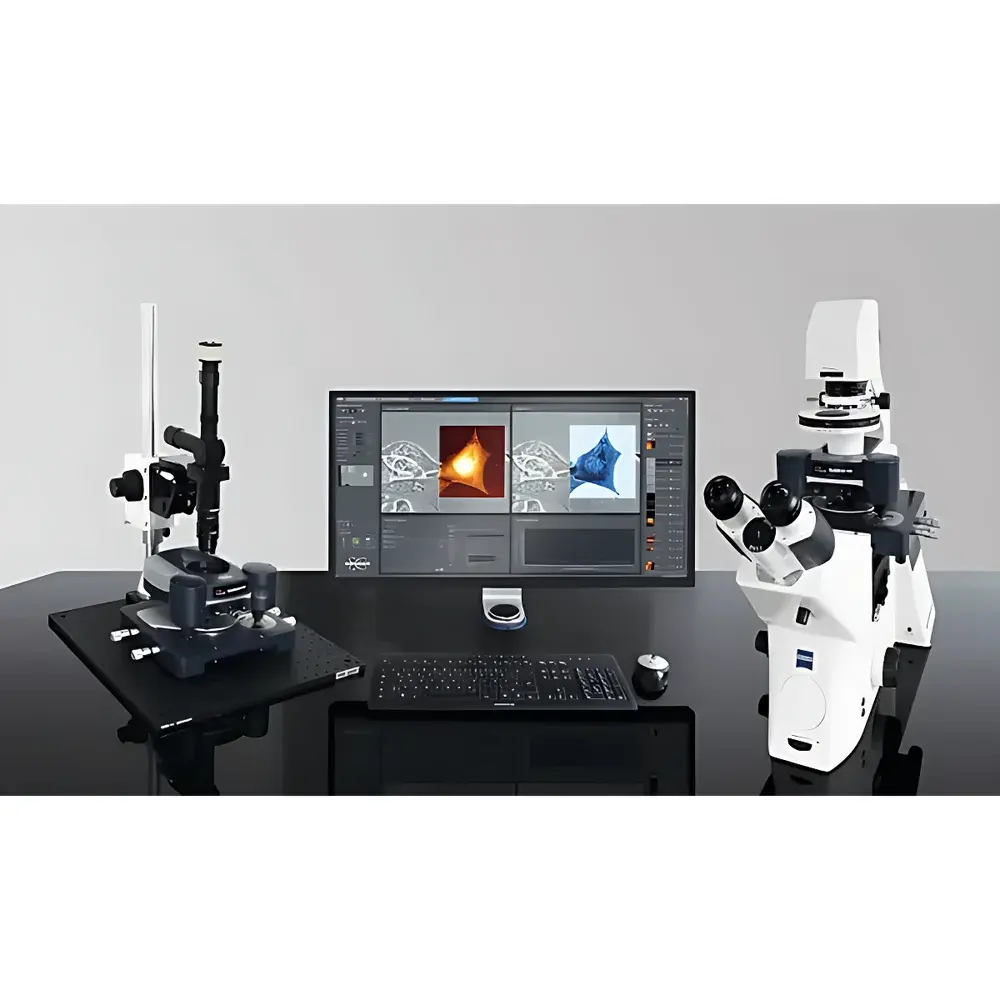
Bruker NanoWizard PURE Biological Atomic Force Microscope
| Brand | Bruker |
|---|---|
| Origin | Germany |
| Model | NanoWizard PURE |
| Instrument Type | Biological Atomic Force Microscope |
| Category | Scanning Probe Microscope (SPM) |
| Architecture | Modular, Optically Compatible SPM Platform |
| Key Capabilities | Correlative Optical-AFM Imaging, Quantitative Nanomechanics, Multi-Modal Functional Imaging (PFM, MFM, EFM, KPFM, C-AFM, SSRM, STS, sThermal-AFM), Nanomanipulation & Nanolithography |
| Software Suite | JPK Instruments (now part of Bruker) SPMLab+, ExperimentalPlanner, RampDesigner, DirectOverlay2, DirectTiling |
Overview
The Bruker NanoWizard PURE is a high-precision, modular biological atomic force microscope engineered for quantitative nanoscale characterization in life science and soft-matter research environments. Based on the proven principles of dynamic and static force detection in scanning probe microscopy, it employs piezoelectric tube scanners with closed-loop positioning feedback to deliver sub-nanometer spatial resolution and piconewton force sensitivity. Its core architecture is purpose-built for integration with inverted optical microscopes—enabling true correlative imaging across modalities including confocal, super-resolution (STED, STORM), and structured illumination microscopy (SIM). Unlike conventional AFMs limited to ambient or vacuum operation, the NanoWizard PURE supports physiological conditions via liquid cell compatibility, temperature-controlled stages, and electrochemical flow cells—making it suitable for live-cell imaging, mechanobiology studies, and functional biomaterial analysis under near-native environments.
Key Features
- Modular SPM platform designed for seamless integration with inverted optical microscopes—including full mechanical, optical, and software-level synchronization via DirectOverlay2 and DirectTiling modules.
- Quantitative nanomechanical mapping using PeakForce QNM and Quantitative Imaging (QI) modes, delivering simultaneous topography, adhesion, deformation, and modulus data with nm-scale spatial registration.
- Advanced functional imaging capabilities: Piezoresponse Force Microscopy (PFM) for ferroelectric domain analysis; Magnetic Force Microscopy (MFM) and Electrostatic Force Microscopy (EFM) for magnetic and surface potential mapping; Kelvin Probe Force Microscopy (KPFM) for work-function quantification; Conductive AFM (C-AFM) and Scanning Tunneling Spectroscopy (STS) for local conductivity and electronic structure assessment.
- Nanomanipulation and nanofabrication support through integrated nanopositioning, voltage pulse control (e.g., PFM lithography), and optional FluidFM® coupling for single-cell injection, aspiration, and force-controlled patch clamping.
- User-configurable experimental workflow automation via ExperimentalPlanner and RampDesigner—enabling reproducible force spectroscopy protocols, multi-point indentation series, and time-lapse mechanical property monitoring.
- Hinged-stage sample holder compatible with multi-well plates and Petri dishes; biocompatible materials and sterilizable components certified for ISO 13485-aligned lab workflows.
Sample Compatibility & Compliance
The NanoWizard PURE accommodates diverse biological and hybrid specimens—from fixed and live mammalian cells (e.g., neurons, fibroblasts, epithelial monolayers) to extracellular matrix scaffolds, hydrogels, lipid bilayers, and polymer-based biosensors. Its liquid cell design conforms to ASTM E2539-20 guidelines for AFM-based nanomechanical testing in aqueous media. All firmware and acquisition software comply with FDA 21 CFR Part 11 requirements for electronic records and signatures when deployed in GLP/GMP-regulated environments. Audit trails, user access controls, and instrument calibration logs are natively supported within SPMLab+ software to meet ISO/IEC 17025 and ISO 9001 quality management system expectations.
Software & Data Management
Controlled by SPMLab+, the NanoWizard PURE’s native software environment provides a unified interface for hardware orchestration, real-time image processing, and metadata-rich data export. It supports HDF5 and TIFF formats with embedded calibration parameters (e.g., scanner sensitivity, cantilever spring constant, deflection sensitivity) required for traceable quantitative analysis. ExperimentalPlanner enables protocol-driven experiment definition—including position lists, trigger logic for synchronized optical acquisition, and conditional loop execution. Data integrity is reinforced via automatic timestamping, digital signature embedding, and versioned project archiving compliant with FAIR (Findable, Accessible, Interoperable, Reusable) data principles.
Applications
- Mechanobiology: Mapping Young’s modulus gradients across subcellular domains (nucleus vs. cytoplasm), quantifying changes during differentiation or disease progression (e.g., cancer cell stiffness, neuronal growth cone mechanics).
- Ferroelectric Biomaterials: PFM-driven polarization switching and domain wall dynamics in PVDF-TrFE thin films used for neural interfaces or piezoelectric scaffolds.
- Neuroscience: Correlative QI–DirectOverlay imaging of immunostained peripheral nerve tissue to correlate structural ultrastructure with molecular marker localization.
- Data Storage Materials: High-resolution MFM phase imaging of magnetic domain structures at track boundaries in hard disk media.
- Electrochemical Interfaces: In situ SECM-AFM hybrid mode for mapping local redox activity and topographic evolution during battery electrode cycling or enzymatic catalysis.
FAQ
Is the NanoWizard PURE compatible with commercial inverted microscopes from Nikon, Olympus, and Zeiss?
Yes—it features standardized mechanical mounting interfaces and optical path alignment tools for integration with all major inverted microscope platforms, including Nikon Ti2, Olympus IX83, and Zeiss Axio Observer systems.
Can I perform force spectroscopy on live cells without compromising viability?
Absolutely—the system supports low-force, high-speed QI mode with adaptive trigger thresholds and fluidic environmental control (temperature, CO₂, humidity) to maintain physiological conditions during prolonged measurements.
Does the platform support third-party add-ons such as FluidFM or custom electrochemical cells?
Yes—its open API architecture and modular stage design allow certified integration of FluidFM® probes, bespoke electrochemical flow cells, and cryo-compatible accessories upon validation by Bruker Application Engineers.
What level of training and application support is provided post-installation?
Bruker offers on-site installation qualification (IQ), operational qualification (OQ), and comprehensive user training covering both routine operation and advanced correlative workflows, backed by regional application scientists and remote troubleshooting via secure VNC-enabled support channels.






