
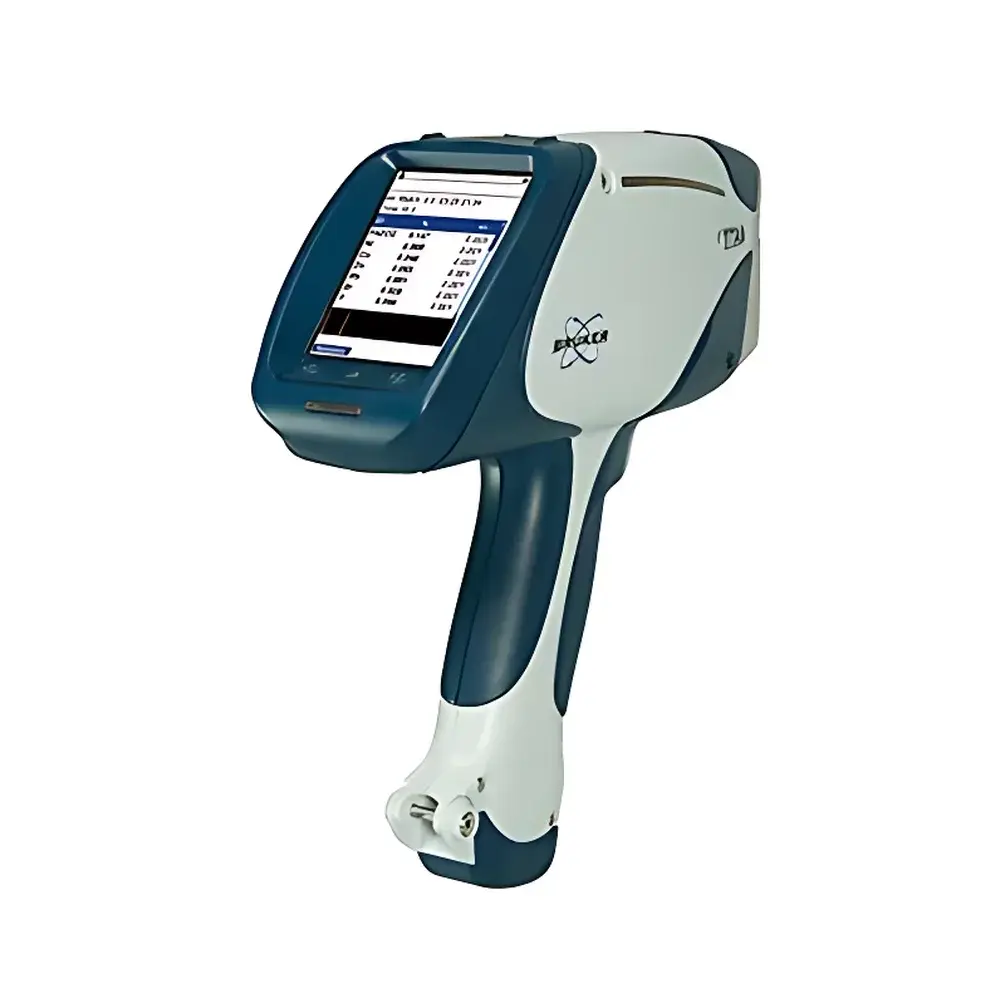
Bruker S1 TITAN Handheld Energy Dispersive X-Ray Fluorescence (ED-XRF) Spectrometer
| Brand | Bruker |
|---|---|
| Origin | Germany |
| Model | S1 TITAN |
| Application | Handheld/Portable |
| Element Range | Mg–U |
| Concentration Range | 1 ppm – 99.99% |
| Energy Resolution | <140 eV (Mn Kα) |
| Repeatability | 0.1% RSD |
| Detector | Silicon Drift Detector (SDD) |
Overview
The Bruker S1 TITAN is a field-deployable, handheld energy dispersive X-ray fluorescence (ED-XRF) spectrometer engineered for rapid, non-destructive elemental analysis of solid and powdered samples in situ. Based on fundamental ED-XRF physics, the instrument excites atoms in the sample using a miniature Rh or Ag anode X-ray tube, causing emission of characteristic secondary X-rays that are resolved by a high-performance silicon drift detector (SDD). The resulting spectrum is quantitatively deconvoluted using fundamental parameter (FP) algorithms and empirical calibrations to deliver precise, matrix-corrected elemental concentrations across the Mg–U range. Designed for operational robustness, the S1 TITAN meets IP54 ingress protection standards and operates reliably under extreme ambient conditions—including high humidity, rain, elevated temperatures, and mechanical shock—making it suitable for continuous use in industrial yards, scrap yards, pipeline corridors, and remote mining sites without laboratory infrastructure.
Key Features
- Ruggedized magnesium alloy housing with reinforced impact-resistant display and sealed optical path for long-term field reliability
- Integrated SDD detector with <140 eV energy resolution at Mn Kα, enabling high-fidelity peak separation for overlapping transitions (e.g., S Kα/Pb Mα, Cr Kβ/Mn Kα)
- TITAN™ anti-puncture detector window—patented polymer-reinforced beryllium foil that withstands direct contact with sharp metal shavings, wires, and abrasive surfaces without performance degradation
- Real-time spectral averaging, automatic beam current regulation, and adaptive pulse processing to maintain count-rate linearity up to 100 kcps
- On-device color-coded pass/fail grading (e.g., ASTM A751, UNS, EN 10027), audible tone feedback, and battery-level visualization for operator guidance
- Low-power mode with intelligent duty cycling extends battery life to >10 hours per charge (standard Li-ion pack)
Sample Compatibility & Compliance
The S1 TITAN supports direct analysis of alloys, ores, soils, slags, catalysts, coatings, and electronic components without sample preparation. Its optimized excitation geometry and FP-based quantification ensure trace-level detection (1 ppm) for light elements (Mg, Al, Si, P, S) and high-precision quantification of major and minor constituents (e.g., Ni, Cr, Mo in stainless steels; Cu, Zn, Sn in brasses). The system complies with IEC 62495 (radiation safety for handheld XRF), ISO 12885 (XRF methodology), and ASTM E2857 (standard guide for validation of portable XRF analyzers). Firmware and calibration libraries support GLP/GMP-aligned workflows, including user-accessible audit trails, electronic signatures, and configurable data retention policies compliant with FDA 21 CFR Part 11 requirements.
Software & Data Management
Powered by Bruker’s proprietary S1 PX software suite, the S1 TITAN enables offline method development, library customization (e.g., custom alloy grades, geological reference materials), and multi-instrument fleet management via Bruker CloudLink. All spectra, metadata (GPS coordinates, operator ID, timestamp), and quantitative reports are stored in encrypted SQLite databases with SHA-256 hashing. Export options include CSV, PDF (with embedded spectral plots), and XML formats compatible with LIMS integration. Remote firmware updates, calibration verification checks, and spectral quality metrics (peak-to-background ratio, FWHM stability) are accessible through the web-based administrator portal.
Applications
- Positive Material Identification (PMI) for ASME B31.3, API RP 578, and NACE MR0175 compliance in oil & gas, power generation, and chemical processing facilities
- Scrap sorting and recycling stream optimization—rapid differentiation of stainless steel grades (304 vs. 316), aluminum alloys (6061 vs. 7075), and copper-bearing materials
- In-field geochemical mapping and ore grade estimation (Fe, Cu, Zn, Pb, Au-associated elements) during exploration and mine planning
- QA/QC of incoming raw materials, weld deposits, and finished components in aerospace (Ti-6Al-4V verification), automotive (Mg-Al die-cast validation), and heavy machinery manufacturing
- Environmental screening of contaminated soils (Pb, As, Cd, Hg) and regulatory reporting per EPA Method 6200 and ISO 18227
FAQ
What regulatory standards does the S1 TITAN meet for radiation safety?
The device complies with IEC 62495:2020 and carries type approval from national radiation protection authorities (e.g., German BfS, US FDA CDRH). It features dual interlocks, real-time dose monitoring, and automatic beam cutoff upon tilt or obstruction.
Can the S1 TITAN quantify light elements such as magnesium and aluminum in alloys?
Yes—optimized vacuum/purge modes and low-noise SDD electronics enable reliable Mg–P quantification in metallic matrices, validated per ASTM E2857 Annex A2 protocols.
Is method transfer between multiple S1 TITAN units supported?
Calibration models, spectral libraries, and QA/QC templates are fully portable across instruments via encrypted USB import/export or Bruker CloudLink synchronization.
How is detector damage prevented during aggressive scrap yard use?
The TITAN anti-puncture window eliminates the need for fragile Mylar films while maintaining full transmission efficiency down to 1 keV—validated over 50,000 puncture-cycle simulations.
Does the instrument support trace element analysis in geological samples?
With optional helium purge and extended counting (up to 120 s), detection limits for As, Se, and Sr in soil CRM matrices achieve sub-5 ppm (1σ) per ISO 18227 guidelines.





