
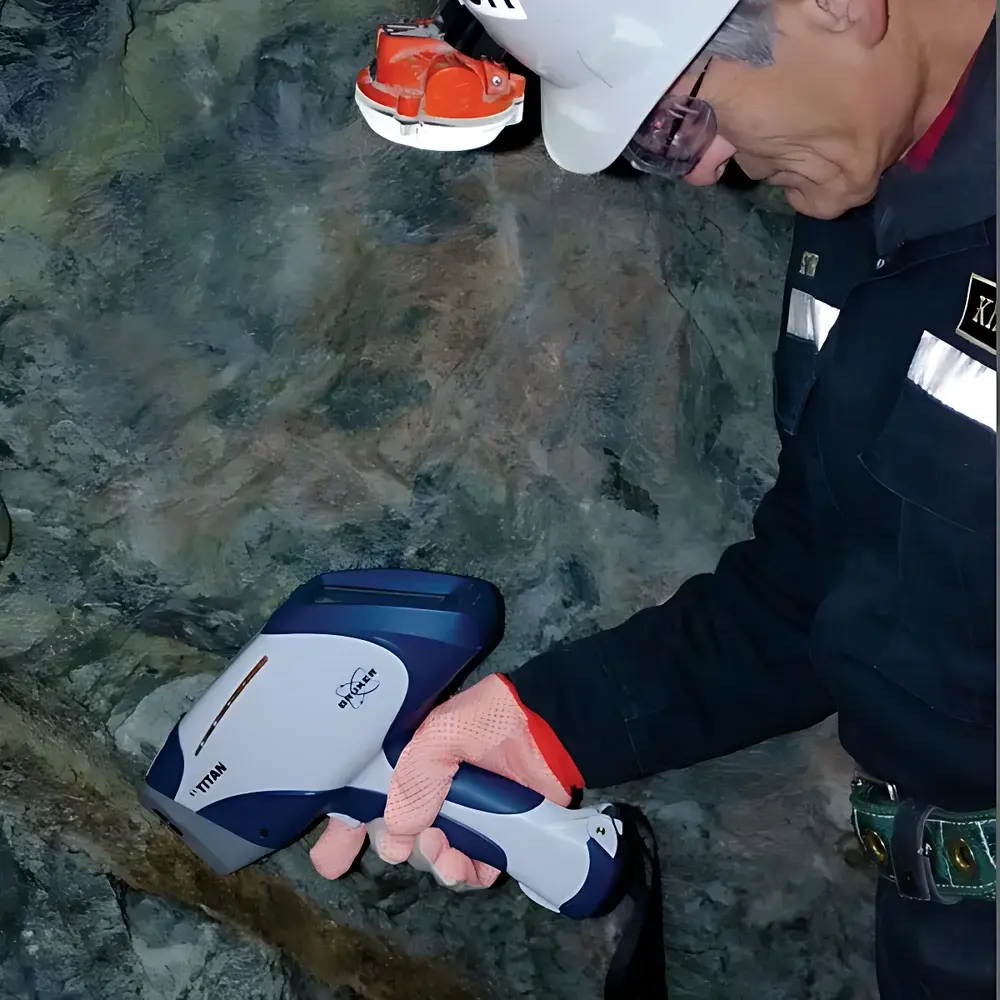
Bruker S1 TITAN Handheld Energy Dispersive X-Ray Fluorescence (ED-XRF) Spectrometer for Ore Grade Analysis
| Brand | Bruker |
|---|---|
| Origin | Germany |
| Model | S1 TITAN |
| Application | Field-Portable Ore & Geochemical Analysis |
| Elemental Range | Mg–U |
| Detection Limit | 1 ppm |
| Quantification Range | 1 ppm – 99.99 wt% |
| Energy Resolution | <140 eV (Mn Kα) |
| Detector | Silicon Drift Detector (SDD) |
Overview
The Bruker S1 TITAN is a field-deployable, handheld energy dispersive X-ray fluorescence (ED-XRF) spectrometer engineered for rapid, non-destructive elemental analysis of geological materials in situ. Operating on the fundamental principle of X-ray fluorescence—where primary X-rays excite atoms in a sample, inducing emission of characteristic secondary X-rays—the instrument delivers quantitative and semi-quantitative data for elements from magnesium (Mg, Z=12) to uranium (U, Z=92). Unlike traditional lab-based XRF systems requiring vacuum or helium purge for light-element detection, the S1 TITAN integrates optimized excitation geometry, high-power microfocus X-ray tube, and an ultra-low-noise silicon drift detector (SDD) to achieve reliable Mg–P quantification under ambient air conditions. This capability eliminates logistical dependencies on gas supplies or controlled environments, enabling real-time geochemical assessment directly at drill sites, open-pit faces, stockpiles, and core logging facilities.
Key Features
- Robust, ergonomic handheld design with IP54-rated enclosure for dust and splash resistance—engineered for extended field operation in harsh mining and exploration environments.
- High-performance SDD detector with <140 eV energy resolution at Mn Kα, ensuring precise peak separation and accurate multi-element deconvolution—even in complex mineral matrices.
- Optimized X-ray tube configuration (up to 50 kV, 4 W) with selectable filters and voltage/current settings to maximize sensitivity across light (Mg–Cl), mid-Z (K–Zr), and heavy elements (Nb–U).
- Integrated GPS, digital camera, and touchscreen interface for georeferenced data capture, visual documentation of sampling points, and intuitive on-device spectral review.
- Pre-calibrated factory methods for common ore types (e.g., iron ores, bauxites, copper sulfides, polymetallic veins) with optional user-defined method development via Bruker’s S1 PXRF software suite.
- Battery-powered operation (hot-swappable Li-ion packs) supporting >8 hours of continuous analysis per charge—validated per IEC 62133 safety standards.
Sample Compatibility & Compliance
The S1 TITAN accommodates heterogeneous solid samples without preparation: uncrushed rocks, drill core segments, pulverized powders, soil cores, mine tailings, slag, and filter media. Its large-area collimation (8 mm spot size) and adaptive beam stabilization minimize heterogeneity-related bias. The system complies with international radiation safety standards (IEC 62471, EN 61000-6-3), carries CE marking for electromagnetic compatibility and low-voltage directive conformity, and meets ISO 18504:2020 guidelines for field-portable XRF performance verification. For regulated workflows, it supports audit-ready reporting aligned with ASTM D7349 (XRF analysis of soils and sediments) and ISO 12847 (geochemical exploration surveys). Data integrity features include time-stamped spectra, operator ID tagging, and configurable electronic signatures compliant with ALCOA+ principles.
Software & Data Management
Data acquisition and processing are managed through Bruker’s proprietary S1 PXRF software, compatible with Windows-based PCs and tablets. The platform provides real-time spectrum visualization, automatic peak identification (using NIST X-ray database), matrix-matched calibration curve generation, and limit-of-detection (LOD) calculation per element. All spectral data—including raw counts, background-subtracted intensities, and quantified results—are stored in vendor-neutral .csv and .spx formats. Cloud synchronization (via optional Bruker Connect portal) enables centralized project-level data aggregation, version-controlled method libraries, and role-based access control. For GLP/GMP environments, optional 21 CFR Part 11 compliance packages provide electronic signature enforcement, full audit trails, and secure user authentication.
Applications
- Exploration & Prospecting: Rapid reconnaissance of anomalous zones; real-time mapping of elemental associations (e.g., Au–As–Sb in orogenic gold systems); discrimination of lithological units based on trace-element fingerprints.
- Core Logging & Resource Estimation: High-density elemental profiling along drill core trays; estimation of cut-off grades; identification of mineralogical zonation (e.g., Cu–Mo–Re in porphyry systems).
- Mine Site Process Control: On-belt or truckload analysis for feed grade validation; segregation of high- and low-grade material pre-crushing; monitoring of deleterious elements (e.g., As, Hg, Pb) in run-of-mine ore.
- Environmental & Rehabilitation Monitoring: Screening of soil and sediment for heavy metal contamination (Pb, Cd, Cr, Ni); verification of remediation efficacy; characterization of acid mine drainage precipitates.
- Trade & Logistics: Verification of concentrate shipments against contractual specifications (e.g., Cu %, Co %, As ppm); rapid screening of scrap metals and recycled feedstocks.
FAQ
Does the S1 TITAN require helium or vacuum for light-element analysis?
No. Its optimized air-path optics and high-sensitivity SDD enable reliable Mg, Al, Si, P, and S detection without external gas purging.
Can it quantify elements in soils with high organic content or moisture?
Yes—though moisture and organics affect matrix absorption, built-in empirical corrections and optional soil-specific calibrations mitigate bias. Sample drying or pelletization improves precision for regulatory reporting.
Is spectral data export compatible with third-party geochemical modeling tools?
Yes. Exported .csv files contain net intensities, uncertainties, and metadata required for import into Leapfrog Geo, Surpac, or Petrel for spatial interpolation and resource modeling.
What maintenance is required for long-term field reliability?
Annual detector calibration verification and X-ray tube output validation are recommended. Bruker-certified field service technicians perform on-site diagnostics and firmware updates per ISO/IEC 17025-accredited procedures.
How does it handle overlapping peaks—e.g., Pb Mα and Sb Kα?
The S1 PXRF software applies iterative least-squares fitting using fundamental parameters and library-based interference coefficients, resolving overlaps with typical accuracy better than ±5% RSD for concentrations above 100 ppm.



