
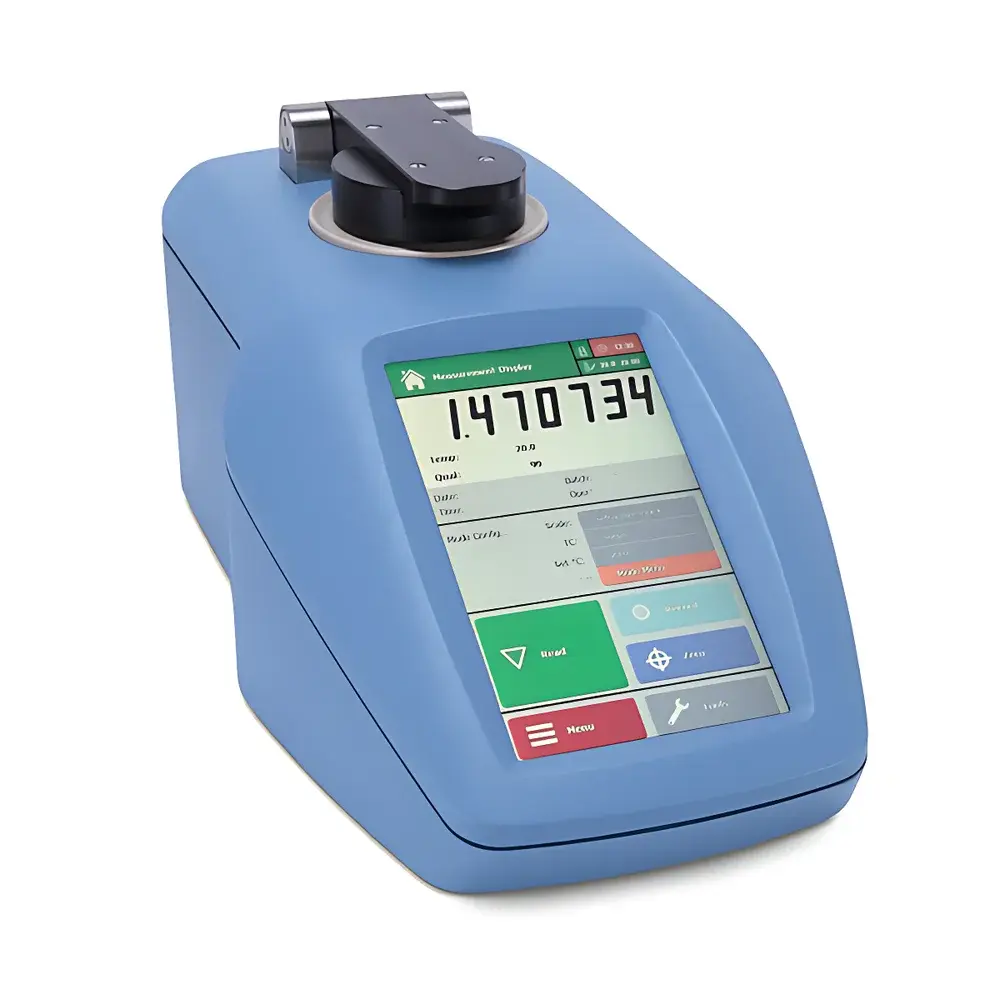
B+S RFM970-T Benchtop Digital Refractometer
| Brand | Bellingham + Stanley |
|---|---|
| Origin | United Kingdom |
| Model | RFM970-T |
| Type | Benchtop Refractometer |
| Temperature Control | Peltier-based, integrated |
| Display | High-resolution capacitive touchscreen |
| Measurement Range | Refractive Index (RI) 1.300000–1.700000 |
| °Brix | 0.000–100.000 |
| Resolution | RI ±0.000001 |
| Accuracy | ±0.000002 RI / ±0.002 °Brix (at 20 °C, traceable to NIST-certified standards) |
| Sample Chamber | Low-profile stainless-steel prism with non-contact pneumatic cover |
| Data Storage | 8,192 measurement records with timestamp, user ID, temperature, and method metadata |
| RFID Authentication | Integrated ISO 14443-A compliant reader for operator identification and access-controlled configuration |
| Compliance | Designed to support GLP/GMP workflows with audit trail-ready data export (CSV/Excel), 21 CFR Part 11–compatible optional software module |
Overview
The B+S RFM970-T is a high-precision benchtop digital refractometer engineered for laboratories requiring traceable, repeatable refractive index and °Brix measurements across demanding industrial and research applications. It operates on the principle of total internal reflection at the prism-sample interface, where incident light undergoes critical angle shift proportional to the sample’s refractive index. This optical measurement is converted into a digital RI value via a high-stability CCD linear array and proprietary angular interpolation algorithm. Unlike traditional Abbe-style instruments, the RFM970-T employs a temperature-stabilized sapphire-coated borosilicate prism and real-time thermal equilibrium verification—ensuring that readings are only acquired when both the prism surface and bulk sample temperature have converged within ±0.02 °C. Its extended RI range (1.300000–1.700000) accommodates not only aqueous solutions but also organic solvents, polymer melts, essential oils, and high-refractive-index specialty chemicals commonly encountered in fine chemical synthesis and formulation development.
Key Features
- Peltier-driven temperature control system with active cooling/heating (5–40 °C range, ±0.01 °C stability) and dual-sensor thermal validation (prism + sample chamber)
- Capacitive touchscreen interface with multilingual UI (English, German, French, Spanish, Chinese), intuitive icon-based navigation, and context-sensitive help
- Non-contact pneumatic cover actuation with auto-triggered measurement upon closure—eliminating mechanical pressure variability and prism contamination risk
- Integrated ISO 14443-A RFID reader enabling operator authentication, role-based access to calibration menus, and automatic user tagging of all measurements
- High-resolution prism assembly featuring scratch-resistant sapphire coating and optimized optical path geometry for minimal stray light and enhanced signal-to-noise ratio
- Onboard storage for 8,192 full measurement records—including RI, °Brix, temperature, timestamp, user ID, method name, and QC flag status—with USB export and optional Ethernet connectivity
Sample Compatibility & Compliance
The RFM970-T accepts liquid, semi-liquid, and low-viscosity paste samples (up to ~500 mPa·s) with volumes as low as 0.5 mL. Its low-profile sample well and ergonomic loading geometry facilitate rapid turnover in high-throughput QC environments. The instrument complies with ISO 21648:2020 (Refractometers — Requirements and test methods) and supports alignment with ASTM D1218, USP , and Ph. Eur. 2.2.20. When paired with B+S TraceLink™ software (optional), it delivers full 21 CFR Part 11 compliance—including electronic signatures, audit trails, and secure user authentication—making it suitable for regulated pharmaceutical, food safety, and contract testing laboratories operating under GLP or GMP frameworks.
Software & Data Management
Data management is handled via embedded firmware supporting CSV export to USB mass storage devices or direct transfer via RS-232/USB-C virtual COM port. Optional TraceLink™ PC software provides advanced features: method library management, statistical process control (SPC) charting, automated report generation (PDF/Excel), and integration with LIMS via HL7 or custom API. All stored records include embedded metadata—temperature drift logs, prism cleaning alerts, and calibration history—enabling full traceability from measurement to final report. Audit trail entries record every configuration change, user login/logout, and calibration event with immutable timestamps and operator identifiers.
Applications
The RFM970-T serves as a primary analytical tool in quality control laboratories across multiple sectors: concentration monitoring of glycols and ethanol blends in automotive coolant and fuel formulations; purity assessment of mono- and di-glycerides in edible oil refining; active pharmaceutical ingredient (API) identity verification via refractive index fingerprinting; quantification of sucrose, fructose, and glucose mixtures in beverage R&D; and characterization of solvent composition in reaction mixture analysis during continuous flow chemistry optimization. Its sub-micro-RI resolution enables detection of subtle compositional shifts—such as hydrolysis progress in esterification reactions or polymerization degree in acrylic monomer systems—that are undetectable with conventional refractometers.
FAQ
What temperature control accuracy does the RFM970-T achieve during measurement?
The instrument maintains prism temperature stability within ±0.01 °C over time and validates thermal equilibrium between prism and sample before acquisition—only initiating measurement when delta-T ≤ ±0.02 °C.
Can the RFM970-T be calibrated using certified reference standards?
Yes—it supports multi-point calibration using NIST-traceable RI standards (e.g., Cargille series) and includes built-in calibration verification routines with pass/fail reporting.
Is the RFID function mandatory for operation?
No—RFID is optional for user identification; manual user selection remains available. However, regulatory environments may require enforced authentication for audit integrity.
Does the instrument support custom concentration conversion tables?
Yes—users can import or define up to 32 custom RI-to-concentration polynomials per method, including temperature-corrected models for non-aqueous systems.
How is prism cleaning validated?
The system logs cleaning events and monitors baseline drift; if residual contamination exceeds threshold (determined by dark-current stability), a “Prism Clean Required” warning appears on the display with step-by-step cleaning guidance.





