
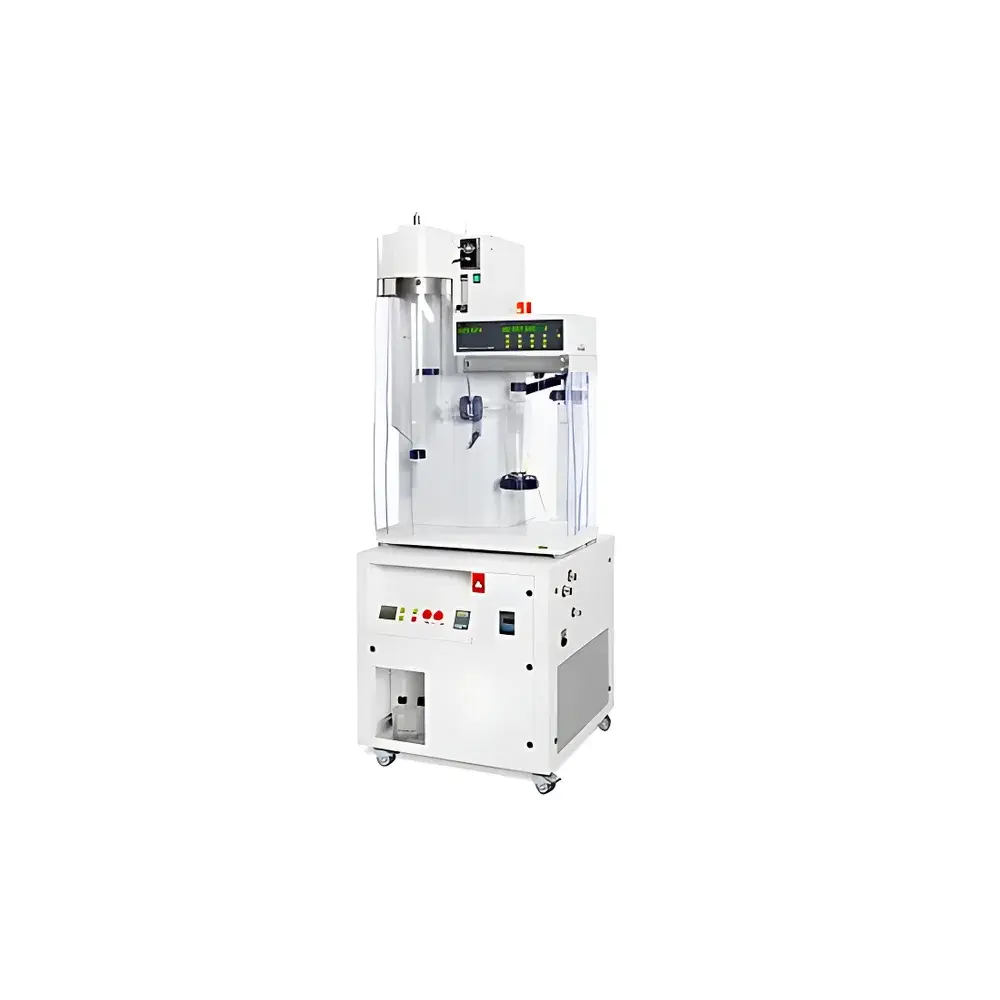
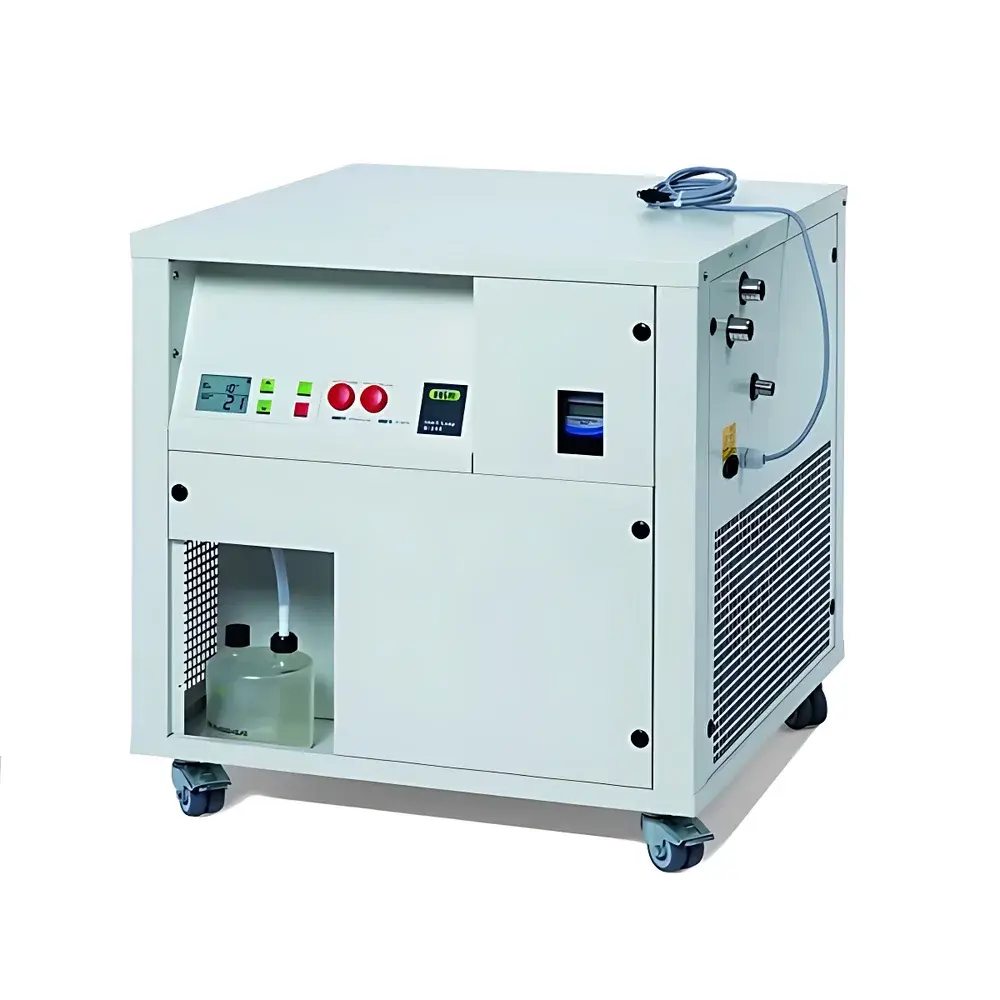
BUCHI B-290/B-295 Inert Gas Spray Drying Safety System
| Brand | BUCHI |
|---|---|
| Origin | Switzerland |
| Manufacturer | BUCHI AG |
| Product Type | Imported Laboratory Equipment |
| Models | B-290 (Spray Dryer), B-295 (Inert Gas Recycling Unit) |
| Sample Compatibility | Aqueous, organic solvents, and mixed-phase solutions |
| Max Feed Rate | 1.5 L/h |
| Inlet Air Temperature Range | Ambient to 220 °C |
| Particle Size Output | 1–60 µm |
| B-295 Cooling Capacity | 800 W at −10 °C |
| B-295 Minimum Outlet Temperature | −25 °C |
| B-295 Power Rating | 1.4 kW |
| Voltage | 200/230 V, 50–60 Hz |
| Dimensions (L×W×H) | 60 × 70 × 77 cm |
| Weight | 95 kg |
Overview
The BUCHI B-290/B-295 Inert Gas Spray Drying Safety System is an engineered solution for closed-loop, oxygen-controlled spray drying of heat-sensitive and flammable materials. It integrates the B-290 laboratory-scale spray dryer with the B-295 inert gas recycling unit to replace ambient air with nitrogen (or other inert gases) throughout the drying chamber, exhaust path, and cyclone system. This configuration eliminates ignition risk by maintaining oxygen concentration below the limiting oxygen index (LOI) of common organic solvents—enabling safe processing of methanol, ethanol, acetone, ethyl acetate, dichloromethane, toluene, hexane, and aqueous-organic mixtures. The system operates on the principle of continuous solvent vapor condensation, inert gas recirculation, and real-time O₂ and pressure monitoring—complying with fundamental requirements of explosion protection per IEC 60079-10-1 and Swiss accident prevention regulations (SUVA). Designed for research-scale formulation development, it supports reproducible particle engineering under GMP-aligned workflows without compromising operator safety or process integrity.
Key Features
- Integrated inert gas recirculation architecture: B-295 unit connects to B-290 via dual fluid lines (inert gas supply & solvent-laden exhaust) and a dedicated control signal cable
- Dual-sensor safety interlock: Independent optical O₂ sensor and absolute pressure transducer continuously monitor the closed loop; automatic shutdown and purge-to-safe mode triggered upon deviation from preset thresholds
- Cryogenic condensation module: Achieves −25 °C minimum outlet temperature with 800 W cooling capacity at −10 °C, enabling high-efficiency solvent recovery (>95% typical for low-boiling organics)
- Modular, mobile design: B-295 unit (60 × 70 × 77 cm, 95 kg) installs adjacent to existing B-290 systems without structural modification or facility retrofitting
- Validated solvent compatibility: Certified operation with methanol, ethanol, acetone, ethyl acetate, dichloromethane, toluene, hexane, and water–organic blends—documented per SUVA certification (Swiss National Accident Insurance Fund)
- Scalable auxiliary integration: Compatible with optional B-296 desiccant dryer for extended dew point control in high-humidity environments or hygroscopic solvent applications
Sample Compatibility & Compliance
The B-290/B-295 system accommodates thermolabile APIs, polymeric nanoparticles, metal–organic frameworks (MOFs), and solvent-based nanocomposites where conventional open-air drying poses fire hazard or decomposition risk. It supports feed solutions with total solids content up to 30 wt% and viscosity ≤500 mPa·s (measured at 25 °C). All wetted components comply with USP Class VI biocompatibility standards. The system meets mechanical safety requirements per EN 61000-6-2 (immunity) and EN 61000-6-3 (emission), and its control logic adheres to SIL 2 functional safety principles as defined in IEC 61508. Documentation packages include Factory Acceptance Test (FAT) reports, calibration certificates for O₂ and pressure sensors, and traceable material declarations compliant with REACH and RoHS directives.
Software & Data Management
The B-290 main controller (with integrated touchscreen HMI) communicates with the B-295 unit via RS-485 serial protocol, synchronizing temperature ramps, airflow setpoints, and safety state transitions. Process parameters—including inlet/outlet temperatures, feed rate, chamber pressure, O₂ concentration (% v/v), and condensate collection mass—are logged at 1 Hz resolution and exportable in CSV format. Audit trail functionality complies with FDA 21 CFR Part 11 requirements when operated with optional BUCHI LabX® software, providing electronic signatures, role-based access control, and immutable record retention. All safety events (e.g., O₂ excursion, compressor fault, door interlock breach) are timestamped and stored with contextual metadata for GLP/GMP traceability.
Applications
- Pharmaceutical R&D: Production of amorphous solid dispersions using solvent-based polymer carriers (e.g., HPMCAS, PVP-VA); stabilization of poorly water-soluble drugs (BCS Class II/IV) without thermal degradation
- Advanced materials synthesis: Encapsulation of catalysts, quantum dots, or perovskite precursors in inert atmospheres to prevent oxidation or hydrolysis during particle formation
- Agrochemical formulation: Microencapsulation of active ingredients in flammable solvent systems (e.g., xylene–acetone blends) with controlled release profiles
- Food-grade ingredient engineering: Solvent-free or low-residual drying of lipid nanoparticles, flavor microcapsules, or probiotic powders requiring strict oxygen exclusion
- Academic research: Method development for continuous nanoparticle synthesis, crystallinity modulation via quench-drying kinetics, and solvent–polymer phase behavior mapping
FAQ
Can the B-290/B-295 system be used with chlorinated solvents such as chloroform or carbon tetrachloride?
Yes—chlorinated solvents have been evaluated for compatibility with the B-295 condenser materials (316L stainless steel, EPDM gaskets, and fluoropolymer-coated heat exchangers). However, thermal stability limits require inlet air temperatures ≤120 °C for chloroform and ≤100 °C for carbon tetrachloride to prevent decomposition.
Is nitrogen consumption minimized during steady-state operation?
Yes—the system achieves >90% inert gas recirculation efficiency; make-up N₂ is only required to compensate for minor leaks and solvent vapor displacement, typically <5 L/min at full load.
Does the B-295 unit require external chilled water or refrigerant servicing?
No—the B-295 incorporates a hermetically sealed, oil-free scroll compressor and R-513A refrigerant circuit; no external coolant connections or periodic refrigerant recharging are needed.
Can the system be validated for regulatory submission (e.g., ANDA, MAA)?
Yes—BUCHI provides IQ/OQ documentation templates aligned with ASTM E2500 and ISO 13485. Full validation support, including protocol drafting and execution oversight, is available through BUCHI’s Global Validation Services team.
What is the maximum allowable solvent flash point for safe operation?
The system is certified for solvents with flash points down to −14 °C (e.g., diethyl ether), provided the O₂ concentration remains ≤5% v/v throughout the drying loop and all electrical components meet ATEX Zone 1 rating requirements.
Related Products



