
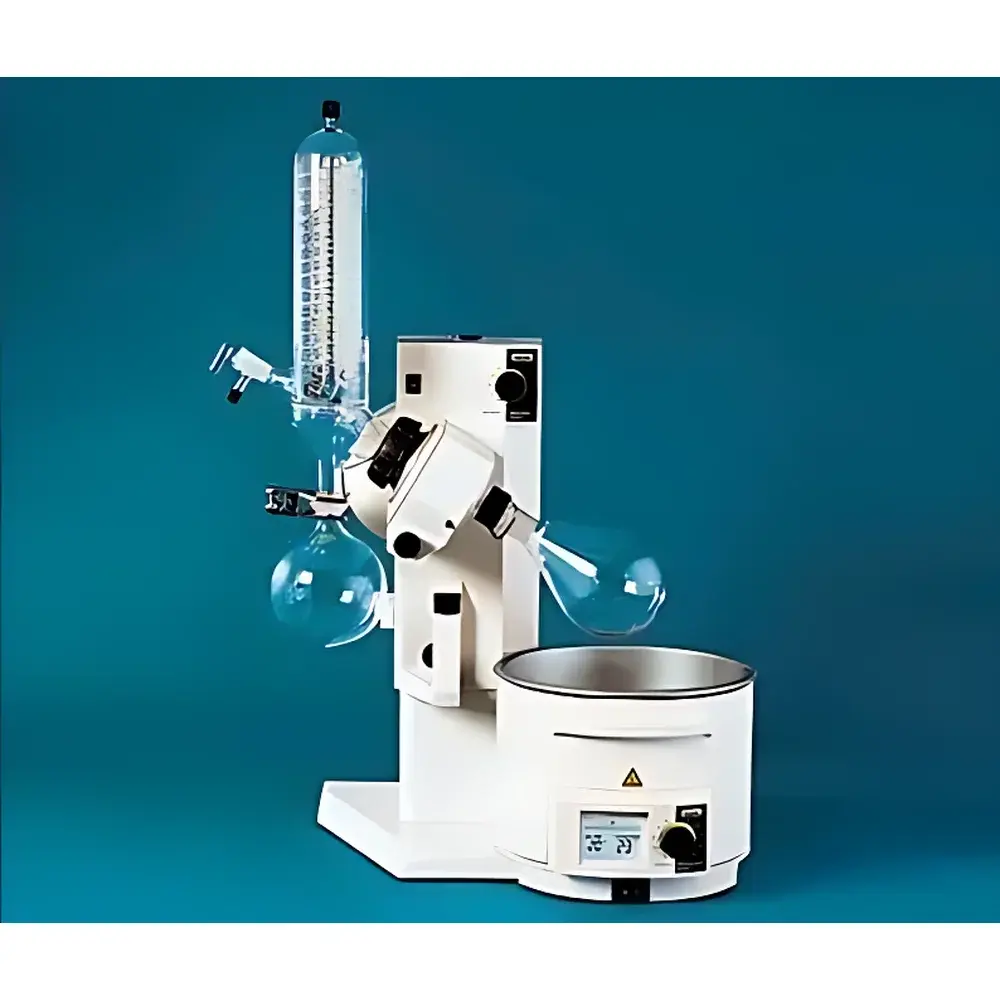
BUCHI Rotavapor R-210/R-215 Rotary Evaporator System with Integrated Vacuum Control, Chemical-Resistant Diaphragm Pump, and Circulating Chiller
| Brand | BUCHI |
|---|---|
| Origin | Switzerland |
| Model | R-210 / R-215 |
| Rotation Speed | 20–280 rpm |
| Bath Temperature Range | +20°C to +180°C (B-491) or +20°C to +95°C (B-495) |
| Evaporation Flask Capacity | 50–4000 mL |
| Max. Flask Weight | 3 kg |
| Display | Basic (R-210) / Steam Temperature & Rotation Speed (R-215) |
| Vacuum Pump | V-700 (1.8 m³/h, <10 mbar final vacuum) or V-710 |
| Vacuum Controller | V-850 (standard) / V-855 (advanced, with pressure gradient programming & EasyVac) |
| IP Rating | IP21 |
| Power Supply | 100–240 V, 50/60 Hz |
| Dimensions (L×H×D) | 550 × 575 × 415 mm |
| Weight | 16–18 kg (without bath) |
Overview
The BUCHI Rotavapor R-210 and R-215 represent the culmination of over six decades of engineering leadership in rotary evaporation technology. As the original inventor of the modern rotary evaporator, BUCHI has systematically refined core principles—thin-film formation under controlled vacuum, precise temperature regulation via thermostatic baths, and condensation efficiency governed by thermal gradient management—to deliver reproducible, scalable solvent removal across academic, pharmaceutical, and industrial laboratories. These systems operate on the fundamental principle of reducing boiling points through dynamic vacuum control while maintaining laminar solvent film geometry on rotating flasks. The R-210/R-215 platform is engineered for precision, safety, and modularity—not as a standalone instrument, but as the central node within an integrated purification workflow. Its architecture supports seamless interoperability between vacuum generation (V-700/V-710), pressure regulation (V-850/V-855), thermal management (B-491/B-495 baths), and condensation configuration (Configurations V, C, S, CR, E, BY), enabling method-driven rather than equipment-driven experimental design.
Key Features
- Modular system architecture: Base R-210 can be upgraded to Advanced (R-210 + V-850) or Professional (R-215 + V-855) configurations without hardware replacement.
- Dual-display interface on R-215: Real-time steam temperature and rotation speed monitoring ensure process traceability and inter-run repeatability—critical for GLP/GMP-aligned workflows.
- Chemical-resistant PTFE diaphragm vacuum pump (V-700/V-710): Oil-free operation, <10 mbar ultimate vacuum, 1.8 m³/h flow rate, and axial diaphragm motion design extend service life beyond 10,000 operating hours.
- Intelligent vacuum controllers: V-850 provides timer-based termination, LabVac multi-pump coordination, and USB data export; V-855 adds pressure gradient programming, EasyVac automatic distillation initiation via condenser-mounted vapor sensor, and repeatable curve storage.
- Wireless bath communication: B-491 (20–180°C) and B-495 (20–95°C) heating baths use RF-based power and data transmission—eliminating cable strain, improving ergonomics, and enhancing IP21 compliance.
- Enhanced safety mechanisms: Fail-safe motorized lift retracts flask upon power loss; combi-clip glass joints prevent disconnection during rotation; PTFE composite seals ensure long-term vacuum integrity with minimal maintenance.
Sample Compatibility & Compliance
The Rotavapor R-210/R-215 accommodates diverse sample matrices—including heat-sensitive natural product extracts, viscous polymer solutions, low-boiling organic solvents (e.g., diethyl ether, pentane), and foaming aqueous mixtures—through configurable condenser assemblies (dry ice-cooled, vertical, reflux-capable, or expansion-buffered). All standard glassware is manufactured from DIN ISO 3585 borosilicate 3.3 glass, certified for thermal shock resistance and chemical inertness per ASTM E438 Type I, Class A. Optional plastic coating (polymer-encapsulated glass) meets IEC 61000-4-2 ESD requirements and reduces fragmentation risk per EN 14470-1 for laboratory safety cabinets. System-level compliance includes CE marking, UL/CSA certification, and full audit readiness for FDA 21 CFR Part 11 when paired with V-855’s electronic logbook and user-access-controlled parameter locking.
Software & Data Management
Data integrity is embedded at the firmware level. The V-850/V-855 controllers record timestamped vacuum profiles, bath temperatures, rotation speeds, and solvent-specific parameters (drawn from a built-in library of 43 solvents compliant with IUPAC nomenclature and CRC Handbook reference values). USB 2.0 export enables direct import into LIMS or ELN platforms using CSV/TSV formats. The integrated solvent database supports customer-defined entries—including custom azeotrope definitions and vapor pressure curves—enabling automated calculation of optimal distillation endpoints per USP and ISO 5725-2 accuracy guidelines. Audit trails include operator ID, parameter changes, and system error logs—all retained for ≥36 months without external storage.
Applications
This platform serves as the primary concentration tool in regulated environments requiring method validation: residual solvent analysis per ICH Q3C, botanical extract standardization per AOAC 992.12, peptide synthesis workup per USP , and catalyst recovery in fine chemical manufacturing (ISO 9001:2015 Clause 8.5.1). Its modular condenser options enable specialized protocols—Configuration CR for cryogenic distillation of THF or DCM; Configuration E for foam-prone fermentation broths; Configuration BY for high-efficiency condensation of chlorinated solvents in EPA Method 502.2 workflows. Parallel processing is extended via integration with Multivapor P-12 (12-position simultaneous evaporation), maintaining cross-contamination prevention per CLSI EP29-A3 recommendations.
FAQ
What distinguishes the R-215 from the R-210?
The R-215 incorporates a secondary display showing real-time steam temperature and rotation speed—enabling closed-loop process verification without external probes.
Can the system comply with 21 CFR Part 11 requirements?
Yes—when operated with V-855 firmware v3.2+, enabled electronic signatures, audit-trail logging, and parameter lockout features meet ALCOA+ data integrity criteria.
Is the V-700 pump suitable for corrosive vapors such as HCl or HF?
The V-700 uses PTFE diaphragms and wetted-path components rated for pH 0–14; however, continuous exposure to anhydrous HF requires optional Hastelloy C-276 upgrade kits (sold separately).
How does EasyVac detect distillation endpoint automatically?
A thermocouple mounted in the condenser detects latent heat absorption cessation—signaling vapor phase depletion—and triggers automatic pressure ramping or shutdown per preconfigured logic trees.
What maintenance intervals are recommended for the sealing system?
PTFE composite seals require no scheduled replacement; functional verification (vacuum hold test at 50 mbar for 30 min) is advised quarterly per ISO/IEC 17025:2017 Clause 6.4.3.



