
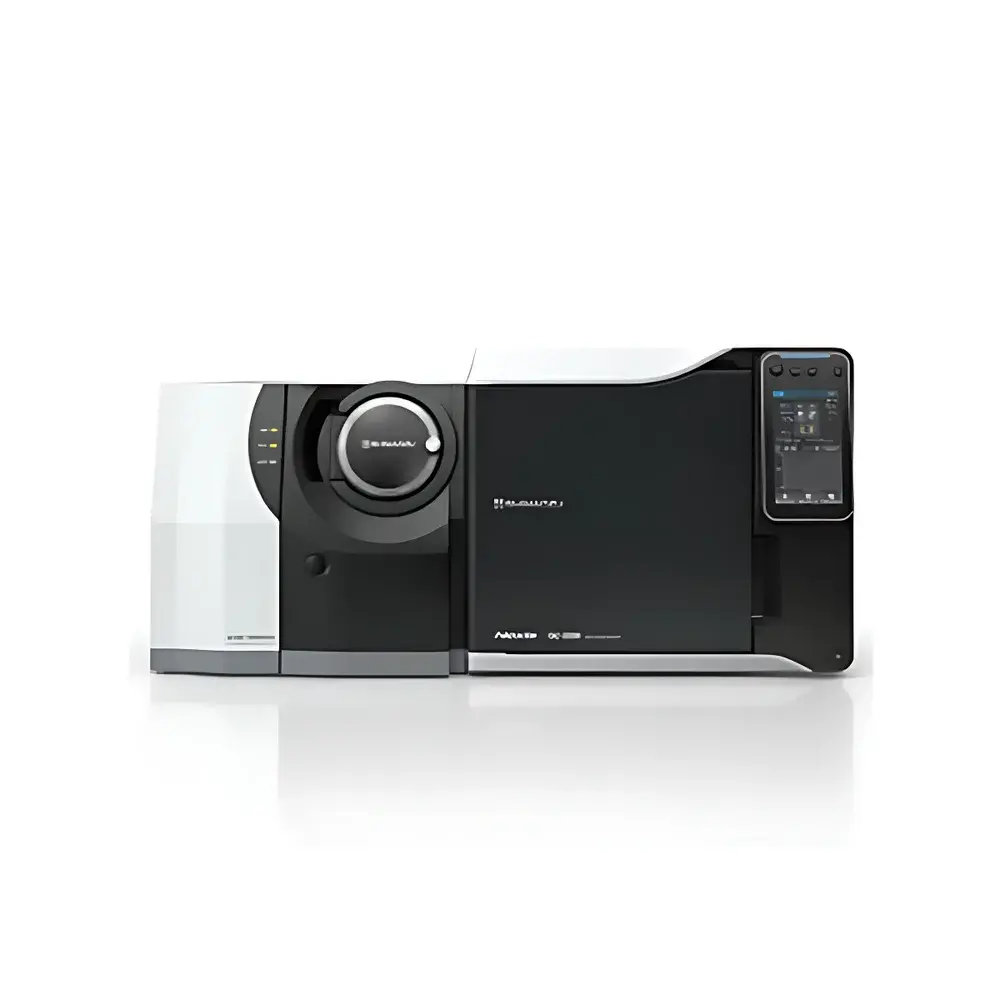

Shimadzu GCMS-TQ8040 NX Triple Quadrupole Gas Chromatography Mass Spectrometer
| Brand | Shimadzu |
|---|---|
| Origin | Japan |
| Model | GCMS-TQ8040 NX |
| Instrument Type | Triple Quadrupole Mass Spectrometer |
| Chromatography Mode | Conventional Gas Chromatography-Mass Spectrometry (GC-MS/MS) |
| Mass Range | 2–1090 u |
| Resolution | 1000–2000 (FWHM, at m/z 502) |
| Sensitivity | >18,000:1 (S/N, for 1 pg OFN in Scan mode) |
| Scan Speed | Up to 20,000 u/s |
| Ion Source | High-Efficiency EI/CI Dual-Mode Ion Source |
| Collision Cell | Optimized RF-only Quadrupole Collision Cell |
| Temperature Ramp Rate | Programmable up to 120 °C/min (oven-dependent) |
| Pressure Control Accuracy | ±0.01 psi (electronic pneumatic control) |
Overview
The Shimadzu GCMS-TQ8040 NX is a high-performance triple quadrupole gas chromatography mass spectrometer engineered for robust, high-sensitivity quantitative analysis in regulated and research laboratories. It operates on the fundamental principle of tandem mass spectrometry (MS/MS), where the first quadrupole (Q1) selects a precursor ion, the second quadrupole (q2) serves as a collision-induced dissociation (CID) cell, and the third quadrupole (Q3) filters and detects specific product ions. This configuration delivers exceptional selectivity, reduced chemical noise, and superior signal-to-noise ratios—critical for trace-level quantitation in complex matrices such as environmental extracts, food residues, clinical biofluids, and pharmaceutical impurity profiles. The system integrates seamlessly with Shimadzu’s Nexis GC-2030 gas chromatograph, supporting advanced temperature programming, backflush capability, and cryo-focusing for enhanced peak capacity and retention time stability.
Key Features
- Smart MRM Technology: Enables fully automated method setup for up to 32,768 MRM transitions per acquisition, significantly accelerating multi-analyte workflows without manual optimization.
- High-Luminosity Ion Source: Features an extended-life electron impact (EI) source with optimized filament geometry and active temperature stabilization, delivering consistent ionization efficiency across extended run times.
- Advanced Scan Speed Processing (ASSP): Real-time data acquisition engine supporting simultaneous Scan and MRM acquisition—allowing full-scan spectral confirmation alongside targeted quantitation within a single injection.
- Dual-Mode Ionization: Integrated EI/CI source with automatic switching capability, enabling structural confirmation via electron ionization and soft ionization for molecular weight determination using chemical ionization.
- Intelligent Collision Energy Optimization: Auto-tuning algorithms dynamically adjust collision energy based on analyte mass and retention time, ensuring reproducible fragmentation patterns across diverse compound classes.
- Robust Pneumatic Architecture: Electronically controlled pressure regulation with ±0.01 psi accuracy ensures precise carrier gas flow management, critical for retention time reproducibility and method transferability.
Sample Compatibility & Compliance
The GCMS-TQ8040 NX accommodates a broad range of volatile and semi-volatile organic compounds—including pesticides, PAHs, PCBs, endocrine disruptors, residual solvents, and small-molecule metabolites—across liquid, solid, and gaseous sample formats when coupled with appropriate inlet systems (split/splitless, PTV, or headspace). It complies with international regulatory frameworks including EPA Methods 500/600/8000 series, ISO 17025 requirements for accredited testing laboratories, and supports audit-ready operation under GLP and GMP environments. Data integrity features include electronic signatures, full audit trail logging (per FDA 21 CFR Part 11), and secure user access controls integrated into LabSolutions software.
Software & Data Management
LabSolutions LCMS/GCMS software provides a unified platform for instrument control, method development, data processing, and reporting. Its Smart MRM module automates parameter derivation—including retention time windows, Q1/Q3 masses, dwell times, and collision energies—from standard injections or library spectra. Quantitative workflows support internal standard calibration curves, matrix-matched standards, and isotopic dilution methods. All raw and processed data are stored in vendor-neutral formats (e.g., ANDI/NetCDF) and can be exported to LIMS or third-party statistical packages. Version-controlled method templates ensure inter-laboratory consistency and facilitate revalidation during method lifecycle management.
Applications
This system is routinely deployed in environmental monitoring labs for ultra-trace detection of organochlorine pesticides in soil and water; in food safety programs for multi-residue screening of veterinary drugs and mycotoxins; in forensic toxicology for rapid confirmation of controlled substances in biological specimens; and in pharmaceutical quality control for genotoxic impurity profiling per ICH M7 guidelines. Its combination of speed, sensitivity, and specificity makes it particularly suited for high-throughput compliance testing where regulatory limits demand sub-ppt detection levels and unambiguous identification.
FAQ
What regulatory standards does the GCMS-TQ8040 NX support for data integrity?
It meets FDA 21 CFR Part 11 requirements through LabSolutions’ built-in electronic signature, audit trail, and role-based access control modules.
Can the system perform both qualitative and quantitative analysis in a single run?
Yes—via simultaneous Scan and MRM acquisition enabled by ASSP technology, allowing spectral library matching and targeted quantitation without compromising data quality.
Is method transfer from legacy GC-MS/MS platforms feasible?
Method portability is supported through standardized MRM transition lists, retention time locking, and compatibility with common GC column dimensions and carrier gas conditions.
What maintenance intervals are recommended for routine operation?
Ion source cleaning is typically required every 2–4 weeks depending on sample load; vacuum pump oil replacement every 6 months; and annual performance verification using certified tuning standards (e.g., PFOS, DFTPP).
Does the system support remote monitoring and diagnostics?
Yes—via LabSolutions’ web-based remote access interface, enabling real-time status checks, queue management, and diagnostic log review from authorized network endpoints.





