
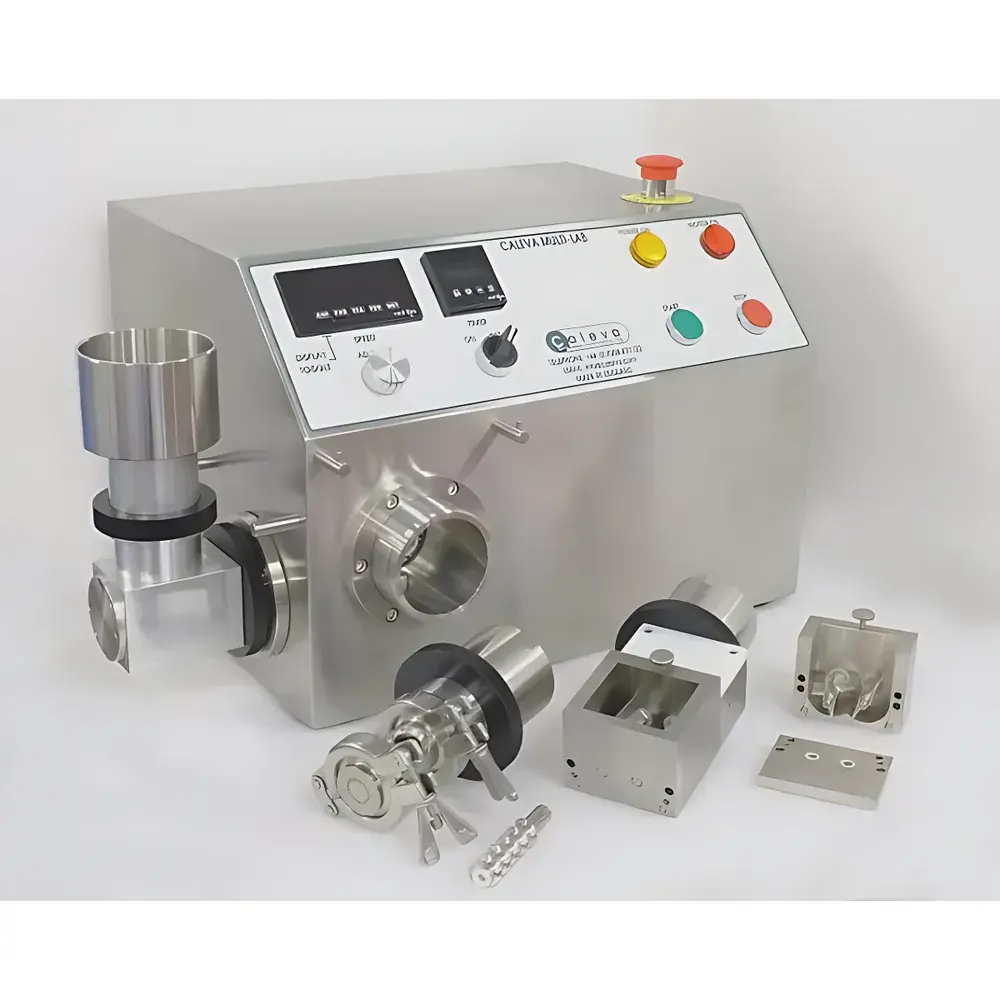
Caleva CML Multi-Function Wet Granulation, Extrusion & Spheronization System
| Brand | Caleva |
|---|---|
| Origin | United Kingdom |
| Model | CML |
| Type | Benchtop Integrated Pharmaceutical Process Development Instrument |
| Construction | 304 Stainless Steel Frame |
| Product-Contact Parts | 316/316L Stainless Steel & POM (Polyoxymethylene) |
| Batch Capacity | 10–25 g (dry weight), up to 50 g (wet weight) |
| Granulator Bowl Options | Full-height & semi-bowl (enables 20 g dry-weight minimum batch) |
| Extruder | Continuous operation |
| standard die plate | Ø1.0 mm × 1 mm depth (interchangeable: 0.5–3.0 mm) |
| Spheronizer Bowl Capacity | 10–80 g (wet weight) |
| Drive Speed Control | Analog potentiometer with digital RPM display (switchable between granulator shaft, extruder screw, and spheronizer disc speeds) |
| Safety | Interlocked CE-compliant safety guard |
| Dimensions (base unit) | 450 × 365 × 375 mm |
| Weight | 34.25 kg |
| Compliance | CE-marked |
Overview
The Caleva CML Multi-Function Wet Granulation, Extrusion & Spheronization System is a benchtop-integrated process development platform engineered for precision feasibility studies in solid oral dosage form design. It implements three core unit operations—high-shear wet granulation, extrusion, and spheronization—within a single, space-optimized mechanical architecture. Unlike conventional sequential lab-scale equipment, the CML enables end-to-end microsphere (pellet) manufacturing from dry powder to spherical granules in under 30 minutes per batch, using as little as 20 g (dry weight) of active pharmaceutical ingredient (API) and excipients. Its operational principle relies on controlled mechanical energy input: granulation occurs via impeller-driven shear in a hemispherical or full-height bowl; extrusion utilizes a single-screw configuration with interchangeable die plates to generate cylindrical strands; spheronization employs frictional attrition in a rotating friction plate system to transform extrudates into near-spherical pellets. This integrated approach eliminates inter-unit transfer losses, reduces cross-contamination risk, and maintains consistent moisture and thermal history across stages—critical parameters for reproducible pellet morphology, density, and dissolution behavior.
Key Features
- Modular “phase-upgrade” architecture: Users may initially commission only the base unit (granulator) and add extruder or spheronizer modules later without hardware retrofitting.
- Minimal batch capability: Semi-bowl granulator accessory enables full-process execution starting from 20 g dry-weight material—ideal for high-value APIs, early-stage formulation screening, or scarce catalyst/ ceramic precursors.
- Tool-free disassembly: All product-contact components—including bowls, screws, dies, and discs—are designed for rapid release and reassembly without wrenches or calibration recalibration.
- Interlocked CE-compliant safety system: Machine operation is physically inhibited unless the polycarbonate safety guard is fully seated and latched.
- Dual-speed monitoring interface: Digital RPM display toggles between granulator impeller speed, extruder screw speed, and spheronizer disc rotational speed via front-panel “Display Switch” button.
- Torque-limited granulation: Mechanical torque coupler preset at 8 N·m prevents motor overload and ensures consistent densification across variable formulations.
Sample Compatibility & Compliance
The CML accommodates diverse powder systems including pharmaceutical blends (e.g., MCC, HPMC, lactose), ceramic slurries, polymer composites, and heterogeneous catalyst supports. All wetted surfaces are constructed from electropolished 316 or 316L stainless steel and FDA-compliant POM—validated for non-reactivity with acidic, basic, and organic solvent–containing formulations. The system meets CE Machinery Directive 2006/42/EC requirements and conforms to ISO 13857 (safety distances) and IEC 60204-1 (electrical safety). Optional qualification packages include Factory Acceptance Testing (FAT), Site Acceptance Testing (SAT), material traceability certificates (EN 10204 3.1), and GMP-aligned documentation suitable for regulatory submissions (e.g., FDA IND/IMPD dossiers). When paired with validated data logging software (available as an upgrade), the system supports audit trails compliant with 21 CFR Part 11 for electronic records and signatures.
Software & Data Management
The base CML operates via analog speed control and real-time RPM feedback—ensuring deterministic, repeatable mechanical actuation without software dependency. For enhanced traceability, Caleva offers the optional CML-DataLink module: a USB-connected acquisition interface that logs time-stamped speed, torque (via strain gauge), and runtime metadata to CSV files. This module supports GLP/GMP workflows by enabling user-defined electronic signatures, session-level password protection, and immutable export formats compatible with LIMS integration. All raw data files retain embedded instrument ID, operator ID, date/time stamps, and version-controlled firmware identifiers—facilitating full process reconstruction during regulatory audits.
Applications
- Pharmaceutical R&D: Rapid screening of binder type/concentration, granulation endpoint detection, extrudate strand uniformity assessment, and spheronization time optimization for modified-release pellet formulations.
- Catalyst development: Preparation of mechanically robust, high-surface-area spherical catalyst carriers (e.g., alumina, silica, zeolite-based microspheres) with controlled pore structure and attrition resistance.
- Ceramic processing: Lab-scale synthesis of sinterable zirconia or hydroxyapatite microspheres for additive manufacturing feedstock evaluation.
- Polymer compounding: Feasibility testing of thermoplastic elastomer pelletization prior to twin-screw extrusion scale-up.
- Academic research: Hands-on pedagogy in unit operation integration, residence time distribution analysis, and empirical modeling of granule growth kinetics.
FAQ
What is the smallest recommended batch size for full-process operation (granulation → extrusion → spheronization)?
For optimal repeatability and yield recovery (>90%), a minimum of 20 g dry-weight material is recommended when using the semi-bowl granulator accessory.
Can the extruder operate independently of the granulator?
Yes—the extruder module functions as a standalone continuous-feed device when mounted to the base unit; it accepts pre-moistened or dry powder feed via manual loading into the hopper.
Is validation support available for GMP environments?
Caleva provides optional IQ/OQ protocols, URS templates, and traceable calibration certificates. Full 21 CFR Part 11 compliance requires the CML-DataLink software module and site-specific computer system validation.
How is cleaning verified between batches?
Visual inspection and swab sampling are supported by the tool-free disassembly design; all bowls and screws feature smooth, crevice-free surfaces meeting ASME BPE surface finish standards (Ra ≤ 0.8 µm).
Are spare parts and technical support available globally?
Caleva maintains regional service hubs in the UK, USA, Germany, and Singapore, with 48-hour spare parts dispatch for critical wear components (e.g., die plates, POM discs, torque couplers).






