
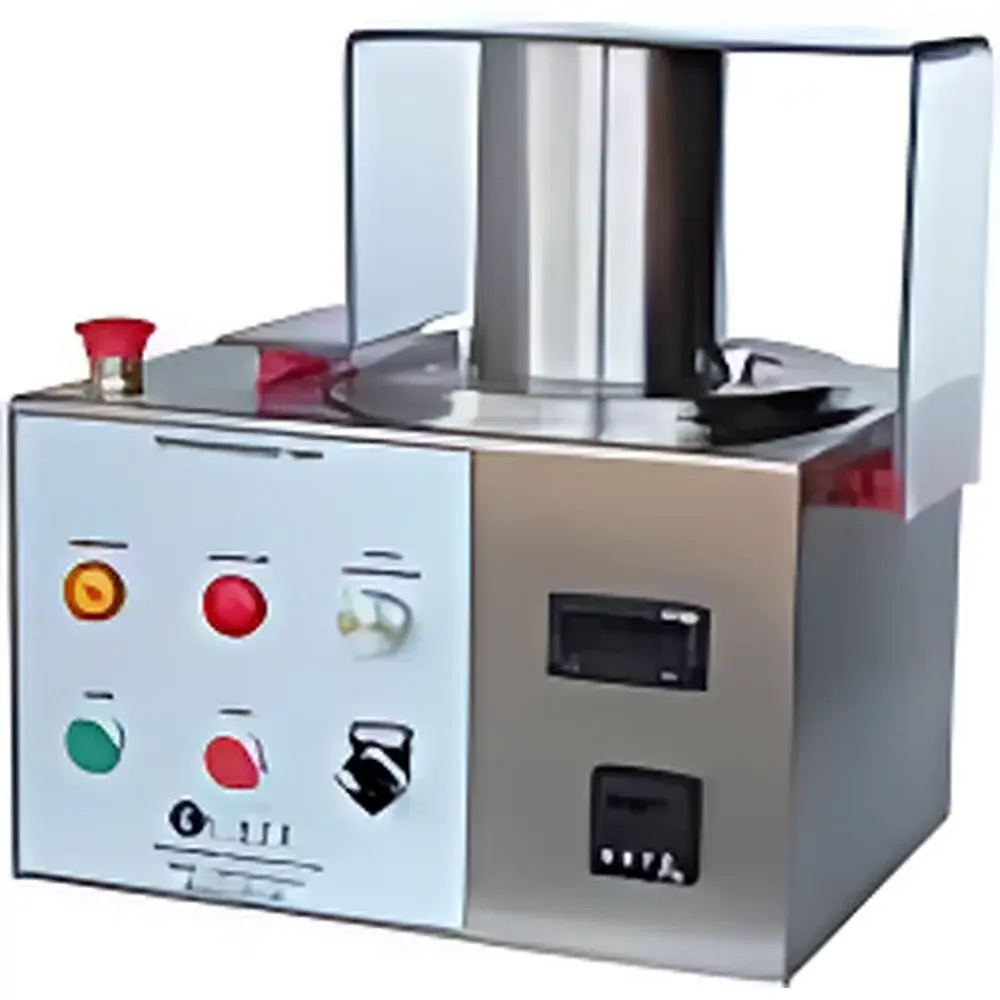
Caleva MBS-120 Laboratory Extrusion-Spheronization System
| Brand | Caleva |
|---|---|
| Origin | United Kingdom |
| Model | MBS-120 Spheronizer |
| Drum Diameter Range | 70–120 mm |
| Batch Capacity | 10–150 g |
| Dimensions (W×D×H) | 250 × 200 × 420 mm |
| Weight | 15 kg |
| Contact Materials | 316 stainless steel, acrylic |
| Drive | High-power DC motor with thyristor speed controller |
| Speed Control | 10-turn uncalibrated potentiometer + handheld tachometer |
| Standard Inserts | Two cross-hatched discs (3 mm and 6 mm pitch) |
| Power Supply | Single-phase |
Overview
The Caleva MBS-120 Laboratory Extrusion-Spheronization System is a compact, benchtop spheronizer engineered for precision particle engineering in pharmaceutical development and formulation science. It operates on the principle of rotational shear-induced agglomeration: extruded strands—typically produced by a companion extruder such as the Caleva Extruder-20—are fed into a rotating drum containing patterned spheronizing discs. Under controlled centrifugal force and mechanical impact, the strands fragment and undergo plastic deformation, progressively rounding into near-spherical granules. This process is critical for producing uniform multiparticulate dosage forms that exhibit high flowability, consistent dosing accuracy, content uniformity, and reduced airborne dust—key requirements for regulatory compliance in oral solid dose manufacturing. The MBS-120 is not a production-scale device; rather, it is purpose-built for early-stage R&D, formulation screening, and process optimization where material conservation, operational flexibility, and reproducible small-batch output are paramount.
Key Features
- Modular drum design accommodating interchangeable drums from 70 mm to 120 mm internal diameter—enabling systematic study of scale-up effects and geometry-dependent sphericity.
- Benchtop footprint (250 × 200 × 420 mm) with total mass of only 15 kg—optimized for space-constrained laboratories and cleanroom integration.
- Batch capacity range of 10–150 g, adjustable via optional sleeve inserts—ideal for handling high-value APIs or limited-excipient formulations without wastage.
- Full-contact wetted surfaces constructed from electropolished 316 stainless steel and FDA-compliant acrylic—ensuring corrosion resistance, non-reactivity, and ease of cleaning per GMP-aligned procedures.
- Front-panel controls including momentary Start/Stop switches, illuminated Power On/Motor On indicators, and an emergency stop button—integrated with magnetic interlock circuitry to prevent operator access during rotation.
- Tool-free drum removal via dual quick-release hooks—facilitating rapid product discharge, visual inspection, and residue-free cleaning between batches.
- Thyristor-controlled DC drive system with 10-turn speed adjustment and calibrated handheld tachometer—providing stable, repeatable rotational speeds across the full operating range (typically 200–1200 rpm, dependent on drum size and load).
Sample Compatibility & Compliance
The MBS-120 accommodates a broad spectrum of extrudate rheologies—from brittle, low-moisture pastes to highly plastic, moisture-sensitive masses—provided feed strand diameter falls within the 0.8–3.0 mm range typical for spheronizable formulations. Its compatibility extends to aqueous, organic, and solvent-based systems used in immediate-release, sustained-release, and enteric-coated multiparticulate development. All wetted components comply with USP Class VI biocompatibility standards and meet ISO 9001 manufacturing requirements. The system supports GLP/GMP documentation workflows: optional digital speed controller (with real-time RPM display and data logging interface) enables audit-ready traceability, while optional temperature-controlled drum jackets (heating/cooling) allow process parameter mapping under ICH Q5A-relevant thermal stress conditions. Though not intrinsically 21 CFR Part 11 compliant, the instrument’s analog control architecture permits integration with validated electronic lab notebooks (ELNs) and LIMS platforms when paired with external data acquisition modules.
Software & Data Management
The base MBS-120 operates via hardware-level analog controls and does not include embedded firmware or proprietary software. However, its modular electrical architecture supports third-party instrumentation interfaces. The optional digital speed controller provides RS-232 or USB output for real-time RPM logging into spreadsheet or statistical analysis tools (e.g., JMP, Minitab). When used in conjunction with Caleva’s Extruder-20 and optional vacuum-assisted powder handling accessories, the combined system facilitates Design of Experiments (DoE) studies—including factorial analysis of drum speed, residence time (0.5–10 min), disc geometry (cross-hatched, radial, or smooth), and feed rate—enabling empirical modeling of sphericity, friability, and particle size distribution (PSD) per USP and Ph. Eur. 2.9.36 guidelines.
Applications
- Pharmaceutical R&D: Screening excipient blends for spheronizability; optimizing binder concentration and moisture content; generating clinical trial supplies of coated pellets.
- Biopharmaceutics: Producing uniform microgranules for dissolution testing per USP Apparatus 1 or 2; supporting BCS classification studies.
- Nutraceutical & Veterinary Formulation: Developing taste-masked, chewable, or sprinkle-dose multiparticulates with controlled release profiles.
- Material Science Research: Studying granule densification kinetics, surface roughness evolution, and mechanical strength development during spheronization.
- Process Transfer Support: Bridging lab-scale data to pilot-scale Caleva TSE-12 or industrial spheronizers via geometric and dynamic similarity modeling.
FAQ
What is the minimum and maximum batch size supported by the MBS-120?
The standard operating range is 10–150 g per batch, scalable through drum sleeve selection and disc configuration.
Is the MBS-120 compatible with the Caleva Extruder-20?
Yes—its drum geometry and feed port are specifically designed to accept extrudate from the Extruder-20’s reduced-height screen assembly.
Can the spheronization temperature be controlled?
Not in the base configuration; however, an optional jacketed drum with external chiller/heater circulation is available for isothermal or thermally modulated processing.
Are replacement spheronizing discs available in custom patterns?
Yes—Caleva offers radial, fine-pitch cross-hatched, and non-stick PTFE-coated discs upon request, all machined to ISO 2768-mK tolerances.
Does the system meet clean-in-place (CIP) requirements?
While not fully CIP-capable due to manual drum removal, its smooth 316 SS surfaces, absence of dead-legs, and tool-free disassembly support validated manual cleaning protocols per PDA Technical Report No. 29.



