
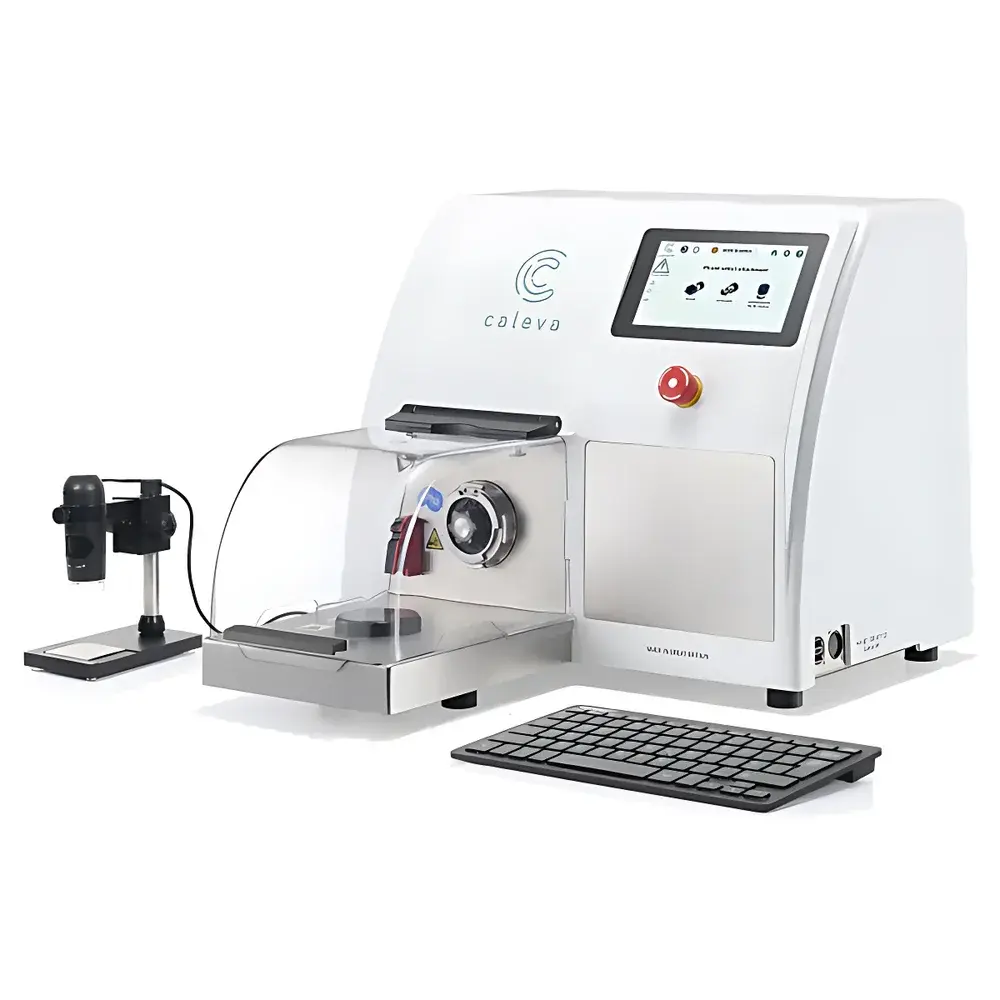
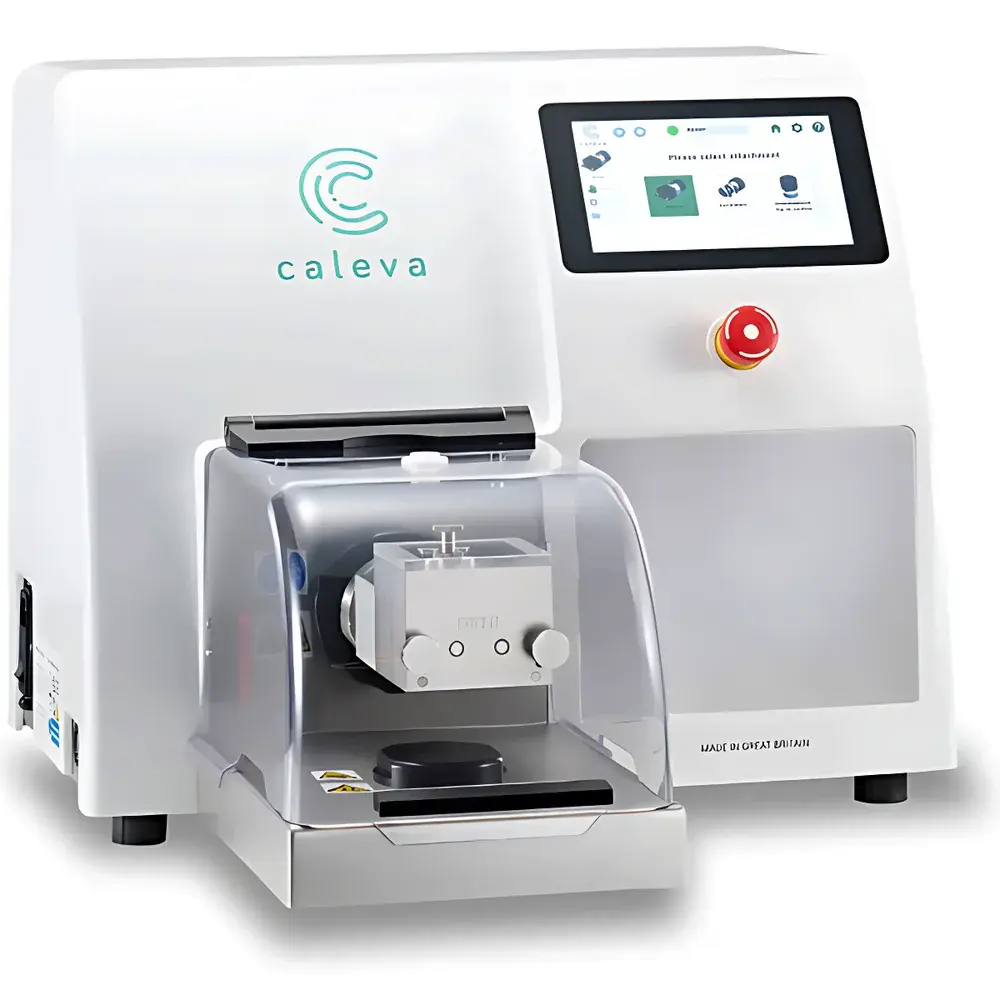
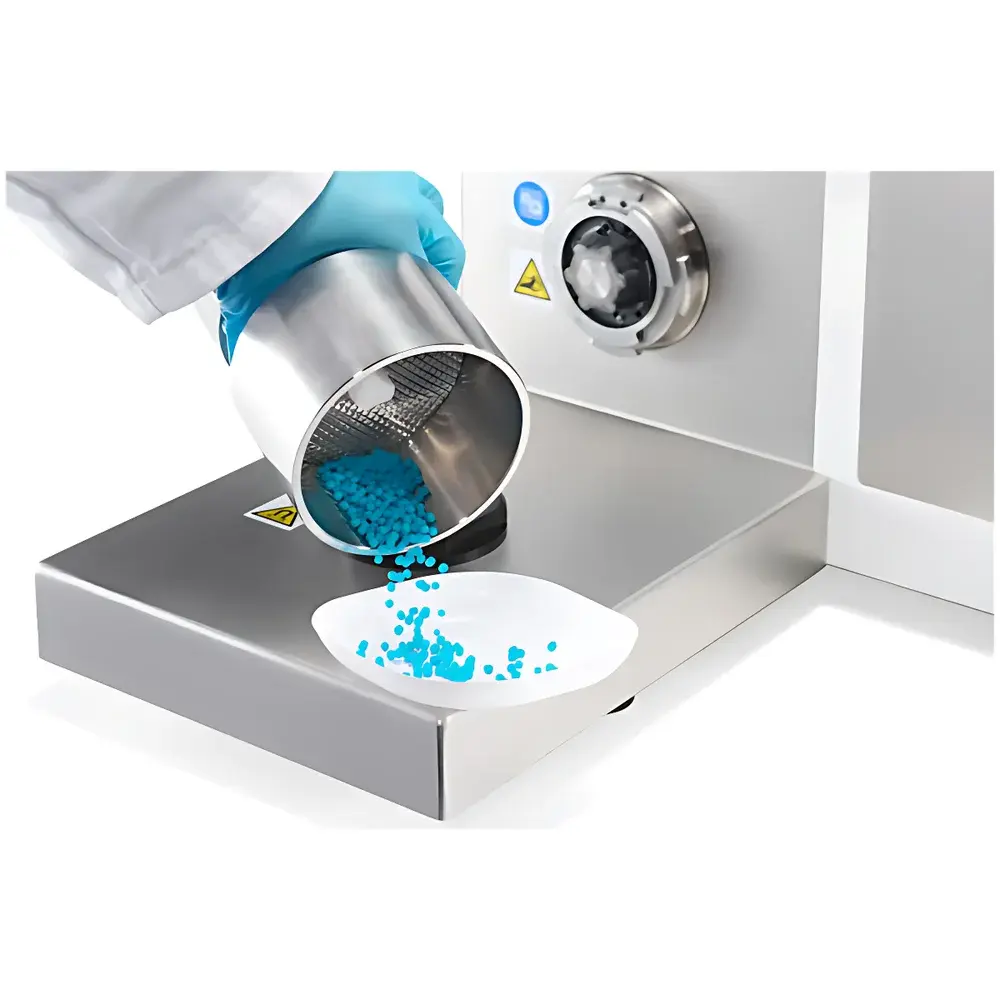
Caleva MLS Desktop Wet Granulation, Extrusion & Spheronization Integrated System
| Brand | Caleva |
|---|---|
| Origin | United Kingdom |
| Model | MLS |
| Voltage | 230 V or 110 V |
| Touchscreen | 7-inch capacitive LCD |
| Data Interface | 2 × USB 3.0, 2 × USB 2.0 |
| Machine Weight | 34 kg |
| Dimensions (W × D × H) | 505 × 600 × 420 mm |
| Mixing Capacity | 15–40 g (30–80 mL) |
| Extrusion Capacity | 10–80 g |
| Spheronization Capacity | 10–80 g |
| Main Impeller Speed | 10–250 rpm |
| Extruder Screw Speed | 90–150 rpm |
| Spheronizer Disc Speed | 500–4500 rpm |
| Die Orifice Standard | Ø1.0 mm × 1.0 mm square |
| Optional Dies | Ø0.5–3.0 mm round, multi-lobed profiles, variable thickness |
| Standard Spheronization Disc | 3 × 3 mm cross-hatched |
| Temperature Monitoring | Ambient & process zone |
| Motor Load Monitoring | 0–100% real-time reporting |
| Microscopy | Integrated USB digital microscope |
| Compliance Support | GLP-aligned data integrity, audit-trail-ready operation |
Overview
The Caleva MLS Desktop Wet Granulation, Extrusion & Spheronization Integrated System is an engineered platform for lab-scale formulation development in solid oral dosage form manufacturing. It combines three unit operations—high-shear wet granulation, screw-based extrusion, and centrifugal spheronization—within a single, compact, and fully instrumented benchtop unit. The system operates on the principle of controlled mechanical energy input to induce particle densification, plastic deformation, and spherical agglomeration, enabling precise mapping of critical process parameters (CPPs) such as impeller speed, screw torque, residence time, moisture content, and disc rotational dynamics. Designed for early-phase pharmaceutical R&D, nutraceutical development, and advanced polymer pelletization studies, the MLS delivers reproducible material transformation across batch sizes from 10 g upward—facilitating robust scale-up correlation to pilot and production equipment per ICH Q5A and Q8(R2) guidance.
Key Features
- Integrated Process Workflow: Seamless transition between granulation, extrusion, and spheronization without manual sample transfer—minimizing operator variability and contamination risk.
- Digital Recipe Management: Intuitive touchscreen interface with password-protected recipe creation, versioning, and execution logging; supports wireless keyboard input for rapid parameter entry.
- Real-Time Process Monitoring: Simultaneous acquisition of motor load (%), rotational speeds (rpm), ambient and localized temperature, and time-stamped event markers.
- Automated Data Capture & Export: Each experiment generates a timestamped .csv file containing full parameter history; files export via USB to external storage for statistical analysis (e.g., JMP, Minitab) or regulatory submission packages.
- GLP-Ready Operation: Experimental lockout upon run initiation prevents mid-process edits; all changes are logged with user ID and timestamp—supporting 21 CFR Part 11 compliance when paired with validated network storage and access controls.
- Ergonomic & Safe Design: Interlocked safety guard with quick-release mechanism ensures operation only when fully engaged; tool-free attachment system guarantees correct orientation of mixing bowls, extruder barrels, and spheronization discs.
Sample Compatibility & Compliance
The MLS accommodates a broad range of formulation matrices—including microcrystalline cellulose, lactose monohydrate, hydroxypropyl methylcellulose (HPMC), polyvinylpyrrolidone (PVP), thermoplastic elastomers, and biodegradable polyesters—across varying moisture sensitivities and rheological behaviors. Its modular design allows substitution of standard components (e.g., jacketed mixing bowl, variable-thickness dies, alternative disc geometries) to match material-specific shear sensitivity and sphericity requirements. The system conforms to ISO 14971:2019 (risk management for medical devices) and supports alignment with USP , ASTM D3417 (thermal transitions of polymers), and FDA Guidance for Industry on Scale-Up and Postapproval Changes (SUPAC). Routine calibration verification using traceable torque and rotational standards ensures continued metrological traceability.
Software & Data Management
The embedded control software provides real-time graphical overlays of speed vs. time, load vs. duration, and temperature drift—enabling immediate visual assessment of process stability. Historical datasets are indexed by experiment ID, date, operator, and formulation code. Exported files include metadata headers compliant with ALCOA+ principles (Attributable, Legible, Contemporaneous, Original, Accurate, Complete, Consistent, Enduring, Available). Integration with laboratory information management systems (LIMS) is achievable via USB-hosted flat-file ingestion protocols. Optional firmware updates deliver enhanced interpolation algorithms for granule size distribution estimation based on extrudate consistency metrics and spheronization energy input.
Applications
- Formulation screening for immediate- and extended-release multiparticulate systems
- Moisture-sensitive API granulation under inert atmosphere (with optional glovebox integration)
- Hot-melt extrusion feasibility studies for amorphous solid dispersions
- Development of sustained-release polymer pellets for veterinary and pediatric applications
- Process analytical technology (PAT) method development—correlating torque signatures with granule strength and porosity
- Teaching and training in GMP-compliant pharmaceutical engineering curricula
FAQ
Can the MLS be used for non-pharmaceutical applications, such as polymer pelletization?
Yes—the system’s mechanical design and material-contact surfaces (316 stainless steel, food-grade polymers) support R&D in rubber compounding, biopolymer processing, and catalyst support bead development.
Is remote monitoring or network connectivity supported?
The MLS does not feature built-in Ethernet or Wi-Fi; however, exported data files can be ingested into cloud-based analytics platforms via intermediate PC transfer.
What maintenance intervals are recommended for GLP compliance?
Daily visual inspection of seals and drive belts; monthly torque calibration verification; annual full mechanical audit using Caleva-certified service engineers.
Are validation documents (IQ/OQ/PQ protocols) available?
Caleva provides template qualification protocols aligned with ASTM E2500 and EU Annex 15; site-specific execution requires qualified personnel and documented evidence generation.
How is data integrity ensured during power interruption?
All active experiments write to non-volatile memory at 1-second intervals; unsaved data is retained upon restart and flagged for review prior to resumption.





