
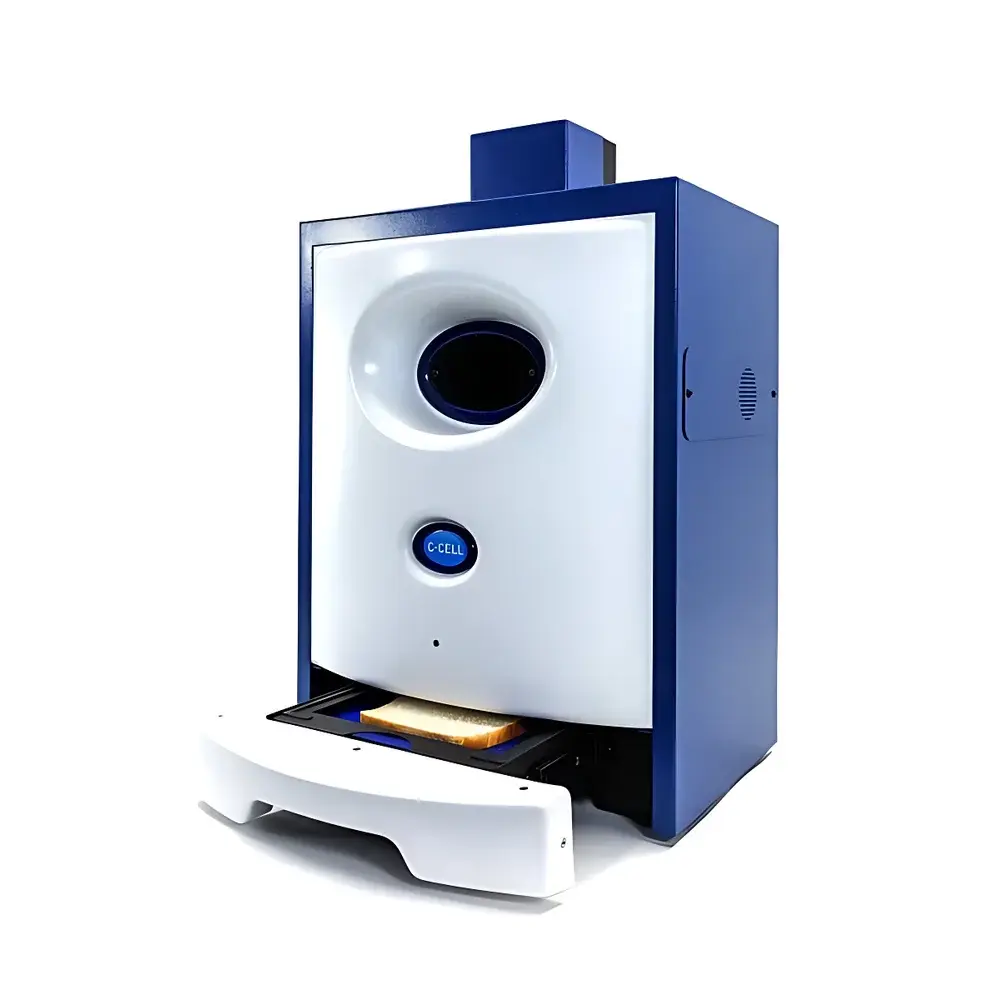
Calibre C-Cell HD Leaflet Pore Structure Imaging System
| Brand | Calibre |
|---|---|
| Origin | United Kingdom |
| Manufacturer Type | Authorized Distributor |
| Origin Category | Imported Instrument |
| Model | C-Cell HD Leaflet |
| Pricing | Available Upon Request |
Overview
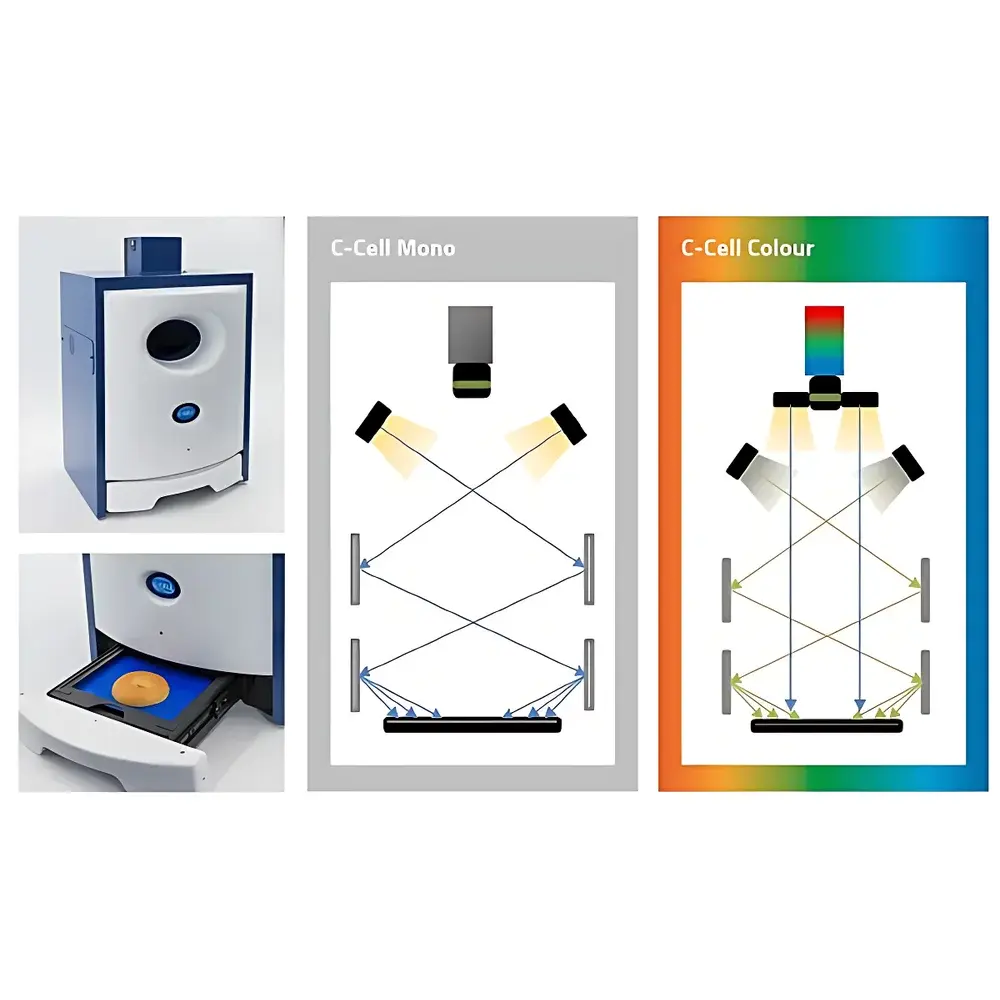
The Calibre C-Cell HD Leaflet Pore Structure Imaging System is a dedicated, non-destructive optical imaging platform engineered for quantitative structural analysis of leavened bakery products—including bread, buns, mantou, cakes, and other aerated food matrices. It operates on the principle of standardized digital image acquisition followed by algorithmic morphometric analysis of internal pore architecture. Unlike subjective sensory evaluation or manual grading, the C-Cell system delivers repeatable, traceable, and metrologically grounded measurements aligned with internationally recognized methodology AACC 10-18.01 (“Standard Method for Determining Crumb Grain Characteristics of Bread Using Image Analysis”). The system captures high-fidelity lateral illumination images (grayscale) and optional top-illuminated color images to decouple structural parameters from surface chromatic attributes—enabling independent assessment of crumb porosity, cell distribution, and crust/slice color uniformity.
Key Features
- High-resolution imaging module featuring a 75 mm f/1.4 C-mount lens (C-Cell HD upgrade over legacy 200.05), optimized for sharp edge definition and minimal optical distortion across standard bakery slice dimensions (typically 30–50 mm thickness).
- Dual-illumination capability: side-lit grayscale imaging for pore geometry extraction; top-lit RGB imaging for colorimetric analysis (L*a*b*, ΔE, hue, saturation, lightness).
- Proprietary image-processing algorithms developed in collaboration with Campden BRI and Chorleywood Food Research Association—validated against AACC 10-18.01 and widely adopted in industrial R&D and QC laboratories.
- Generation of 48 quantitative descriptors per sample, including pore count, mean pore area (µm²), pore circularity, elongation ratio, orientation angle distribution, brightness histogram metrics, texture roughness (via gray-level co-occurrence matrix), and spatial homogeneity indices.
- Intuitive touchscreen interface with guided workflow—sample placement, auto-focus, illumination calibration, and one-click analysis—requiring no prior image analysis expertise.
- Modular software architecture supporting custom scoring models: users may weight individual parameters (e.g., pore uniformity vs. average size) to reflect product-specific quality criteria or process KPIs.
Sample Compatibility & Compliance
The C-Cell HD accommodates standard bakery slices (10–60 mm width × 10–60 mm height × 20–50 mm depth), with automated ROI selection for consistent cross-sectional analysis. It supports both pre-sliced commercial samples and lab-scale test loaves. All measurement protocols comply with AACC International Standard 10-18.01 and are compatible with GLP-compliant documentation workflows. Audit trails, user access controls, and raw image archiving meet foundational requirements for FDA 21 CFR Part 11 readiness when integrated with validated LIMS or electronic lab notebook systems. While not a regulated medical device, its analytical outputs support ISO 22000 food safety management systems by enabling objective verification of process consistency related to dough mixing, proofing, and baking parameters.
Software & Data Management
The embedded C-Cell software (v5.x or later) runs on Windows-based industrial PCs and provides real-time visualization of processed images alongside tabular and graphical export (CSV, PNG, PDF). Each analysis session logs metadata—including timestamp, operator ID, instrument configuration, and environmental notes—ensuring full traceability. Batch reporting tools enable statistical comparison across production lots, ingredient variants, or fermentation conditions. Optional API integration allows bidirectional data exchange with enterprise MES or SAP QM modules. Custom software development services are available through Calibre to embed proprietary algorithms, integrate with PLC-controlled slicing stations, or align output units with internal QA scorecards.
Applications
- Optimization of dough formulation (yeast activity, enzyme dosage, gluten strength) via correlation of pore morphology with rheological and fermentation profiles.
- Validation of baking process parameters: oven temperature ramp, steam injection timing, and cooling rate effects on final crumb structure.
- Supplier qualification: objective benchmarking of flour performance across milling batches or wheat varieties.
- Shelf-life studies: tracking microstructural degradation (pore coalescence, moisture migration) during storage under controlled RH/temperature conditions.
- Regulatory and customer audit preparation: generating reproducible evidence of structural consistency compliant with retailer technical specifications (e.g., Tesco Bakery Standards, Walmart Quality Assurance Protocol).
- Academic research in cereal science, food physics, and soft matter characterization—particularly where pore network topology influences texture perception or staling kinetics.
FAQ
Does the C-Cell HD require sample preparation beyond standard slicing?
No—samples are analyzed as-cut without staining, freezing, or vacuum impregnation. Consistent slice thickness (±1 mm) is recommended for inter-sample comparability.
Can the system differentiate between open and closed pores?
Yes—the algorithm identifies pore connectivity via watershed segmentation and calculates open-cell fraction based on adjacency mapping within the binary crumb mask.
Is color calibration traceable to NIST standards?
The top-illumination module includes built-in white reference tiles and supports user-defined calibration using certified color charts (e.g., X-Rite ColorChecker Passport), ensuring repeatability across instruments and sites.
What file formats are supported for data export?
Raw TIFF images, processed PNG overlays, structured CSV reports (48-parameter matrix), and annotated PDF summaries—all timestamped and operator-tagged.
Is remote diagnostics or software update support available?
Yes—Calibre offers secure remote maintenance via encrypted VNC sessions and quarterly software release notifications with version-controlled changelogs and validation documentation.





