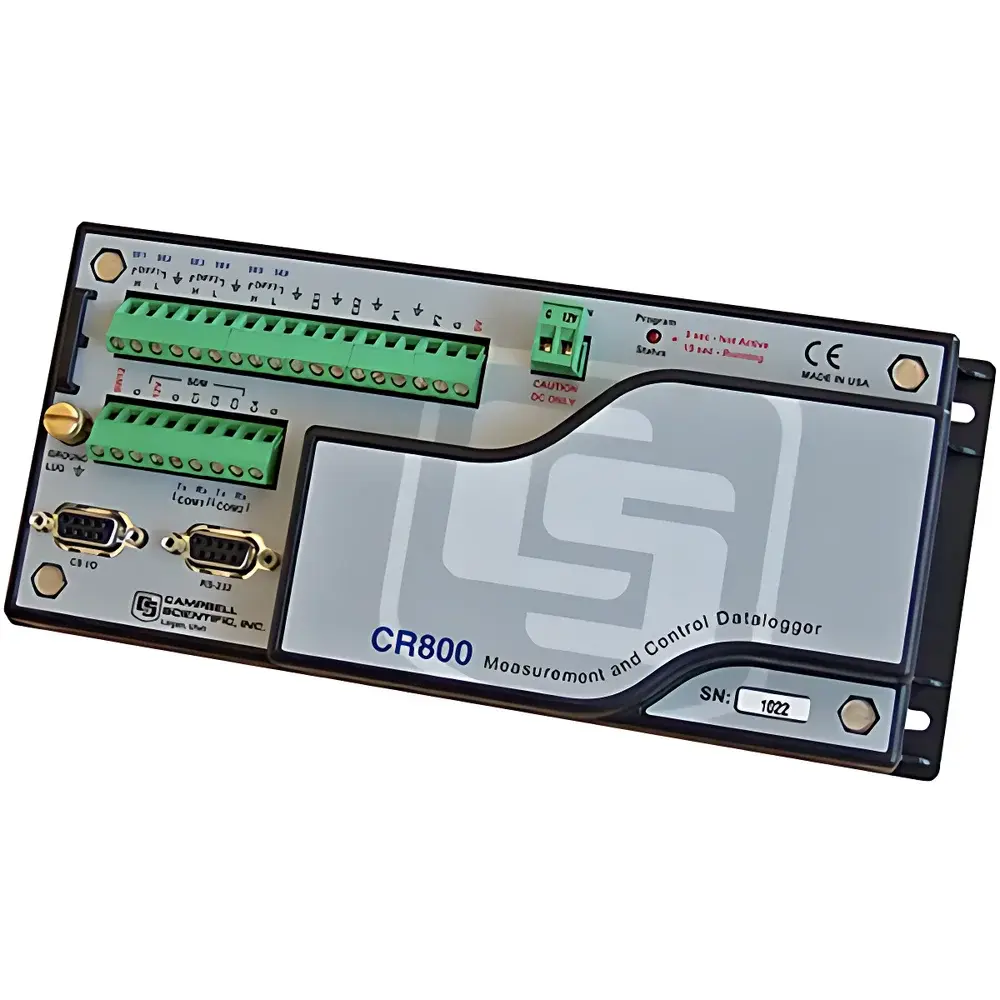
Campbell Scientific CR800 Data Acquisition Unit
| Brand | Campbell Scientific |
|---|---|
| Model | CR800 |
| Origin | USA |
| Differential Input Channels | 3 (6 single-ended) |
| Analog Input Resolution | 13-bit A/D |
| Scan Rate | Up to 100 Hz |
| Operating Temperature Range | 0 to 40 °C |
| Voltage Measurement Resolution | 0.33 µV |
| Sleep Mode Current Draw | ~0.6 mA |
| Active Current Draw (w/o RS-232) | 1–16 mA |
| Active Current Draw (w/ RS-232) | 17–28 mA |
| Communication Interfaces | 1 × CS I/O port, 1 × RS-232 serial port |
| Supported Protocols | PakBus®, Modbus RTU/ASCII, SDI-12, SDM, DNP3, FTP, HTTP, XML, POP3, SMTP, Telnet, NTCIP, NTP |
| Onboard Memory | 4 MB (data + program storage) |
| Data Format | Tabular ASCII |
| Operating System | PakBus OS |
| Compatible Software | LoggerNet, PC400, Short Cut |
| Optional Peripheral | CR1000KD handheld display |
Overview
The Campbell Scientific CR800 Data Acquisition Unit is a compact, low-power, field-deployable data logger engineered for precision environmental and industrial monitoring applications where cost-efficiency and reliability are critical. Built upon Campbell Scientific’s proprietary PakBus® operating system, the CR800 employs a 13-bit analog-to-digital converter and supports high-fidelity differential voltage measurements—enabling robust signal acquisition from sensors susceptible to electromagnetic interference or ground-loop noise. Its core architecture centers on deterministic scan-based measurement scheduling, ensuring temporal accuracy and repeatability across distributed sensor networks. Designed for unattended operation in remote locations—including weather stations, soil moisture networks, hydrological gauging sites, and infrastructure health monitoring systems—the CR800 delivers synchronized, time-stamped data with microsecond-level internal clock stability, traceable to NTP-synchronized time sources when connected to IP-enabled communication paths.
Key Features
- Differential input capability via three dedicated differential channels (equivalent to six single-ended inputs), optimized for thermocouples, strain gauges, load cells, and other low-level analog sensors requiring common-mode noise rejection
- 4 MB of non-volatile memory for both program storage and tabular ASCII-formatted data logging—supporting months of high-frequency sampling without external media
- Ultra-low power consumption: nominal sleep current of 0.6 mA enables multi-year battery operation with appropriate energy budgets and solar charging integration
- Native support for PakBus® peer-to-peer networking, allowing daisy-chained or meshed topologies with automatic routing, data aggregation, and remote reprogramming over radio, cellular (CDMA/GPRS), satellite, or direct RS-232/USB connections
- Full protocol stack including Modbus RTU/ASCII (master/slave), SDI-12 (for digital smart sensors), SDM (Synchronous Device for Measurement), DNP3 (for SCADA integration), and standard internet protocols (FTP, HTTP, SMTP, POP3, Telnet)
- Programmable control ports (4 total) and pulse counting channels (2) for actuator triggering, event-driven sampling, and digital status monitoring
Sample Compatibility & Compliance
The CR800 interfaces seamlessly with a broad spectrum of analog, digital, and smart sensors compliant with industry-standard physical and communication specifications. It natively acquires signals from sensors meeting ASTM D5092 (soil water content), ISO 11464 (soil thermal properties), and USGS NWIS protocols for hydrologic telemetry. Its analog input stage meets IEC 61000-4-5 surge immunity requirements when used with recommended external protection circuits. While the CR800 itself does not carry CE or FCC certification as a standalone end-device, it is routinely deployed in systems validated under FDA 21 CFR Part 11 (when paired with audit-trail-enabled LoggerNet configurations) and conforms to GLP/GMP data integrity expectations through its deterministic timestamping, immutable data file structure, and programmable metadata tagging. All firmware updates and configuration changes are logged internally with user ID, timestamp, and checksum verification.
Software & Data Management
Data collection, visualization, and system management are fully supported through Campbell Scientific’s LoggerNet software suite—compatible with Windows OS and validated for use in regulated environments. LoggerNet provides secure, role-based access control, encrypted data transfer (via TLS/SSL when using HTTP/FTP), and full audit trail functionality per 21 CFR Part 11 Annex 11 requirements. The CR800 stores data in fixed-width tabular ASCII format, facilitating direct ingestion into MATLAB, Python (pandas), R, SQL databases, or enterprise SCADA historian platforms without proprietary parsing layers. Remote firmware updates, program uploads, and real-time diagnostics are executed via PakBus or Modbus TCP tunnels. Integration with third-party platforms—including Ignition SCADA, AWS IoT Core, and Microsoft Power BI—is enabled through RESTful API gateways or MQTT bridges using the CR800’s embedded HTTP server and XML data export capabilities.
Applications
- Environmental monitoring networks: air temperature/humidity, precipitation, solar radiation, soil moisture and temperature profiles, groundwater level and conductivity
- Agricultural research: irrigation scheduling, evapotranspiration modeling, canopy temperature mapping, nutrient leaching studies
- Civil infrastructure: bridge deflection, tunnel convergence, dam seepage pressure, structural vibration analysis
- Industrial process support: HVAC performance validation, wastewater treatment tank level and pH monitoring, renewable energy site assessment (wind speed/direction, irradiance, inverter output)
- Educational and prototyping deployments: low-cost, teachable DAQ platform for undergraduate instrumentation labs and capstone projects requiring field-hardened reliability
FAQ
Can the CR800 operate independently without a PC or display?
Yes—the CR800 runs autonomously once programmed; no continuous host connection is required for data acquisition or storage. Optional peripherals like the CR1000KD handheld display enable local readout and manual command entry but are not necessary for core functionality.
Does the CR800 support SD card expansion?
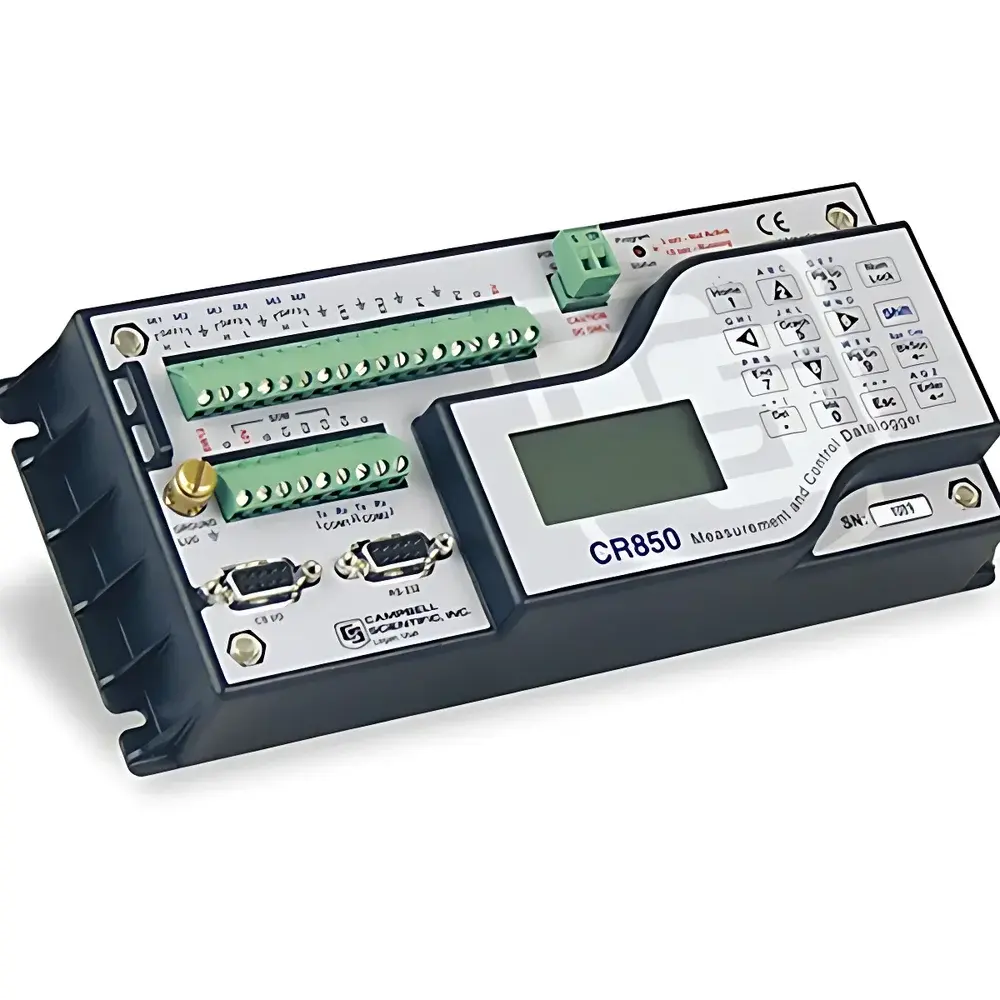
No—the CR800 has fixed 4 MB internal memory and does not feature an SD card slot. For higher capacity, users select the CR850 (same measurement engine, integrated LCD) or upgrade to CR1000X/CR6 series loggers with microSD support.
Is Modbus TCP supported, or only Modbus RTU/ASCII over RS-232?
The CR800 implements Modbus RTU and ASCII exclusively over its RS-232 port. Modbus TCP requires Ethernet connectivity and is available only on newer models such as the CR6 or CR300 series.
How is time synchronization maintained in remote deployments?
The CR800 uses an internal temperature-compensated crystal oscillator (TCXO) with ±2 ppm accuracy. When connected to an IP network, it synchronizes automatically via NTP; when using radio or cellular modems, time can be updated manually or via PakBus time broadcast from a master node.
What is the maximum recommended cable length for differential analog sensors?
For optimal noise immunity, twisted-pair shielded cables up to 100 m are recommended. Longer runs require proper grounding practices, signal conditioning, or use of SDI-12 or SDM digital sensors to preserve measurement integrity.