
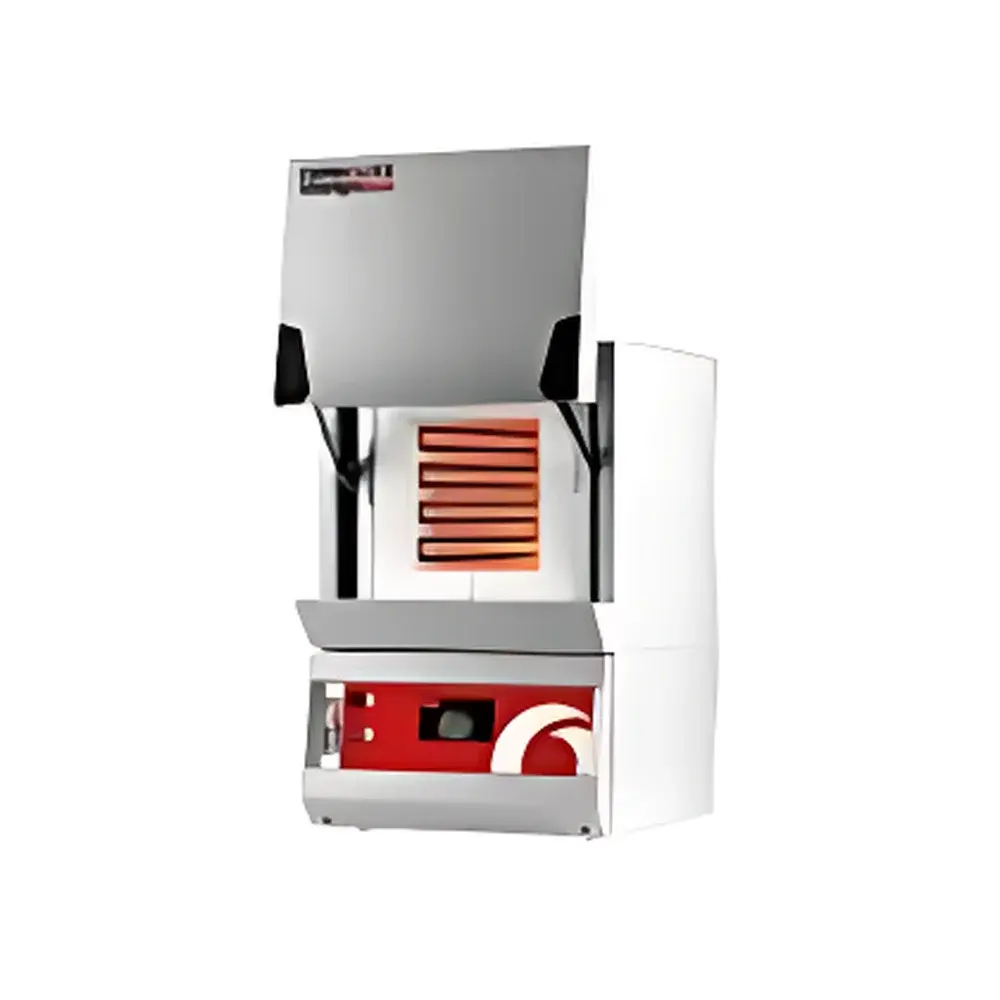
Carbolite Gero CWF Series Benchtop Box Furnace
| Brand | Carbolite Gero |
|---|---|
| Origin | Germany |
| Model | CWF |
| Type | Benchtop Muffle Furnace |
| Max Operating Temperature | 1100 °C / 1200 °C / 1300 °C (configurable) |
| Chamber Volume | 5 L / 13 L / 23 L / 36 L / 65 L |
| Standard Controller | PID301 (single-segment programming) or PID3216CC (single-segment with CC interface) |
| Door Operation | Vertically upward-opening, damped mechanism |
| Insulation | High-purity alumina fiber (low thermal mass, low energy consumption) |
| Heating Element | Kanthal® A1 wire, mounted for rapid replacement |
| Temperature Uniformity | ±3 °C at max temperature (per ISO 9001-qualified calibration protocol) |
| Optional Configurations | CWF-B (enhanced natural convection via elevated chimney & bottom air inlet), CWF-BAL (integrated analytical balance: 3 kg capacity, 0.01 g readability, RS232/USB output, PC-compatible software) |
Overview
The Carbolite Gero CWF Series is a precision-engineered benchtop box furnace designed for controlled high-temperature thermal processing in research laboratories, quality control environments, and industrial R&D settings. Based on Carbolite Gero’s decades of German engineering heritage, the CWF employs a robust muffle architecture with electric resistance heating and high-efficiency insulation to deliver stable, repeatable thermal profiles across its operational range—up to 1300 °C. Its measurement principle relies on calibrated thermocouple feedback (Type S or K, depending on configuration) coupled with digital PID regulation to maintain setpoint accuracy and minimize thermal overshoot. The furnace complies with IEC 61000-6-3 (EMC) and IEC 61000-6-2 (immunity) standards, and its structural design adheres to EN 60519-1 for electrical safety in industrial heating equipment. Unlike open-hearth or tube-style furnaces, the CWF’s fully enclosed muffle chamber ensures uniform radiant heat distribution, minimal atmospheric interference, and reliable performance during ashing, calcination, sintering, heat treatment, and gravimetric analysis procedures.
Key Features
- Vertically opening, damped top door — engineered to pivot away from the operator during access, reducing exposure to radiant heat and improving ergonomic safety.
- High-purity alumina fiber insulation lining the chamber walls, door, floor, and rear wall — delivering low thermal conductivity, rapid heat-up/cool-down cycles, and reduced standby power consumption.
- Kanthal® A1 heating elements mounted externally on ceramic supports — enabling tool-free element replacement without disassembling the furnace shell or compromising insulation integrity.
- Standard PID301 or PID3216CC digital controllers — offering single-segment ramp-soak programming, real-time temperature display, and configurable alarm thresholds (over-temperature, sensor break, door-open).
- CWF-B variant includes optimized natural convection pathways: an extended chimney height and dedicated bottom air intake ports promote consistent oxidizing atmosphere circulation, enhancing combustion efficiency during organic matrix removal.
- CWF-BAL model integrates a Class I analytical balance (3 kg × 0.01 g) with independent power and signal isolation — eliminating electromagnetic interference from heating circuits and ensuring metrological traceability per ISO/IEC 17025 requirements.
Sample Compatibility & Compliance
The CWF accommodates standard crucibles (alumina, platinum, silicon carbide), ceramic boats, and quartz sample holders up to the internal chamber dimensions (e.g., 180 × 180 × 180 mm for the 23 L model). Its inert muffle environment supports ASTM E1529 (fire-test-response), ISO 1171 (ash content determination), and USP (residue on ignition) protocols. All models are CE-marked and conform to the EU Machinery Directive 2006/42/EC. Optional factory calibration certificates (traceable to NPL or PTB) and IQ/OQ documentation packages are available for GLP/GMP-regulated laboratories requiring audit-ready validation records.
Software & Data Management
The CWF-BAL configuration includes proprietary balance acquisition software compatible with Windows OS (v10/11), supporting real-time weight logging synchronized with furnace temperature and time stamps. Data export is available in CSV and Excel formats; metadata fields include operator ID, batch number, and calibration certificate reference. For regulatory compliance, optional firmware upgrades enable 21 CFR Part 11–compliant electronic signatures, audit trails, and user-access-level controls. The PID3216CC controller also supports Modbus RTU communication for integration into SCADA or LIMS platforms.
Applications
- Gravimetric analysis: residue on ignition (USP ), loss on drying (LOD), and ash content (AOAC 942.05, ISO 2171).
- Thermal pre-treatment of catalysts, battery cathode materials, and ceramic precursors prior to XRD or SEM analysis.
- Calibration of thermocouples and RTDs under controlled soak conditions per ASTM E230/E230M.
- Heat treatment of metallurgical samples (annealing, stress relieving) where atmospheric control is not required but temperature uniformity is critical.
- Preparation of certified reference materials (CRMs) involving high-temperature homogenization and stabilization steps.
FAQ
What temperature uniformity can be expected inside the CWF chamber at 1200 °C?
At 1200 °C, typical radial and axial uniformity across the working zone is ±3 °C, verified using a 9-point thermocouple mapping procedure per ISO/IEC 17025-accredited methodology.
Is the CWF-BAL balance certified for legal metrology use?
The integrated balance meets OIML R76 Class I specifications and may be supplied with a manufacturer’s calibration certificate; field verification and periodic recalibration must follow national metrology institute guidelines.
Can the CWF be operated under inert or reducing atmospheres?
Standard CWF models are rated for air atmosphere only; for controlled gas environments, Carbolite Gero offers the HTF or GLO series with gas-tight seals and purge fittings.
How often does the insulation require replacement?
Under normal usage (≤8 h/day at ≤1200 °C), the alumina fiber insulation maintains structural integrity and thermal performance for ≥5 years; visual inspection and thermal loss testing are recommended annually.
Does the PID3216CC controller support multi-segment programming?
No — the PID3216CC is configured for single-segment ramp-soak operation; multi-segment capability requires upgrading to the Carbolite Gero TMS or TouchControl system.



