
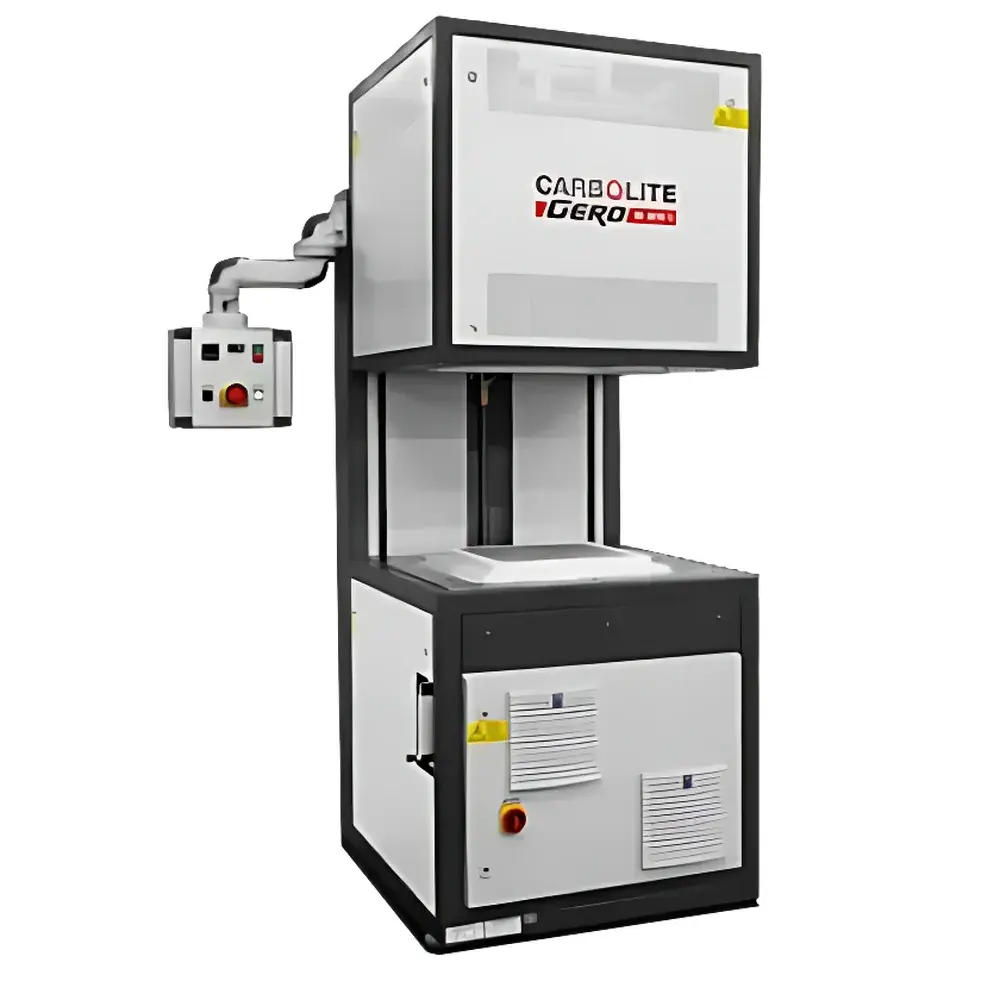
Carbolite Gero HB Series Bell Jar Furnace
| Brand | Carbolite Gero |
|---|---|
| Origin | Germany |
| Model | HB |
| Type | Bell Jar Furnace (Vertical Lift Configuration) |
| Maximum Operating Temperature | 1300 °C (FeCrAl heating elements) |
| Chamber Volume | 80–514 L |
| Controller | EPC3016P1 Programmable Temperature Controller |
| Heating Element Material | FeCrAl (up to 1300 °C) or MoSi₂ (for higher-temperature variants) |
| Insulation | Low-thermal-mass ceramic fiber insulation |
| Safety Features | Over-temperature protection, independent safety thermostat |
| Communication Interface | Ethernet (for remote monitoring and integration) |
| Compliance | Designed and manufactured in accordance with EN 61000-6-2 (EMC), EN 61000-6-4, and CE directives |
Overview
The Carbolite Gero HB Series Bell Jar Furnace is an industrial-grade, vertically configured high-temperature thermal processing system engineered for precision heat treatment, sintering, annealing, and controlled-atmosphere applications in R&D laboratories and pilot-scale production environments. Unlike conventional box-type muffle furnaces, the HB design features a fixed base and a vertically movable bell-shaped furnace chamber—enabling rapid thermal cycling, minimized heat loss during sample loading/unloading, and enhanced operator safety through reduced exposure to radiant heat. The furnace operates on the principle of resistive heating via metallic (FeCrAl) or refractory (MoSi₂) elements embedded within low-thermal-mass ceramic fiber insulation, ensuring fast ramp rates, excellent temperature uniformity (±3 °C at 1300 °C per ASTM E220), and energy-efficient operation. Its modular architecture supports optional inert gas purging, vacuum compatibility (with auxiliary pumping systems), and integration into automated material processing lines.
Key Features
- Vertical bell jar configuration with motorized or manual lift mechanism—reducing thermal mass exposure and enabling rapid access to hot zones without full chamber cooling.
- FeCrAl heating elements rated for continuous operation up to 1300 °C; optional MoSi₂ elements available for extended temperature capability (1600–1800 °C models).
- High-efficiency low-heat-capacity insulation using next-generation alumina-silica ceramic fiber modules—minimizing standby power consumption and improving thermal response time.
- EPC3016P1 programmable controller with 16-segment ramp-soak profiles, real-time data logging, and PID auto-tuning—compliant with ISO/IEC 17025 calibration traceability requirements.
- Dual-stage over-temperature protection: primary controller-based limit + independent mechanical safety thermostat meeting IEC 60519-2 functional safety standards.
- Ethernet (TCP/IP) interface supporting Modbus TCP and OPC UA protocols—enabling seamless integration with LIMS, MES, and SCADA platforms under FDA 21 CFR Part 11-compliant audit trail configurations.
Sample Compatibility & Compliance
The HB furnace accommodates a wide range of sample geometries—including crucibles (graphite, alumina, silicon carbide), boat assemblies, powder compacts, and ceramic green bodies—within its cylindrical working zone. Its open-bottom design allows direct placement onto refractory hearths or custom fixtures mounted on the stationary base plate. All standard HB models conform to European Machinery Directive 2006/42/EC, Electromagnetic Compatibility Directive 2014/30/EU, and Low Voltage Directive 2014/35/EU. Optional configurations meet GLP/GMP documentation requirements, including electronic signature support, user access levels, and event-driven alarm logging aligned with Annex 11 principles.
Software & Data Management
Carbolite Gero’s proprietary C-GeroControl software (Windows-based) provides full remote supervision via Ethernet, including real-time temperature curve visualization, profile editing, alarm history export (CSV/PDF), and automated report generation compliant with ISO 17025 clause 7.8. Data integrity is ensured through encrypted local storage, timestamped audit trails, and configurable retention policies. When deployed in regulated environments, the system supports 21 CFR Part 11 compliance through role-based authentication, electronic signatures, and immutable record archiving—validated per IQ/OQ protocols upon installation.
Applications
- Sintering of advanced ceramics (e.g., ZrO₂, Si₃N₄, AlN) under air or nitrogen atmospheres.
- Heat treatment of metal alloys (e.g., Ni-based superalloys, titanium grades) requiring precise soak control and minimal oxidation.
- Thermal gravimetric analysis (TGA) pre-conditioning and ashing procedures per ASTM D3174 and ISO 1171.
- Research-scale synthesis of battery cathode materials (e.g., NMC, LFP) with repeatable calcination cycles.
- Calibration of thermocouples and reference materials in national metrology labs (traceable to PTB standards).
FAQ
What distinguishes the HB bell jar furnace from the HB-BL bottom-loading variant?
The HB model features a vertically lifting bell-shaped hot zone, while the HB-BL uses a fixed bell and elevating base—optimized for heavier loads and frequent handling of large substrates.
Can the HB furnace be operated under vacuum or controlled gas atmospheres?
Yes—when equipped with optional flanged ports, gas inlet/outlet valves, and compatible seals, it supports inert gas purging (N₂, Ar) and low-vacuum operation (10⁻² mbar) with external pump integration.
Is the EPC3016P1 controller validated for GxP environments?
The controller itself is not pre-validated, but its firmware and communication stack are designed to support IQ/OQ execution and 21 CFR Part 11 compliance when implemented with appropriate procedural controls and documentation.
What maintenance intervals are recommended for FeCrAl heating elements at 1300 °C?
Under continuous operation at maximum rated temperature, annual inspection and resistance measurement are advised; typical service life exceeds 3,000 hours with proper thermal cycling practices.
Does Carbolite Gero provide factory calibration certificates with traceability to national standards?
Yes—each furnace ships with a UKAS-accredited calibration certificate (optional upgrade) covering sensor verification across three points (room temperature, 800 °C, and 1300 °C) per ISO/IEC 17025.



