
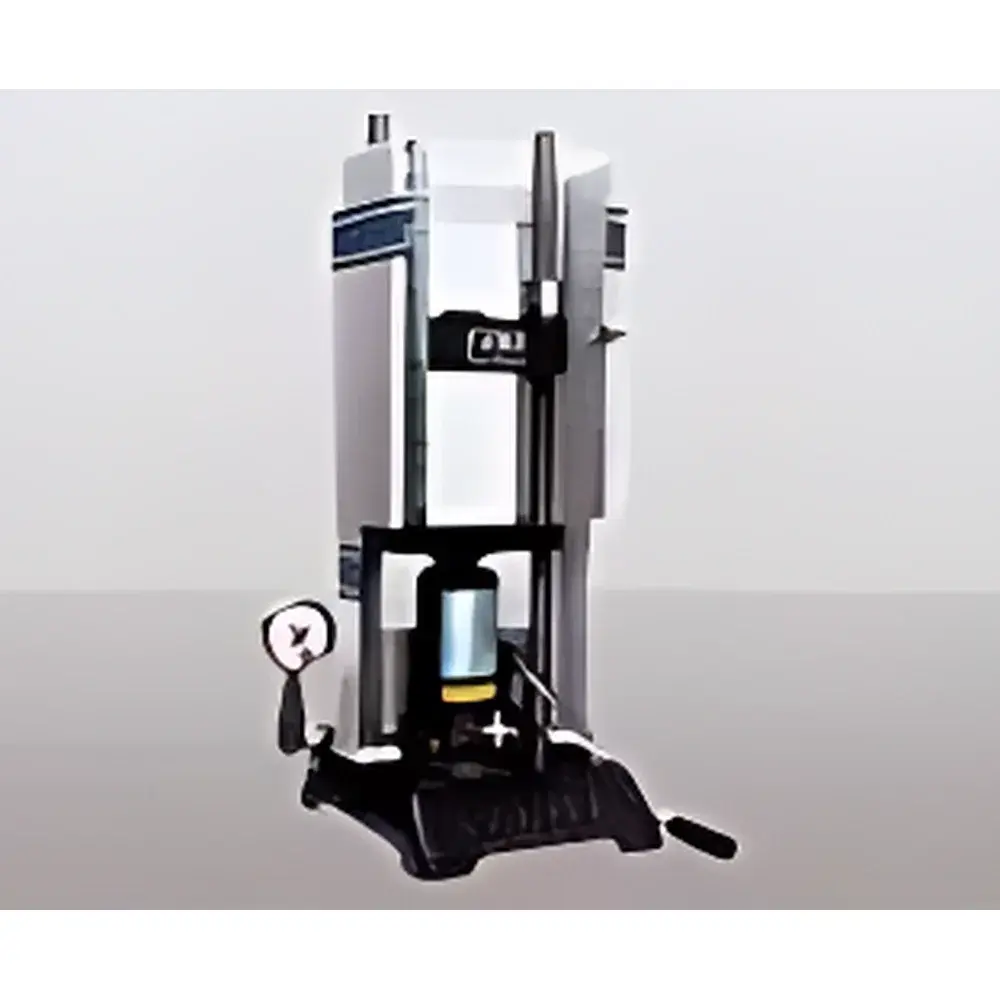
Carver 3851435038533855 Manual Hydraulic Pellet Press
| Brand | Carver |
|---|---|
| Origin | USA |
| Type | Manual Hydraulic Pellet Press |
| Pressure Capacity | 12–30 tons (24,000–60,000 lbf) |
| Frame Configuration | Dual-Post or Four-Post |
| Platen Dimensions | 4" round to 12"×12" |
| Platen Travel | 5.1–6.5 in |
| Adjustable Platen Gap | 0.75–18 in |
| Construction | Cast iron and hardened steel |
| Mold compatibility | 13 mm, 31 mm, and 40 mm diameter dies |
Overview
The Carver 3851435038533855 series comprises a family of precision-engineered manual hydraulic pellet presses designed for reproducible, high-integrity sample compaction in analytical laboratories. These instruments operate on the principle of static hydraulic force transmission—utilizing hand-pumped, oil-filled cylinders to generate controlled, stable compressive loads across parallel platens. Unlike pneumatic or motor-driven systems, manual hydraulic architecture eliminates variability from power supply fluctuations or servo drift, ensuring consistent force application critical for quantitative spectroscopic and diffraction analysis. Each model is rated for nominal pressure capacities of 12, 25, or 30 tons (24,000–60,000 lbf), with dual-post configurations optimized for compact footprint and four-post variants delivering enhanced rigidity for large-area or high-tolerance die sets. The structural integrity—achieved through cast iron bases, hardened steel columns, and precision-ground platens—enables long-term dimensional stability under repeated loading cycles, meeting the mechanical durability requirements outlined in ASTM E1254 for reference material preparation.
Key Features
- Modular frame architecture: Selectable dual-post (e.g., Model 3851, 3853) or four-post (e.g., Models 3969, 3855, 3970) configurations to balance workspace constraints against load distribution uniformity.
- Dual-scale analog pressure gauges: Calibrated in both imperial (psi) and metric (MPa) units, traceable to NIST standards, enabling direct cross-referencing during method transfer between international labs.
- Adjustable platen gap mechanism: Fine-threaded vertical adjustment allows precise control over initial sample height and final pellet thickness—critical for achieving target density in IR KBr pellets or XRF fused beads.
- Integrated safety guard: Transparent polycarbonate shield meets ANSI Z87.1 impact resistance specifications and prevents operator exposure during pressurization.
- Standardized platen interfaces: All models accept industry-standard die holders (e.g., Specac, Pike Technologies) for 13 mm, 31 mm, and 40 mm diameter molds, supporting ISO 1833-1 and ASTM E1318 compliance workflows.
- AutoPak-ready interface: Optional mounting brackets and hydraulic line ports enable seamless integration with Carver’s AutoPak automated pressure control system for GLP-compliant audit trails and repeatable multi-step pressing protocols.
Sample Compatibility & Compliance
These presses are routinely employed in the preparation of homogeneous, binder-free pellets for Fourier-transform infrared (FTIR) spectroscopy, wavelength-dispersive X-ray fluorescence (WDXRF), energy-dispersive X-ray fluorescence (EDXRF), and X-ray diffraction (XRD) analysis. Sample matrices include pharmaceutical APIs, geological powders, polymer additives, catalysts, and environmental particulates. The absence of electrical actuators and reliance on purely mechanical force delivery ensures electromagnetic compatibility (EMC) in shielded analytical suites. All models comply with CE machinery directive 2006/42/EC for safe operation in EU laboratories and support adherence to USP Analytical Instrument Qualification when deployed within validated analytical procedures. Pressure calibration certificates are available upon request per ISO/IEC 17025:2017 requirements.
Software & Data Management
While the base manual models operate without embedded firmware, the AutoPak integration pathway enables full digital data capture—including time-stamped pressure profiles, dwell duration, and cycle count—via RS-232 or USB-to-serial interface. When paired with Carver’s AutoPak Control Software (v4.2+), users can define multi-stage pressing sequences (e.g., pre-compaction at 2 tons → hold → ramp to 12 tons → dwell for 60 s), export CSV-formatted logs, and generate 21 CFR Part 11–compliant electronic records with user authentication and audit trail functionality. Raw pressure gauge readings remain fully accessible for manual verification—a requirement explicitly supported in FDA guidance for hybrid (manual + digital) instrument qualification.
Applications
- FTIR sample preparation: Compaction of KBr or polyethylene dispersions into optically transparent pellets with ≤ ±2% thickness variation across batch runs.
- XRF calibration standard production: High-density pressing of certified reference materials (CRMs) to minimize particle segregation and ensure matrix homogeneity.
- Pharmaceutical tabletting R&D: Low-volume formulation screening using sub-gram powder charges under controlled dwell conditions.
- Geological sample homogenization: Preparation of pressed borate fusion beads for major-oxide quantification via WDXRF.
- Glovebox-compatible operation: Compact Mini-C (Model 3850) and C-type (Model 3851) units fit standard 12″–18″ glovebox ports and operate without external power sources.
FAQ
What is the maximum recommended operating pressure for Model 3851?
The 3851 is rated for continuous operation at 12 tons (24,000 lbf); exceeding this value may compromise gauge accuracy and structural fatigue life.
Can I use non-Carver die sets with these presses?
Yes—standard 13 mm, 31 mm, and 40 mm threaded die assemblies from Specac, Pike, and Harrick are mechanically compatible; verify thread pitch (typically 1.5 mm) and flange diameter before installation.
Is hydraulic oil maintenance required?
Carver recommends annual inspection and replacement of ISO VG 32 mineral hydraulic oil to prevent viscosity drift and seal degradation—particularly in environments with >60% RH or ambient temperatures exceeding 35°C.
Do these presses meet GLP documentation requirements?
When used with AutoPak and validated software, full electronic audit trails—including operator ID, timestamp, pressure setpoints, and deviation alerts—are generated per GLP Annex 11 and FDA 21 CFR Part 11.
What is the typical turnaround time for factory recalibration?
Standard recalibration service (including NIST-traceable pressure transducer verification and platen parallelism assessment) requires 5 business days from receipt at Carver’s Wabash, IN facility.



