
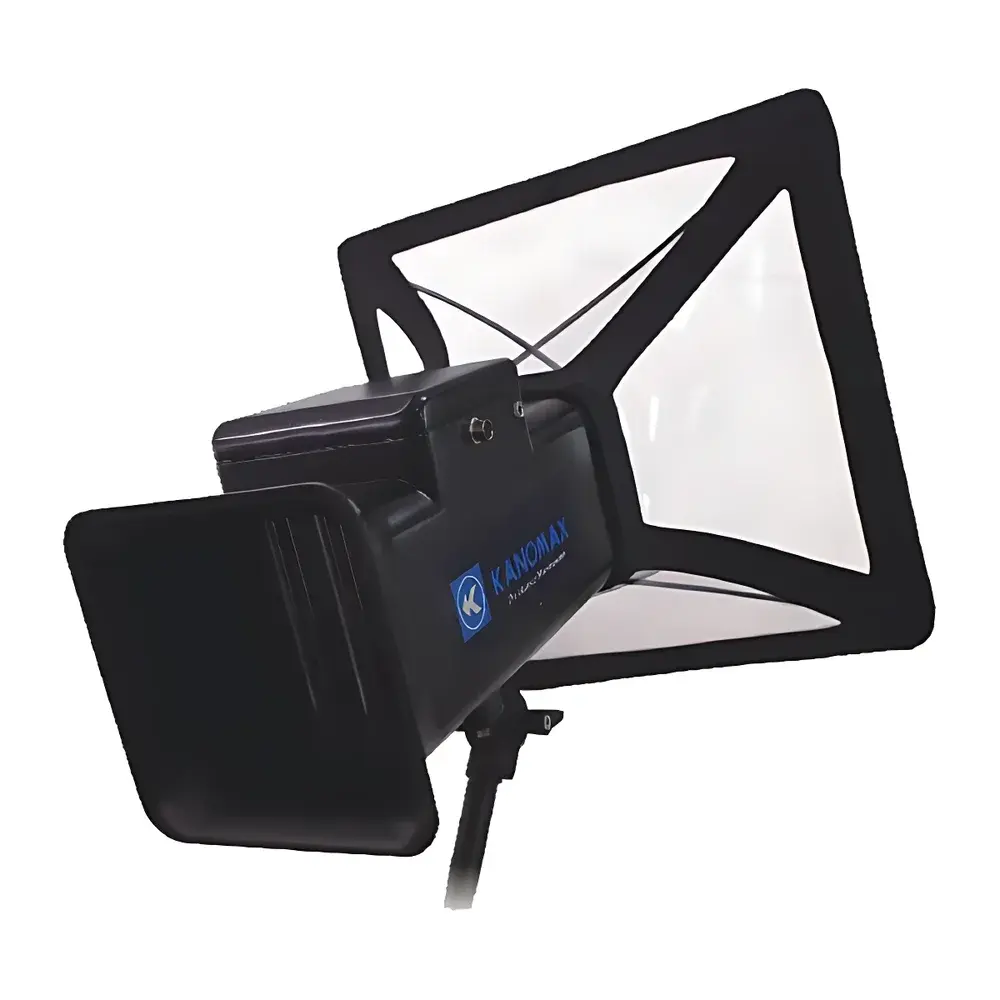
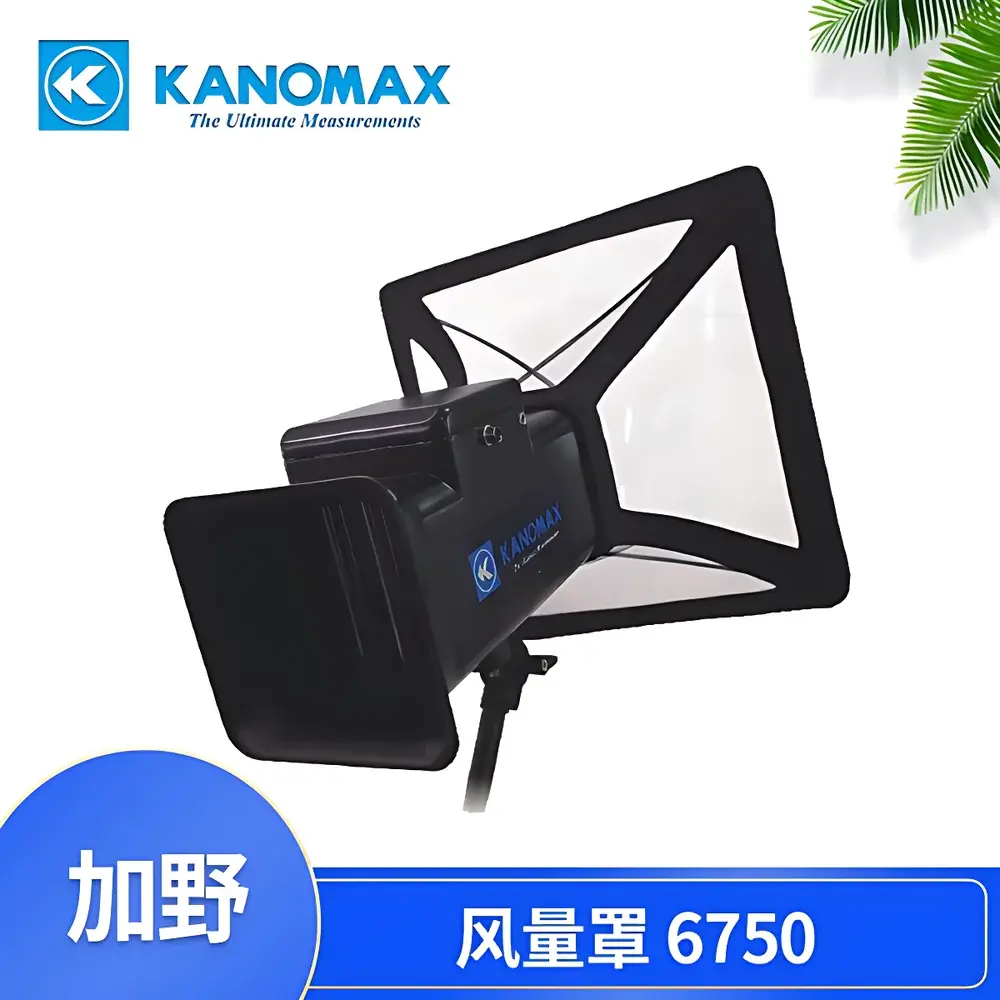
Kanomax Model 6750 Air Flow Hood for HVAC Balancing and Cleanroom Certification
| Brand | Kanomax |
|---|---|
| Origin | Japan |
| Model | 6750 |
| Air Flow Range | ±8–600 m³/h |
| Accuracy | ±(3% of reading + 1 m³/h) for 8–350 m³/h |
| Temperature Range | 0–50 °C |
| Temperature Accuracy | ±0.5 °C |
| Display | 160×80 mm color LCD |
| Data Storage | Up to 6,000 records (internal memory) |
| Communication | Bluetooth v4.0, USB output |
| Power | 4 × AA alkaline batteries or AC adapter |
| Operating Time | ~8 hours |
| Dimensions (hood) | 355×355×450 mm (W×H×D) |
| Hood Aperture | 355×355 mm |
| Weight | 1.5 kg |
| Compliance | Designed for ISO 14644-3, ISO 14644-4, IEST-RP-CC006.3, and ASHRAE 111-2020 test protocols |
Overview
The Kanomax Model 6750 Air Flow Hood is a precision-engineered instrument designed for quantitative volumetric airflow measurement at supply and exhaust grilles, diffusers, and terminal units in HVAC systems and controlled environments. It operates on the principle of integrated velocity-area measurement: an internal grid of calibrated thermal anemometer sensors captures spatially averaged air velocity across the hood’s inlet plane, while real-time temperature compensation ensures density-corrected volumetric flow calculation (m³/h or CFM). Its application scope includes HVAC commissioning, duct leakage verification, room pressurization validation, and full compliance testing per ISO 14644-3 for cleanroom classification—particularly critical for pharmaceutical manufacturing, biotech labs, and semiconductor fabrication facilities where airflow uniformity, directionality, and total volume directly impact particle control and process integrity.
Key Features
- High-resolution 160×80 mm full-color LCD display showing simultaneous real-time airflow and temperature readings, battery status, unit selection (m³/h/CFM, °C), and data logging progress
- Optically transparent front viewing window enabling direct visual confirmation of hood-to-grille alignment and sealing integrity—minimizing edge leakage errors and operator-induced misregistration
- Modular hood design with standardized 355×355 mm aperture; compatible with optional adapter frames (sold separately) for non-standard grille sizes without recalibration
- Glass-fiber reinforced support pole providing torsional rigidity and vibration damping during handheld operation, ensuring mechanical stability under variable duct pressure conditions
- Dual-mode data acquisition: local storage of up to 6,000 timestamped records (including date/time, flow value, temperature, and user-defined ID tags), plus wireless transmission via Bluetooth 4.0 to iOS/Android tablets or Windows PCs running Kanomax’s certified configuration software
- Low-power architecture supporting continuous operation for approximately 8 hours on four standard AA alkaline cells; AC adapter included for extended benchtop use or firmware updates
Sample Compatibility & Compliance
The Model 6750 is validated for use with laminar and turbulent airflow profiles typical of VAV boxes, HEPA-filtered supply terminals, and return/exhaust grilles in Class 5–8 cleanrooms (ISO 14644-1). Its measurement uncertainty budget accounts for thermal drift, sensor cross-sensitivity to humidity, and dynamic pressure effects per ASHRAE Guideline 12-2020 Annex B. Instrument calibration traceability follows JIS Z 8015 and NIST-traceable standards, with optional factory calibration certificate (ISO/IEC 17025 accredited). The device supports audit-ready documentation workflows required under FDA 21 CFR Part 11 (when used with compliant software), EU GMP Annex 1, and ISO/IEC 17025-accredited laboratory quality systems.
Software & Data Management
Kanomax’s proprietary PC-based software (v3.2+) enables post-test analysis, report generation (PDF/Excel), and batch export of measurement series. Each record includes embedded metadata: ambient temperature, measurement duration, operator ID, and GPS-tagged location (if enabled via paired mobile device). Audit trails log all parameter changes, file exports, and user login events. Data files are encrypted using AES-128 and support digital signature embedding for GLP/GMP-compliant validation. USB mass-storage mode allows drag-and-drop transfer without driver installation.
Applications
- HVAC system balancing per ASHRAE Standard 111 and ISO 14644-3 Annex D
- Cleanroom certification including face velocity mapping, uniformity assessment, and total supply air volume verification
- LEED EA Credit 1 commissioning documentation for ventilation rate procedure (VRP) compliance
- Pharmaceutical facility qualification (IQ/OQ/PQ) of air handling units and isolators
- University and hospital lab environmental monitoring program execution
- Energy audit pre- and post-retrofit airflow quantification
FAQ
Is the Model 6750 suitable for measuring airflow in high-velocity ducts (>10 m/s)?
No—the instrument is optimized for terminal device measurements (grilles, diffusers, VAV boxes) where velocities typically range from 0.2 to 5 m/s. For in-duct applications, Kanomax recommends the 6501A hot-wire anemometer with pitot-static probe accessories.
Does the device meet ISO 17025 calibration requirements?
The unit ships with a factory calibration certificate traceable to JCSS standards. For ISO/IEC 17025 accreditation, users must engage an accredited calibration laboratory using Kanomax’s documented procedures (Ref: KAN-6750-CAL-PRO-2023).
Can data be exported directly to Building Management Systems (BMS)?
Yes—via USB or Bluetooth, raw CSV files can be ingested by third-party BMS middleware platforms supporting Modbus TCP or BACnet/IP gateways when paired with Kanomax’s optional communication gateway module (K-GW-USB-BT).
What is the recommended recalibration interval?
Annual recalibration is advised under normal usage conditions; more frequent verification (e.g., daily zero-check with supplied cap) is required in regulated environments per internal SOPs aligned with ISO/IEC 17025 clause 6.5.
Is the hood compatible with ISO 14644-3 “as-installed” testing protocols?
Yes—the transparent alignment window, low-profile geometry, and real-time temperature-compensated flow algorithm satisfy Clause 6.3.2.2 requirements for non-intrusive, in-situ measurement of supply air devices without disrupting laminar flow patterns.







