
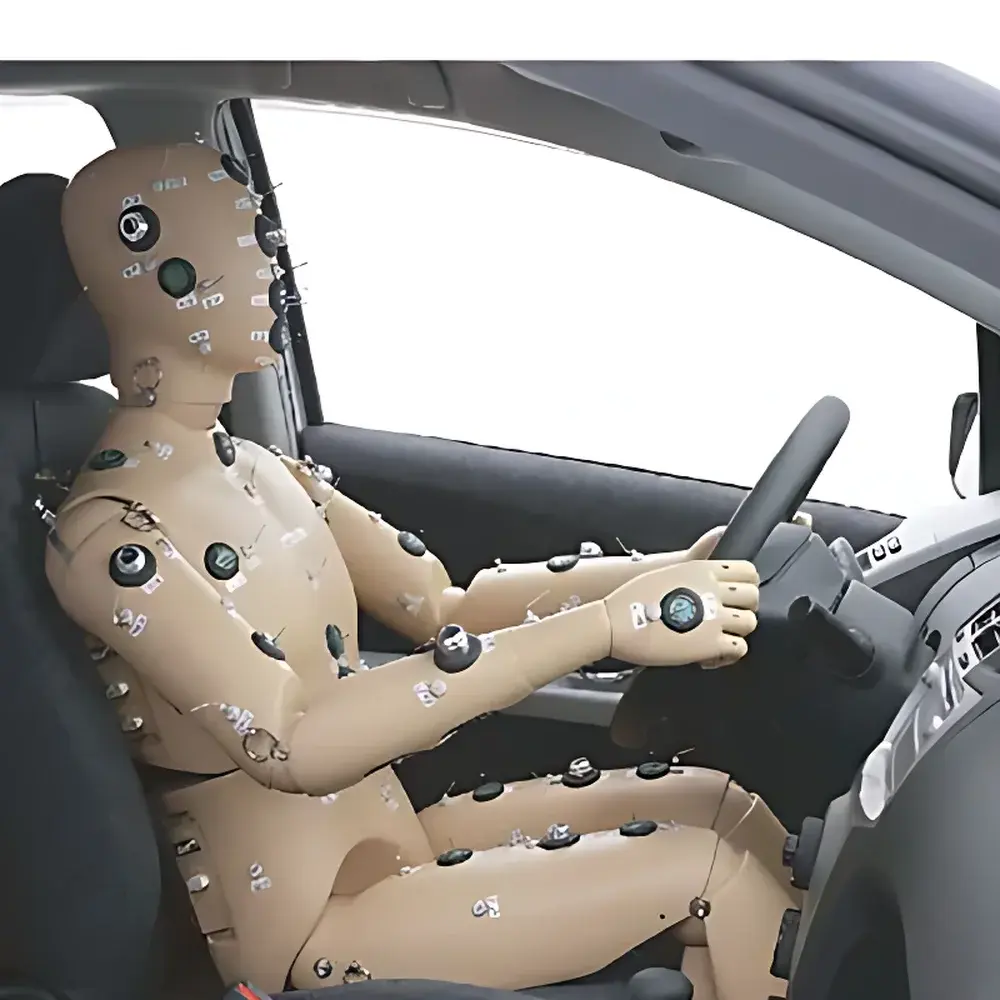
Kanomax KAN-HPM4 Automotive Thermal Manikin System
| Brand | Kanomax |
|---|---|
| Origin | Japan |
| Model | KAN-HPM4 |
| Configuration | 4-segment articulated thermal manikin with integrated wireless telemetry and real-time PMV/PPD calculation capability |
| Compliance | Designed to support ISO 7730, ASHRAE 55, and SAE J2726 test protocols |
| Data Interface | USB + Bluetooth 5.0 |
| Software | Kanomax Thermal Analysis Suite (Windows-based, Excel-compatible export, GLP-compliant audit trail) |
Overview
The Kanomax KAN-HPM4 Automotive Thermal Manikin System is a precision-engineered, four-segment anthropomorphic thermal testing platform designed specifically for objective evaluation of heating, ventilation, and air conditioning (HVAC) performance in automotive cabin environments. Based on the principles of heat balance modeling and segmented surface temperature mapping, the system replicates human thermoregulatory response through 128 independently controlled and monitored thermal zones across head, torso, arms, and legs. Each segment integrates calibrated thermistors (±0.1 °C accuracy), embedded heaters (0–50 W per zone), and convective heat flux sensors, enabling dynamic simulation of metabolic heat generation and evaporative cooling under varying ambient conditions. Unlike passive dummies, the KAN-HPM4 actively regulates surface temperatures in real time to maintain prescribed thermal setpoints—thereby supporting quantitative assessment of local thermal comfort, draft risk, and asymmetric radiation exposure per ISO 7730 Annex B and SAE J2726 Section 5.2.
Key Features
- Four-articulated-segment design with independent thermal control and measurement per anatomical region (head, upper torso, lower torso, limbs)
- 128 high-resolution thermal sensing points with ±0.1 °C repeatability and 0.01 °C resolution
- Real-time Predicted Mean Vote (PMV) and Predicted Percentage Dissatisfied (PPD) computation compliant with ISO 7730:2005 algorithms
- Wireless telemetry via Bluetooth 5.0 with 10 m line-of-sight range and encrypted data streaming at 10 Hz sampling rate
- Integrated battery-powered operation (up to 8 h continuous use) with hot-swappable modules for uninterrupted testing cycles
- Ruggedized aluminum-magnesium alloy frame rated for repeated installation/removal in vehicle mock-ups and climate chambers
- Pre-calibrated out-of-box; NIST-traceable calibration certificate included for each unit
Sample Compatibility & Compliance
The KAN-HPM4 is validated for use in passenger cars, light-duty trucks, and EV cabins under controlled environmental chamber conditions (−20 °C to +60 °C, 10–95% RH). Its modular joint configuration accommodates driver, front passenger, and two rear seating positions without requiring structural modification to OEM seat frames. All sensor electronics and cabling meet IEC 60529 IP54 ingress protection standards for dust and splashing water resistance. The system supports full traceability per GLP and GMP requirements: software enforces user authentication, electronic signatures, and immutable audit logs for all calibration events, test configurations, and raw data exports—fully aligned with FDA 21 CFR Part 11 and ISO/IEC 17025 documentation frameworks.
Software & Data Management
Kanomax Thermal Analysis Suite v4.2 provides a validated Windows application for instrument control, visualization, and regulatory reporting. The interface displays synchronized thermal maps overlaid on a 3D manikin model, with configurable color gradients for surface temperature, heat loss rate, and local PMV deviation. All measurements are timestamped and stored in a relational SQLite database with built-in versioning. Export functions include CSV, XLSX (with formula-preserving formatting), and PDF reports containing metadata, calibration history, and statistical summaries (mean, SD, min/max per zone). Audit trails record operator ID, session start/end, parameter changes, and export actions—retained for minimum 15 years as required by ISO 13485 and automotive OEM quality systems.
Applications
- Objective validation of HVAC airflow distribution, thermal stratification, and cold/hot spot formation in vehicle cabins
- Development and verification of automatic climate control logic under transient thermal loads (e.g., solar loading, door opening)
- Thermal comfort benchmarking against competitor vehicles using standardized PMV/PPD metrics
- Support for homologation testing per UNECE R107 (passenger car interior temperature control) and GB/T 25988–2010 (Chinese automotive HVAC standards)
- Integration with CFD simulation workflows via boundary condition export (surface temperature and convective coefficient arrays)
- Research into occupant-specific thermal preferences across demographic cohorts (age, gender, metabolic rate profiles)
FAQ
Does the KAN-HPM4 require external power during operation?
No—it operates autonomously on internal rechargeable lithium-ion batteries, enabling full functionality inside shielded anechoic chambers or production-line test cells without grounding or AC infrastructure.
Can the system be used outside automotive applications?
Yes—its modular architecture and ISO 7730 compliance make it suitable for aircraft cabin thermal validation, railway rolling stock testing, and HVAC system commissioning in cleanrooms and hospital isolation rooms.
Is firmware upgrade supported in the field?
Yes—over-the-air updates are delivered via Kanomax’s secure portal and applied through the Thermal Analysis Suite; all versions are digitally signed and logged in the audit trail.
What is the recalibration interval recommended by Kanomax?
Annual recalibration is recommended under normal use; however, the system performs self-diagnostics before every test session and flags drift exceeding ±0.15 °C for immediate attention.
Are custom anthropometric configurations available?
Kanomax offers optional anthropometric variants (95th percentile male, 5th percentile female) with corresponding thermal zoning and mass distribution—quoted separately upon technical review.



