Cavitation Monitoring System for Plant Xylem Research
| Origin | UK |
|---|---|
| Manufacturer Type | Authorized Distributor |
| Origin Category | Imported |
| Model | Cavitation Monitoring System |
| Price | Upon Request |
| Pressure Range | 0–100 bar |
| Pressure Hose Length | 3 ft |
| Gas Supply Hose Length | 6 ft |
| Minimum Sample Length | 4.25 in |
Overview
The Cavitation Monitoring System for Plant Xylem Research is a purpose-built, benchtop instrumentation platform engineered to quantify and characterize embolism formation and propagation in vascular plant tissues under controlled negative pressure. It operates on the principle of centrifugal or pressure-driven cavitation induction—where xylem segments are subjected to progressively increasing tension (i.e., negative pressure) while real-time acoustic emissions (AE) or hydraulic conductivity loss is monitored. This enables direct empirical derivation of vulnerability curves (P50, P88, slope), critical metrics in plant hydraulics research aligned with standardized protocols such as those defined by the International Embolism Network (IEN) and ASTM D7957-22 (Standard Guide for Hydraulic Vulnerability Curve Determination).
Key Features
- Full-scale pressure range of 0–100 bar (0–10 MPa), calibrated to ±0.5% FS accuracy, supporting both high-resistance species (e.g., conifers) and low-threshold angiosperms.
- Integrated pressure chamber with precision-machined stainless-steel sample holder, compatible with standard xylem segments ≥10.8 cm (4.25 in) in length and up to 8 mm in diameter.
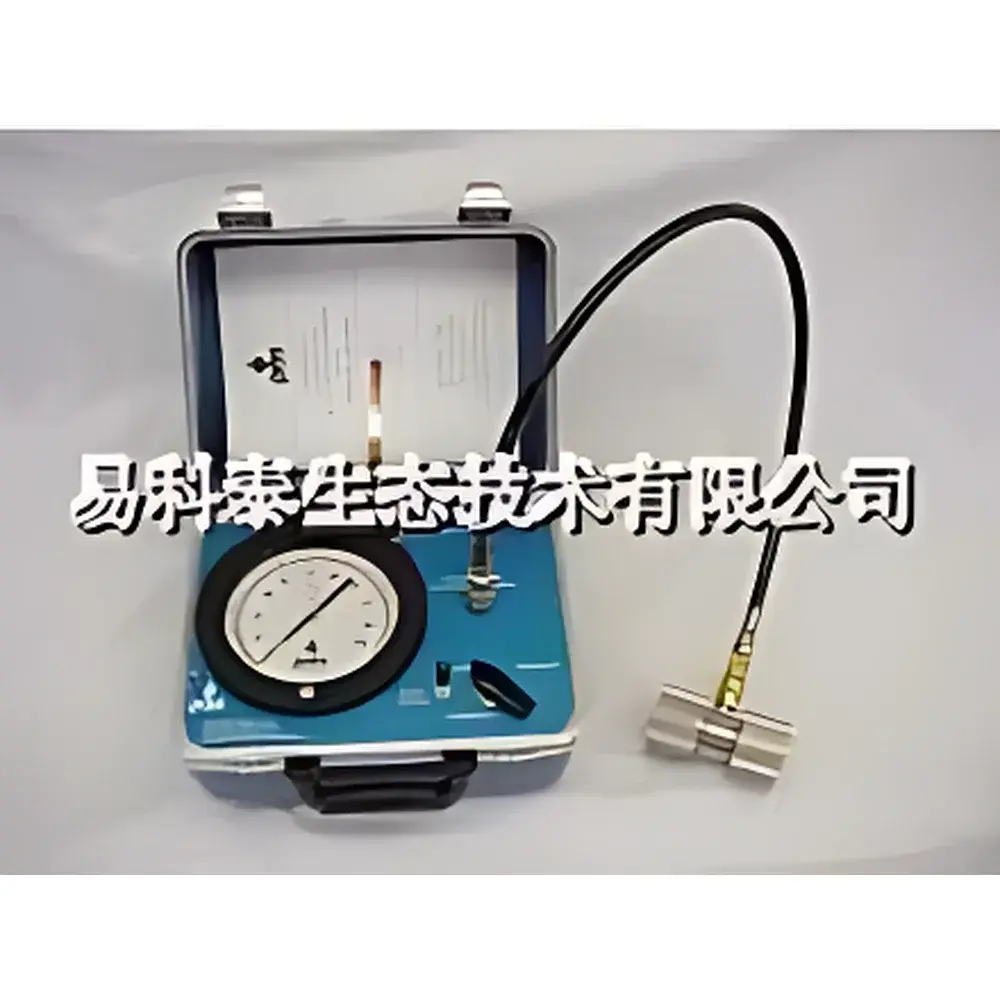
- Dual-hose configuration: a 3-ft reinforced pressure hose rated to 120 bar burst pressure, and a 6-ft gas supply hose with integrated particulate filter and non-return valve for inert gas (N2 or Ar) delivery.
- Modular sealing architecture featuring fluorosilicone O-rings and torque-spec fasteners to ensure leak-tight integrity during prolonged vacuum or pressurization cycles.
- Optional portable high-pressure gas cylinder assembly (certified to PED 2014/68/EU), equipped with dual-stage regulator, pressure relief valve, and ISO 5171-compliant fittings—designed for field-deployable operation or mobile lab setups.
- Designed for compliance with ISO/IEC 17025:2017 general requirements for the competence of testing and calibration laboratories, with traceable documentation for all pressure transducers (NIST-traceable calibration certificate included).
Sample Compatibility & Compliance
The system accommodates intact stem or root segments from herbaceous and woody species—including Quercus robur, Pinus sylvestris, Vitis vinifera, and Arabidopsis thaliana rosette stems—provided minimum dimensional criteria are met. Sample mounting follows IEN-recommended hydration protocols: segments are rehydrated overnight in deionized water under dark, 4°C conditions prior to insertion. All wetted components comply with USP Class VI biocompatibility standards and are free of leachable plasticizers. The instrument meets CE marking requirements for laboratory equipment (2014/30/EU EMC Directive and 2014/35/EU LVD), and its pressure vessel design conforms to EN 853-2 for reinforced rubber hoses used in high-pressure fluid transmission.
Software & Data Management
Data acquisition is performed via a USB-connected 16-bit analog input module synchronized with an external AE sensor (optional add-on) or hydraulic flow meter. Raw pressure, time, and conductivity data are streamed in real time to proprietary software (v3.2+, Windows 10/11 compatible), which supports automated curve fitting using Weibull or sigmoidal regression models. Export formats include CSV, MATLAB .mat, and HDF5—enabling integration into broader ecological modeling frameworks (e.g., TREES, HYDROPHOENIX). Audit trails, user access logs, and electronic signatures adhere to FDA 21 CFR Part 11 requirements when configured with optional GLP/GMP mode, including full version-controlled method storage and change history tracking.
Applications
- Quantification of xylem embolism resistance across phylogenetic gradients and climate gradients.
- Evaluation of drought adaptation traits in breeding programs for cereals, fruit trees, and forest species.
- Validation of imaging-based techniques (e.g., micro-CT, optical coherence tomography) against hydraulic reference data.
- Testing of anti-embolism compounds (e.g., surfactants, nanoparticles) in controlled pharmacological assays.
- Teaching modules in plant physiology and ecohydrology courses requiring reproducible, hands-on cavitation demonstration.
FAQ
What sample preparation steps are required before measurement?
Samples must be cut underwater with razor-sharp blades, rehydrated for ≥12 h at 4°C in darkness, and trimmed to exact length (≥10.8 cm) immediately prior to loading. Air-filled vessels must be avoided.
Can the system be used with root xylem or only stem tissue?
Yes—both root and shoot xylem segments are compatible, provided they meet minimum length and diameter specifications and exhibit sufficient hydraulic continuity.
Is third-party calibration service available?
Yes. Accredited calibration services (ISO/IEC 17025 certified) are offered annually, covering pressure transducers, temperature sensors, and flow meters—with full calibration certificates issued.
Does the system support automated sequential testing of multiple samples?
Not natively; however, the software API (RESTful JSON interface) allows integration with robotic sample handlers and custom LIMS platforms for semi-automated workflows.
What safety certifications does the pressure chamber hold?
The chamber complies with PED 2014/68/EU Annex I essential safety requirements and carries CE marking under Module H (full quality assurance); pressure relief valves are set at 110 bar with ASME B31.3-compliant rupture disc backup.