
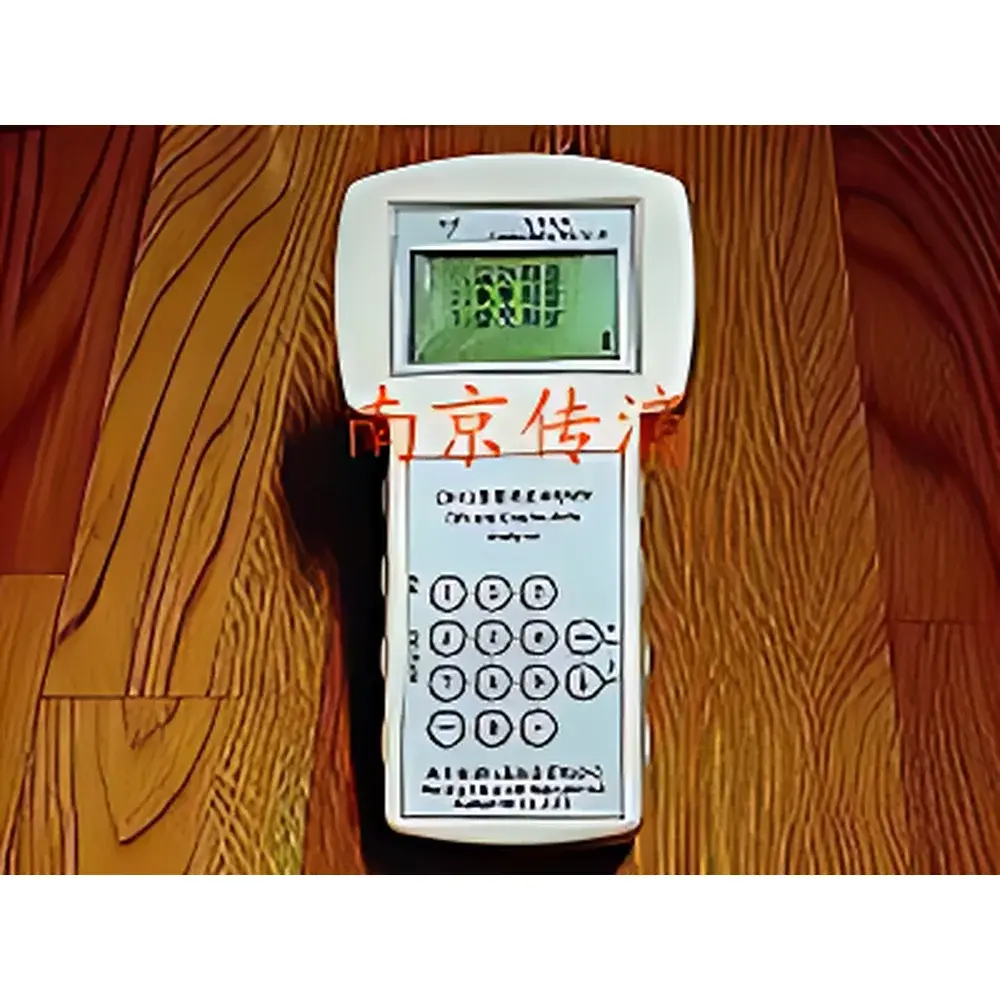
CD-12 Portable Salinity, Conductivity & Temperature Meter
| Origin | Jiangsu, China |
|---|---|
| Manufacturer Type | Distributor |
| Origin Category | Domestic |
| Model | CD-12 |
| Price | Upon Request |
Overview
The CD-12 Portable Salinity, Conductivity & Temperature Meter is a microprocessor-controlled field instrument engineered for simultaneous, real-time measurement of electrical conductivity (EC), salinity (as molar concentration of NaCl-equivalent salts), and temperature in aqueous and semi-solid media—including soil pore water, irrigation runoff, groundwater, and pipeline corrosion monitoring electrolytes. Its core measurement principle follows the fundamental relationship in conductometry: σ = K × G, where σ is the conductivity (in mS/cm), K is the cell constant (cm⁻¹) of the paired conductivity electrode, and G is the measured conductance (in mS). The instrument applies automatic temperature compensation (ATC) using an integrated Pt1000 or thermistor-based temperature probe, normalizing all EC readings to the standard reference temperature of 25 °C per ISO 7888 and ASTM D1125. Salinity is derived algorithmically from the temperature-compensated EC value using empirically validated conversion functions calibrated against NaCl standard solutions across the 0.01–0.3 mol/L range—enabling direct reporting of salt concentration without manual lookup tables.
Key Features
- Triple-parameter acquisition: Simultaneous display of conductivity (0–20 mS), salinity (0.01–0.3 mol/L), and temperature (−20 to +100 °C) with 1-second measurement refresh rate
- Auto-ranging conductivity measurement with 0.001 mS/cm resolution and built-in electrode constant calibration storage for up to 255 unique sensors (ID-coded 1–255)
- Non-volatile memory storing up to 10,000 timestamped measurement records; overflow warning upon full capacity
- USB interface compliant with CDC ACM class for bidirectional data exchange with Windows/Linux PCs; supports parameter import/export (.csv or proprietary binary format)
- Portable ergonomic design: 200 × 105 × 40 mm, mass < 380 g; powered by rechargeable Li-ion battery (< 0.5 W typical power draw)
- Robust environmental rating: Operational within 5–45 °C ambient temperature and ≤85% RH non-condensing humidity
Sample Compatibility & Compliance
The CD-12 is optimized for use with FJA-10-type stainless-steel or graphite-based soil conductivity probes, enabling direct in-situ profiling of saturated paste extracts and field-moist soil slurries. It meets functional requirements for soil salinity assessment under FAO Guidelines for Soil Description and USDA Salinity Laboratory Handbook procedures. While not certified to IEC 61000-6-2/6-4 for EMC or IP67 for ingress protection, its circuitry incorporates galvanic isolation between sensor inputs and USB interface to mitigate ground-loop interference during pipeline cathodic protection surveys. Data logging integrity aligns with GLP principles—each stored record includes sensor ID, timestamp, raw conductance, compensated EC, derived salinity, and temperature—supporting traceability in environmental monitoring and agronomic research workflows.
Software & Data Management
The included PC software (Windows 10/11 compatible) provides full configuration control via USB virtual COM port. Users may perform “Read from Device”, “Write to Device”, “Save to File”, and “Load from File” operations on sensor calibration parameters—including electrode constant, temperature coefficient (β), and salinity conversion offset. Measurement datasets export as UTF-8 CSV with ISO 8601 timestamps (YYYY-MM-DDTHH:MM:SSZ), facilitating integration into LIMS platforms or statistical analysis tools (e.g., R, Python pandas). Audit trails are maintained locally on-device; no cloud connectivity or remote firmware updates are implemented—ensuring data sovereignty and compliance with institutional IT security policies.
Applications
- Field-based salinity mapping of irrigated agricultural land and reclaimed coastal zones
- Long-term monitoring of soil water electrical conductivity (ECe) dynamics in salt-affected ecosystems
- Cathodic protection potential verification along buried oil/gas transmission pipelines using electrolyte conductivity as proxy for soil resistivity
- Quality control of hydroponic nutrient solutions and aquaculture water management
- Teaching laboratories for electrochemical fundamentals: Ohm’s law in ionic media, temperature dependence of conductivity, and calibration traceability
FAQ
Does the CD-12 comply with ISO/IEC 17025 calibration requirements?
The instrument supports user-performed calibration using NIST-traceable KCl standards but does not include factory-issued calibration certificates. Laboratories requiring ISO/IEC 17025 accreditation must establish internal calibration procedures referencing ISO 8466-1 and maintain documented uncertainty budgets.
Can the device measure total dissolved solids (TDS) directly?
No. TDS is not measured; it is estimated indirectly from EC using configurable linear conversion factors (e.g., 0.5–0.7 mg/L per µS/cm), consistent with USGS and EPA guidance for preliminary screening.
Is the USB interface compatible with macOS or Linux?
Yes—when used with generic CDC ACM drivers; however, the official configuration software is Windows-only. Command-line data extraction via serial terminal is supported on POSIX systems.
What is the temperature compensation algorithm?
A second-order polynomial model (σ25 = σT / [1 + β(T − 25) + γ(T − 25)²]) is applied, where β = 0.019/°C and γ is user-adjustable to match probe specifications.
How is sensor drift managed during extended field deployment?
The device retains individual calibration coefficients per sensor ID and allows periodic revalidation using single-point KCl checks; no hardware recalibration is required between field campaigns.




