
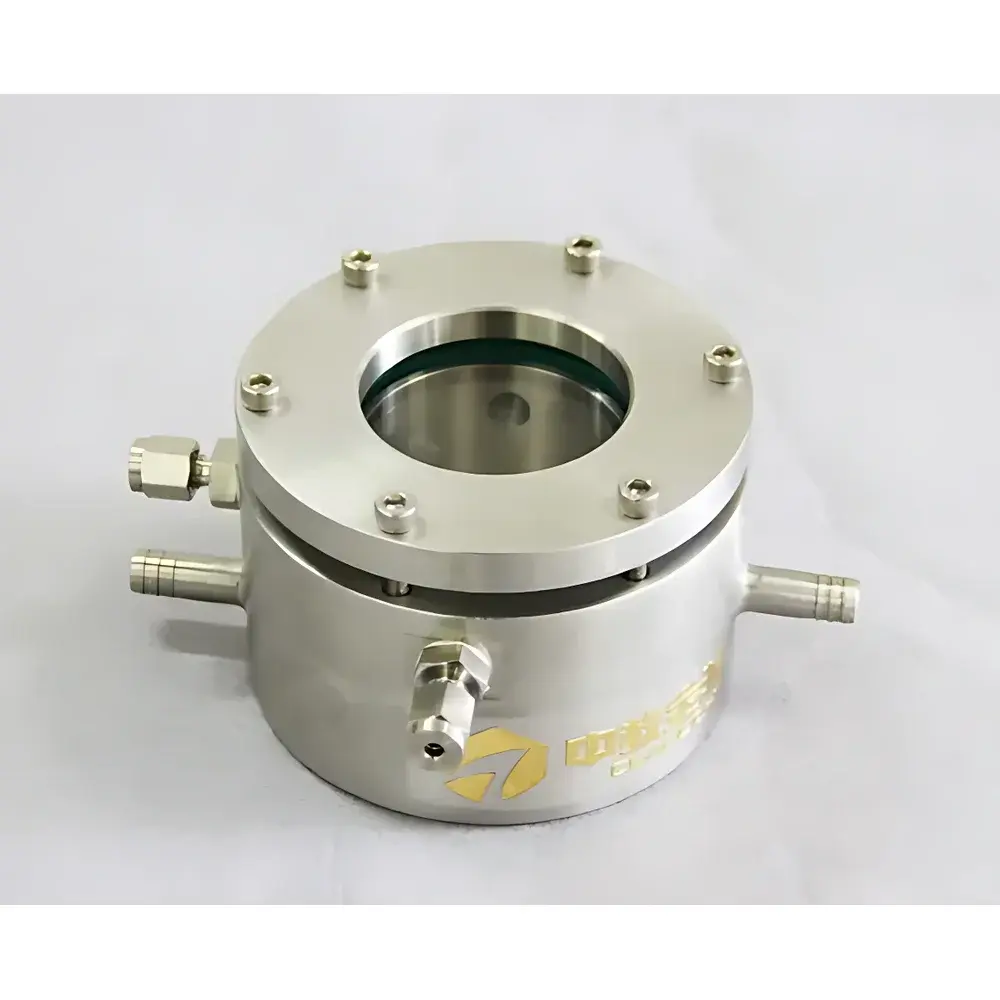
CEL-GPR100 Gas-Phase Photocatalytic Reactor by CEAULIGHT
| Brand | CEAULIGHT |
|---|---|
| Model | CEL-GPR100 |
| Construction Material | 316L Stainless Steel (Monolithic Machined Body) |
| Operating Pressure | ≤2 MPa (Low-Pressure Rated) |
| Working Volume | 100 mL |
| Vacuum Capability | Ambient to Slight Vacuum (No High-Vacuum Rating) |
| Optical Window | Fused Silica, Ø52 mm |
| External Dimensions | Ø106 mm × H78 mm |
| Jacketed Temperature Control | Dual-Port 10 mm NPT Inlet/Outlet for Circulating Bath (Water or Oil) |
| Sealing | O-Ring Flange Seal (ANSI B16.5 Compatible Face) |
| Gas Interface | Three Standard SS-316 Swagelok®-Compatible Ports (2 × 3 mm OD Tubing, 1 × Quick-Connect Fitting) |
| Internal Liners | Two Removable Fused Silica Reaction Liners + Optional PTFE Sleeve |
| Temperature Monitoring | Integrated Digital Thermometer with Front-Panel Display |
| Valves & Fittings | Anlok® Precision Needle Valve, Ball Valve, and SS-316 Tubing Assemblies |
| Compliance | Designed for ISO/IEC 17025 Laboratory Use |
Overview
The CEL-GPR100 Gas-Phase Photocatalytic Reactor is an engineered stainless-steel flow-through reaction vessel designed for controlled heterogeneous photocatalysis under ambient or low-pressure gaseous conditions. It operates on the principle of solid–gas interfacial photoactivation, where UV–visible photons incident through a high-transmittance fused silica window generate electron–hole pairs on supported photocatalysts (e.g., TiO₂, g-C₃N₄, or MOF-based materials) immobilized on reactor internals or substrates. The monolithic 316L stainless-steel body—machined in one piece without welds—ensures structural integrity, corrosion resistance, and leak-tight performance up to 2 MPa, meeting ASME B31.3 process piping design margins for laboratory-scale gas-phase systems. Its compact cylindrical geometry (Ø106 mm × H78 mm), combined with a 52 mm optical aperture, enables uniform irradiation of catalyst beds while minimizing photon loss and thermal gradient distortion. The integrated double-jacketed cooling/heating mantle supports precise temperature regulation (±0.5 °C) via external circulators, critical for kinetic studies requiring isothermal operation across 0–120 °C.
Key Features
- Monolithic 316L stainless-steel construction with CNC-machined flange interface and Viton® O-ring sealing—eliminates weld-induced microcracks and ensures long-term pressure integrity.
- Fused silica optical window (Ø52 mm, ≥92% transmittance from 190–2500 nm) certified to MIL-F-48616 standards for UV durability and thermal shock resistance.
- Three independently configurable gas ports: two 3 mm OD Swagelok®-compatible inlet/outlet lines and one quick-disconnect port for purge or sampling—enabling continuous-flow, batch, or semi-batch operational modes.
- Dual-layer internal lining system: removable fused silica liners (two included) provide inert reaction surfaces and facilitate catalyst recovery; optional PTFE sleeve accommodates acidic or halogenated feedstock compatibility.
- Temperature-controlled jacket with dual 10 mm NPT ports supports integration with standard laboratory chillers or oil baths—validated for stable thermal management during extended irradiation (>24 h).
- Pre-calibrated digital temperature display with Type-K thermocouple input—records real-time internal wall temperature adjacent to catalyst zone, traceable to NIST standards.
Sample Compatibility & Compliance
The CEL-GPR100 is validated for use with powdered, pelletized, or thin-film heterogeneous photocatalysts under dry or humidified gas streams (e.g., CO₂/H₂O/N₂/O₂ mixtures). It complies with ASTM E2719-21 guidelines for evaluating photocatalytic degradation efficiency in gas-phase reactors and supports GLP-aligned experimental documentation when paired with compliant data acquisition systems. The reactor’s material selection (316L SS, fused silica, PTFE) conforms to USP for extractables profiling and meets ISO 10993-12 biocompatibility prerequisites for catalytic surface characterization. It is not rated for explosive atmospheres (ATEX/IECEx) or ultra-high vacuum (<10⁻³ Pa); operation must remain within its specified 0–2 MPa pressure envelope.
Software & Data Management
While the CEL-GPR100 is a hardware-only reactor, it is fully interoperable with third-party control and analysis platforms. When integrated into the CEL-GPPC Gas-Phase Photocatalysis Control System, it accepts analog/digital I/O signals for synchronized valve actuation, light-source triggering (via TTL pulse), and temperature setpoint modulation. All sensor outputs—including thermocouple voltage and optional mass flow controller (MFC) feedback—are compatible with LabVIEW™, MATLAB® Data Acquisition Toolbox, or Python-based PyVISA frameworks. For regulatory compliance, time-stamped temperature logs and gas composition records (when coupled with GC-7920 equipped with FDA 21 CFR Part 11-compliant chromatography software) support audit-ready data trails per ISO/IEC 17025 Clause 7.5.2.
Applications
- CO₂ photoreduction kinetics under simulated solar illumination using Ru/TiO₂ or Cu/ZnO catalysts.
- VOC abatement studies (e.g., formaldehyde, toluene) under low-concentration (<100 ppmv) continuous-flow conditions.
- Photoelectrochemical co-catalyst screening via in situ DRIFTS coupling through the quartz window.
- Stability assessment of perovskite-based photocatalysts under humidified O₂ environments at elevated temperatures.
- Isotopic tracer experiments (¹³CO₂, D₂O vapor) requiring inert liner configuration and leak-free gas handling.
FAQ
Can the CEL-GPR100 be used under vacuum conditions?
It is rated for ambient pressure down to mild vacuum (~10 kPa absolute); it is not designed for high-vacuum applications requiring <100 Pa.
Is the quartz window replaceable in the field?
Yes—the fused silica window is secured with a stainless-steel retaining ring and can be replaced using standard torque tools without disassembling the main body.
Does the reactor include temperature control electronics?
No—it includes only a front-panel digital thermometer; external circulation baths or chillers must be supplied separately.
What catalyst loading configurations are supported?
Flat-bed arrangements (e.g., catalyst-coated quartz slides), packed beds (≤5 g powder), and monolithic substrates (up to Ø50 mm × 10 mm) fit within the internal liner geometry.
Is the CEL-GPR100 compatible with ozone-generating light sources?
Yes—316L stainless steel and fused silica exhibit excellent resistance to ozone exposure up to 200 ppm at 25 °C; however, PTFE liners should be avoided in sustained ozone environments.
Related Products



