
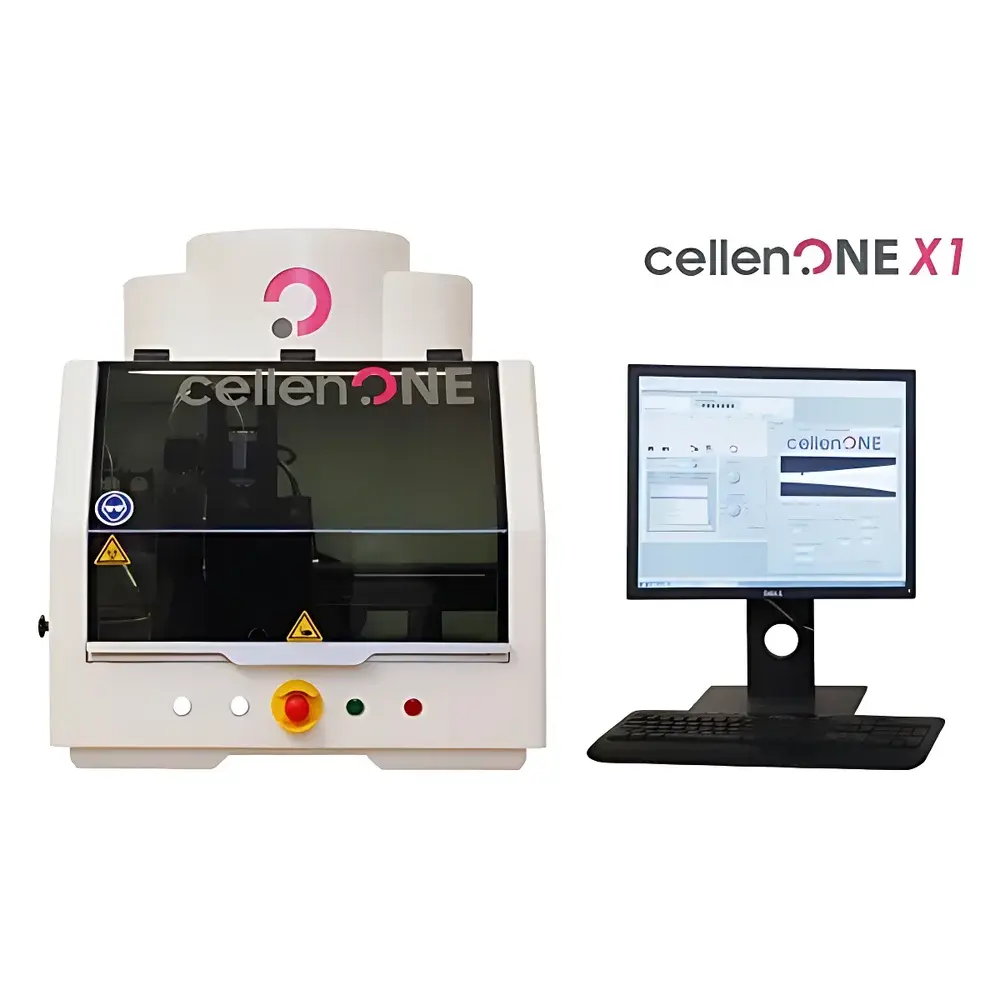
Cellen One Non-Destructive Fully Automated Single-Cell Sorter
| Origin | France |
|---|---|
| Manufacturer Type | Distributor |
| Origin Category | Imported |
| Model | Cellen One |
| Pricing | Upon Request |
Overview
The Cellen One Non-Destructive Fully Automated Single-Cell Sorter is an engineered platform designed for high-fidelity, low-stress isolation of individual viable cells—specifically optimized for applications requiring functional integrity post-sorting, such as single-cell sequencing library preparation, monoclonal antibody development, and stem cell cloning. Unlike conventional fluorescence-activated cell sorting (FACS), which relies on hydrodynamic focusing and high-velocity jet-in-air droplet generation—introducing significant shear stress and requiring minimum input cell numbers—the Cellen One employs piezoelectric acoustic dispensing technology. This principle enables contactless, non-invasive ejection of nanoliter-volume droplets containing precisely one cell, without subjecting the cell to mechanical deformation or electrostatic forces. The system operates under ambient conditions, eliminating the need for pressurized sheath fluid, sterile enclosures, or complex alignment procedures. Its core architecture integrates real-time optical monitoring of nozzle contents, dynamic trajectory mapping per sample, and position-based decision logic to confirm singularity prior to dispensing—ensuring deterministic single-cell deposition with traceable confidence.
Key Features
- Piezoelectric acoustic dispensing engine delivering sub-nanoliter precision with negligible shear stress—validated for sensitive primary human B cells, iPSCs, and fragile circulating tumor cells (CTCs)
- Integrated high-resolution brightfield imaging module continuously monitors cell presence, morphology, and position within the dispensing nozzle in real time
- Automated singularity verification: software evaluates spatial coordinates and temporal occupancy to determine whether a droplet meets strict single-cell criteria before actuation
- Minimal sample requirement: functional operation demonstrated with as few as 50 cells suspended in 1 µL—no pre-amplification or enrichment required
- Rapid deployment: system calibration and assay setup completed in under 5 minutes; fully autonomous run execution thereafter without operator intervention
- Open-well plate compatibility: direct deposition into standard 96-, 384-, or 1536-well plates—including PCR tubes and custom microfluidic substrates
Sample Compatibility & Compliance
The Cellen One accommodates a broad range of suspension-based biological samples, including dissociated mammalian tissues, peripheral blood mononuclear cells (PBMCs), hybridoma cultures, and enzymatically digested organoids. It supports cells ranging from 5 µm (e.g., platelets) to 30 µm (e.g., activated T cells or small spheroids) without clogging or performance degradation. All fluidic pathways are single-use and sterilizable via ethanol or UV-C exposure—supporting GLP-compliant workflows. While not certified as a medical device, the platform aligns with ISO 13485-aligned manufacturing practices and supports audit-ready data logging per FDA 21 CFR Part 11 requirements when integrated with compliant LIMS environments. Documentation packages include IQ/OQ protocols and traceable calibration records for laboratory validation.
Software & Data Management
Control and analysis are executed via the proprietary Cellen One Acquisition Suite—a Windows-based application supporting both guided wizard mode and advanced scripting (Python API available). Each sort event is timestamped and annotated with image thumbnails, nozzle pressure profiles, and positional metadata. Raw image stacks and decision logs are stored in vendor-neutral HDF5 format, enabling interoperability with downstream analysis tools such as Seurat, Scanpy, or commercial bioinformatics pipelines. Audit trails record user actions, parameter changes, and system status transitions—fully exportable for regulatory review. Optional integration with ELN systems (e.g., LabArchives, Benchling) permits automatic metadata injection into experiment records.
Applications
- Single-cell RNA/DNA/ATAC-seq library initiation with preserved transcriptomic fidelity and reduced doublet rates
- High-efficiency monoclonal antibody discovery—particularly in conjunction with HuBBB™ B-cell immortalization, where Cellen One elevates clonal recovery from ~10% to >90%
- Stem cell lineage tracing via serial single-cell deposition followed by long-term culture and phenotypic assessment
- Microbial single-cell genomics from low-biomass environmental samples
- CRISPR screening hit validation requiring functional viability post-isolation
FAQ
What is the minimum viable cell concentration for reliable sorting?
Cellen One does not require a minimum concentration; it functions robustly at densities as low as 50 cells per microliter—making it suitable for rare-cell isolations from limited clinical specimens.
Can the system sort fixed or permeabilized cells?
Yes—provided the fixation method preserves cellular morphology and does not induce aggregation or nozzle adhesion; formaldehyde-fixed cells have been validated in multiple labs.
Is there a maximum throughput limitation?
Throughput is determined by experimental design rather than hardware constraints: typical sorting rates range from 1–10 cells per minute depending on imaging resolution and verification stringency—but total run duration is scalable up to 72 hours unattended.
Does Cellen One support fluorescent labeling or only label-free sorting?
It is inherently label-free but fully compatible with pre-stained samples; optional LED excitation modules enable basic fluorescence-guided sorting (e.g., GFP+ selection), though its primary advantage lies in morphology- and position-based isolation without dye dependency.
How is system performance validated between runs?
Each session includes automated nozzle priming, background image acquisition, and reference bead-based positional calibration—generating a QC report with pass/fail indicators for every critical subsystem.





