
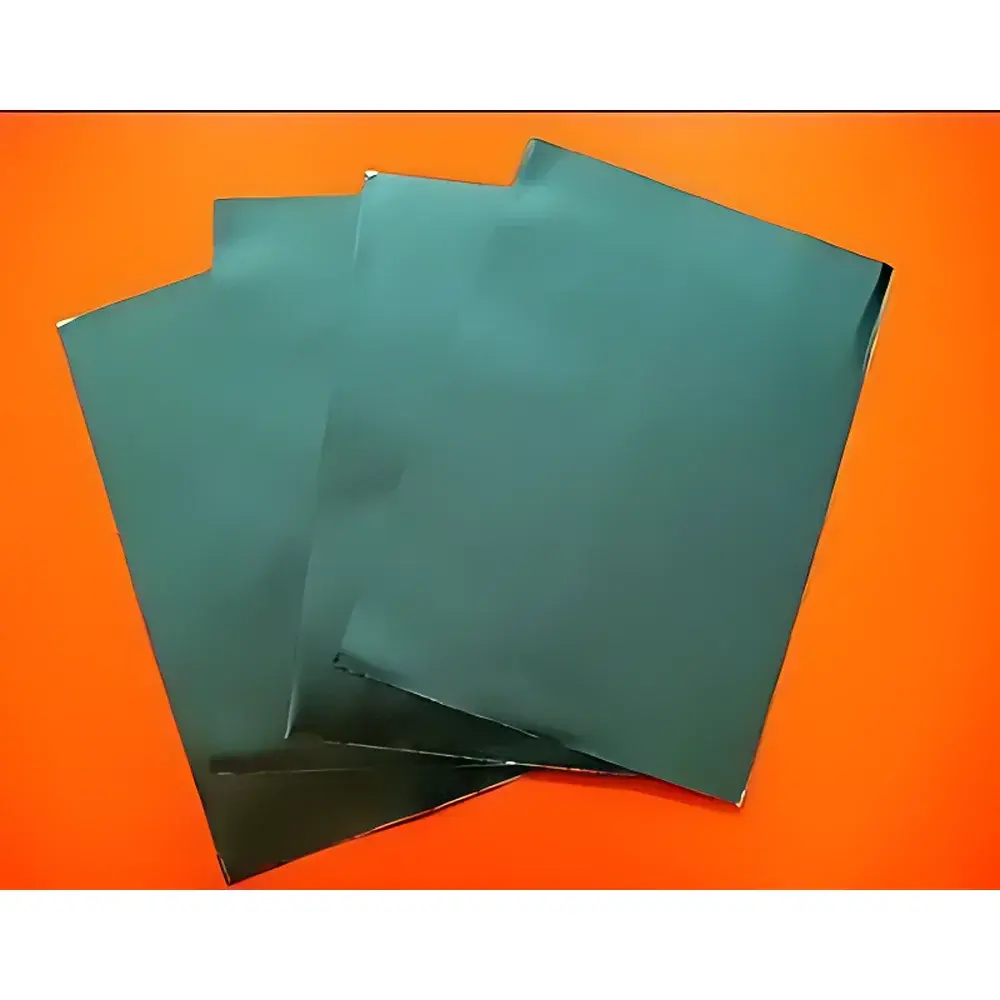
CeTech Graphite Thermal Interface Sheets
| Origin | Taiwan |
|---|---|
| Manufacturer Type | Authorized Distributor |
| Regional Origin | Asia-Pacific |
| Model | CeTech GTI-Series Graphite Thermal Sheets |
| Pricing | Available Upon Request |
Overview
CeTech GTI-Series Graphite Thermal Interface Sheets are highly anisotropic, flexible thermal management materials engineered for efficient lateral heat spreading in compact electronic assemblies. Based on exfoliated natural graphite foil with controlled crystalline orientation, these sheets operate via phonon-dominated conduction along the basal plane—delivering exceptional in-plane thermal conductivity while maintaining low through-plane resistance. Unlike traditional metal-based thermal interface materials (TIMs), GTI sheets do not rely on pressure-dependent contact resistance or phase-change behavior; instead, they provide consistent, geometry-stable thermal bridging between heat-generating components (e.g., ICs, power MOSFETs, LED packages) and heat sinks or chassis structures. Their ultra-thin profile (typically 0.05–0.5 mm), combined with compressibility and conformability, enables reliable thermal coupling across non-planar or dynamically stressed interfaces—critical for mobile, automotive, and aerospace electronics where mechanical tolerance and long-term reliability are paramount.
Key Features
- Anisotropic Thermal Performance: In-plane thermal conductivity ranges from 700 to 1,800 W/m·K depending on grade and thickness—4–5× higher than aluminum (237 W/m·K) and copper (401 W/m·K) under equivalent cross-sectional area.
- Ultra-Low Thermal Resistance: Achieves interfacial thermal resistance as low as 0.15–0.45 cm²·K/W at 50 psi contact pressure, outperforming aluminum by ~40% and copper by ~20% on a per-unit-thickness basis.
- Lightweight & Mechanically Compliant: Density of 2.0–2.2 g/cm³ yields 25% weight reduction versus aluminum and 75% versus copper—enabling mass-sensitive designs without compromising thermal integrity.
- Surface Conformability: Flexible graphite matrix allows seamless adhesion to curved, uneven, or micro-rough surfaces without requiring thermal paste or additional bonding agents.
- Chemical & Environmental Stability: Inert to oxidation below 450°C in inert atmospheres; stable under repeated thermal cycling (−40°C to +125°C) and compliant with RoHS 3 (2015/863/EU) and REACH SVHC screening protocols.
Sample Compatibility & Compliance
GTI-Series sheets are compatible with standard SMT reflow profiles (peak temperatures ≤ 260°C), enabling integration into automated assembly lines without delamination or carbon migration. They adhere reliably to oxidized aluminum heatsinks, nickel-plated copper substrates, FR-4 PCBs, and injection-molded polymer housings—including PC, PPS, and LCP. The material meets UL 94 V-0 flammability requirements when laminated with certified acrylic pressure-sensitive adhesives (PSAs). For regulated industries, documentation supports ISO 9001:2015 manufacturing traceability and provides full material declarations (IMDS, SCIP) for EU automotive and medical device supply chains.
Software & Data Management
While GTI sheets are passive components, CeTech provides comprehensive thermal design support tools including: (i) a web-accessible thermal simulation library (ANSYS Icepak & COMSOL Multiphysics-compatible .mat files) with validated anisotropic conductivity tensors; (ii) dimensional tolerance reports aligned with IPC-7351B footprint standards; and (iii) batch-specific Certificate of Conformance (CoC) with thermal performance verification data (ASTM D5470-compliant test reports available upon request). All documentation is archived for ≥10 years to support GLP/GMP audit readiness and product lifecycle traceability.
Applications
These graphite thermal sheets are deployed in thermally constrained environments where spatial efficiency, weight savings, and dynamic reliability intersect: high-brightness LED modules (COB & CSP packages), smartphone SoC thermal stacks (between AP and mid-frame), notebook GPU/CPU vapor chamber coupling layers, automotive ADAS radar modules, OLED display backplane heat spreading, and industrial IoT edge controllers operating under extended ambient temperature ranges. Their dielectric nature eliminates galvanic corrosion risk in mixed-metal assemblies—a key advantage over metallic TIMs in multi-material enclosures.
FAQ
Are GTI sheets electrically conductive?
Yes—they exhibit in-plane electrical conductivity (~10⁴ S/m), necessitating dielectric isolation when placed near signal traces or high-impedance nodes.
Can GTI sheets be reworked after assembly?
Mechanically removable with moderate peeling force; however, adhesive residue may require IPA cleaning—full reusability is not guaranteed due to surface fiber disruption.
Do GTI sheets require thermal interface paste?
No—designed as dry, pressure-activated interfaces; adding paste introduces interstitial voids and degrades effective conductivity.
What is the maximum continuous operating temperature?
450°C in nitrogen; 350°C in air with gradual oxidative thinning—recommended upper limit for electronics is 125°C for >10,000-hour reliability.
How are custom shapes fabricated?
Precision die-cutting, laser scoring, or CNC milling—CeTech maintains NPI support for prototype-to-volume transitions with GD&T-aligned tooling validation.



