
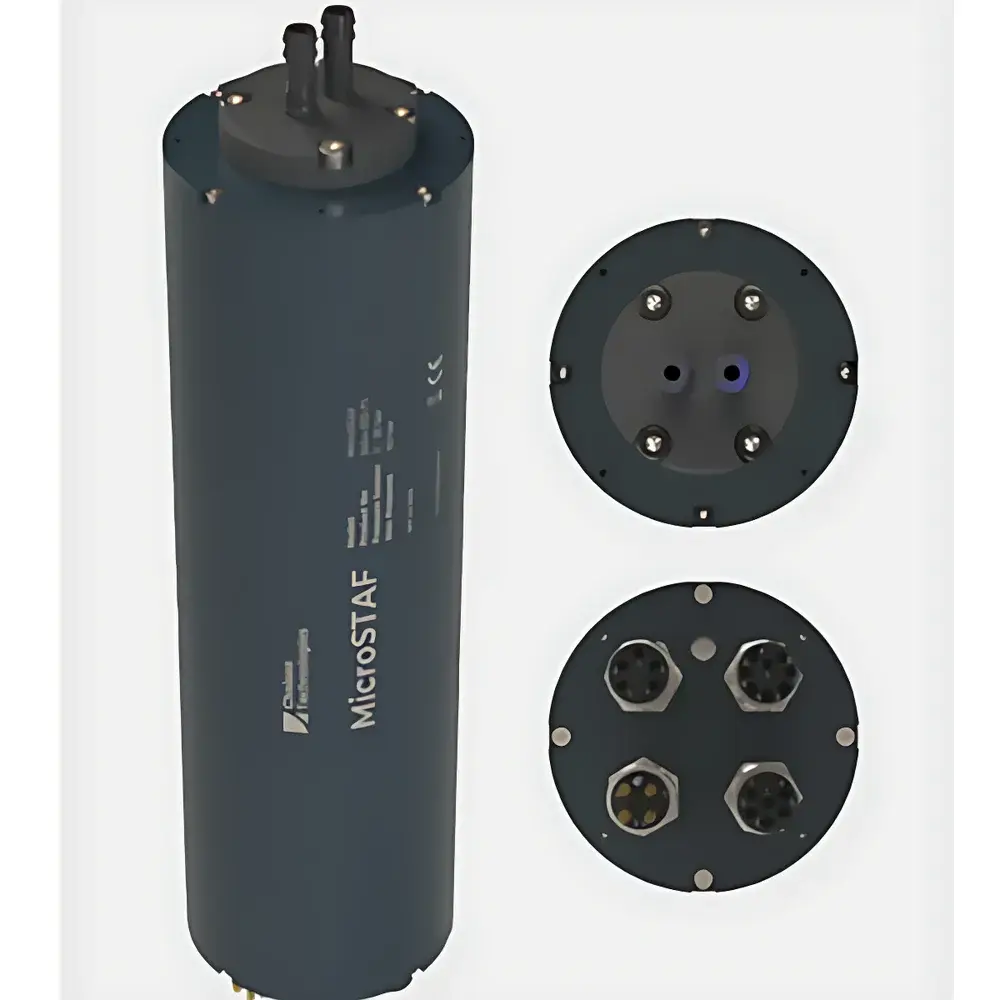
Chelsea MicroSTAF In Situ Primary Productivity Analyzer
| Brand | Chelsea |
|---|---|
| Origin | UK |
| Manufacturer Type | Authorized Distributor |
| Origin Category | Imported |
| Model | MicroSTAF |
| Pricing | Upon Request |
Overview
The Chelsea MicroSTAF In Situ Primary Productivity Analyzer is a submersible, single-turnover active fluorometer engineered for autonomous, high-sensitivity quantification of phytoplankton photochemical efficiency and primary productivity in marine and freshwater environments. Based on the proven LabSTAF platform—widely deployed in shipboard underway systems to acquire >10,000 fluorescence light response curves (FLCs) annually—the MicroSTAF integrates two advanced optical methodologies: Photochemical Excitation Profiles (PEPs) and Dual-Wavelength Measurements (DWMs). These enable automated spectral correction and compensation for package effects (i.e., self-shading and inner-filter artifacts), significantly improving accuracy in oligotrophic and optically complex waters. Operating on the principle of saturation-recovery pulse-amplitude modulation (PAM) fluorometry, the MicroSTAF measures variable fluorescence (Fv) induced by precisely controlled actinic light pulses across seven discrete excitation wavelengths. Its titanium-housed, pressure-rated design (2000 m depth rating) supports long-term deployment on marine autonomous systems (MAS), including surface unmanned vessels, AUVs, gliders, and moored buoys.
Key Features
- Seven narrowband LED excitation sources centered at 416, 442, 468, 495, 520, 598, and 630 nm—enabling PEP-based spectral deconvolution of pigment-specific photosystem II (PSII) quantum yield
- Ultra-low power consumption: 2.7–4 W typical (180–350 mA @ 9–12 VDC), optimized for energy-constrained MAS platforms
- Integrated peristaltic sample exchange pump for unattended profiling and real-time water column interrogation
- Optional SPAR sensor co-mounted for concurrent measurement of photosynthetically active radiation (PAR: 400–700 nm) and photochemical excitation photon irradiance (PEP: 380–660 nm) at 10 nm resolution
- Real-time data output via RS232 or RS485 (115 kBd) in user-configurable CSV format; full raw fluorescence transients stored internally for post-deployment analysis
- Windows 11-based desktop software for protocol scripting, FLC acquisition, PEP calibration, and Fv/Fm, σPSII, and ETRPSII derivation
- Detection limit: Fv equivalent to chlorophyll a concentration of 0.001 mg m−3 (excited at 452 nm)
Sample Compatibility & Compliance
The MicroSTAF is designed for direct in situ analysis of natural seawater, brackish estuarine water, and lacustrine samples without filtration or pre-concentration. Its optical path accommodates particles up to 200 µm in diameter, minimizing clogging risk during extended deployments. The system complies with ISO 10260:2021 (water quality—fluorometric determination of chlorophyll a and pheopigments) and supports traceable calibration against NIST-traceable quantum sensors. When integrated into GMP/GLP-compliant monitoring programs, the device’s audit-ready data logging (with timestamped metadata, instrument status flags, and environmental context from SPAR) satisfies requirements for environmental data integrity under EU Water Framework Directive Annex V and US EPA Method 445.0.
Software & Data Management
The MicroSTAF Control Suite (v3.x) provides a validated, GUI-driven environment for experimental design—including customizable FLC protocols, multi-depth profiling schedules, and dynamic PAR-triggered sampling. All raw fluorescence kinetics (including induction, relaxation, and dark-adaptation phases) are archived in HDF5 format with embedded sensor metadata (temperature, pressure, SPAR irradiance, battery voltage). Export modules generate standardized NetCDF-4 files compliant with IOOS (U.S. Integrated Ocean Observing System) and SeaDataNet conventions. For regulatory reporting, the software supports 21 CFR Part 11-compliant electronic signatures, role-based access control, and immutable audit trails of all parameter changes and data exports.
Applications
- Calibration and validation of satellite-derived primary productivity models (e.g., NASA OCx, ESA S3A/B OLCI algorithms)
- High-resolution mapping of phytoplankton functional types (PFTs) and photophysiological states across mesoscale fronts and eddies
- Early detection and mechanistic assessment of harmful algal blooms (HABs), including Dinophysis, Pseudo-nitzschia, and cyanobacterial events
- Long-term trend analysis of climate-driven shifts in photoinhibition thresholds and non-photochemical quenching (NPQ) dynamics
- Integration into observatory networks (e.g., OceanSITES, EMSO) for multi-year biogeochemical time series aligned with BGC-Argo standards
FAQ
What is the operational depth rating of the MicroSTAF?
The titanium housing is rated to 2000 m depth, with pressure-compensated optical windows and sealed electronics conforming to IEC 60529 IP68 specifications.
Can the MicroSTAF operate independently without external power or telemetry?
Yes—it supports standalone operation with internal lithium-thionyl chloride batteries (optional) and stores >30 days of high-frequency FLC data onboard; telemetry is required only for real-time command and data retrieval.
How does the SPAR sensor improve FLC accuracy?
The SPAR provides real-time, spectrally resolved PEP irradiance data used to dynamically adjust actinic light intensities and correct for wavelength-dependent absorption biases—critical in stratified or CDOM-rich waters.
Is firmware update capability available remotely?
Yes—field-upgradable firmware is delivered via secure RS232/RS485 packet transmission with SHA-256 signature verification and rollback protection.
Does the system support GLP-compliant data archiving?
Yes—raw data files include cryptographic hashes, operator ID, instrument serial number, calibration certificate references, and full environmental context, satisfying ALCOA+ principles for regulated environmental monitoring.







