
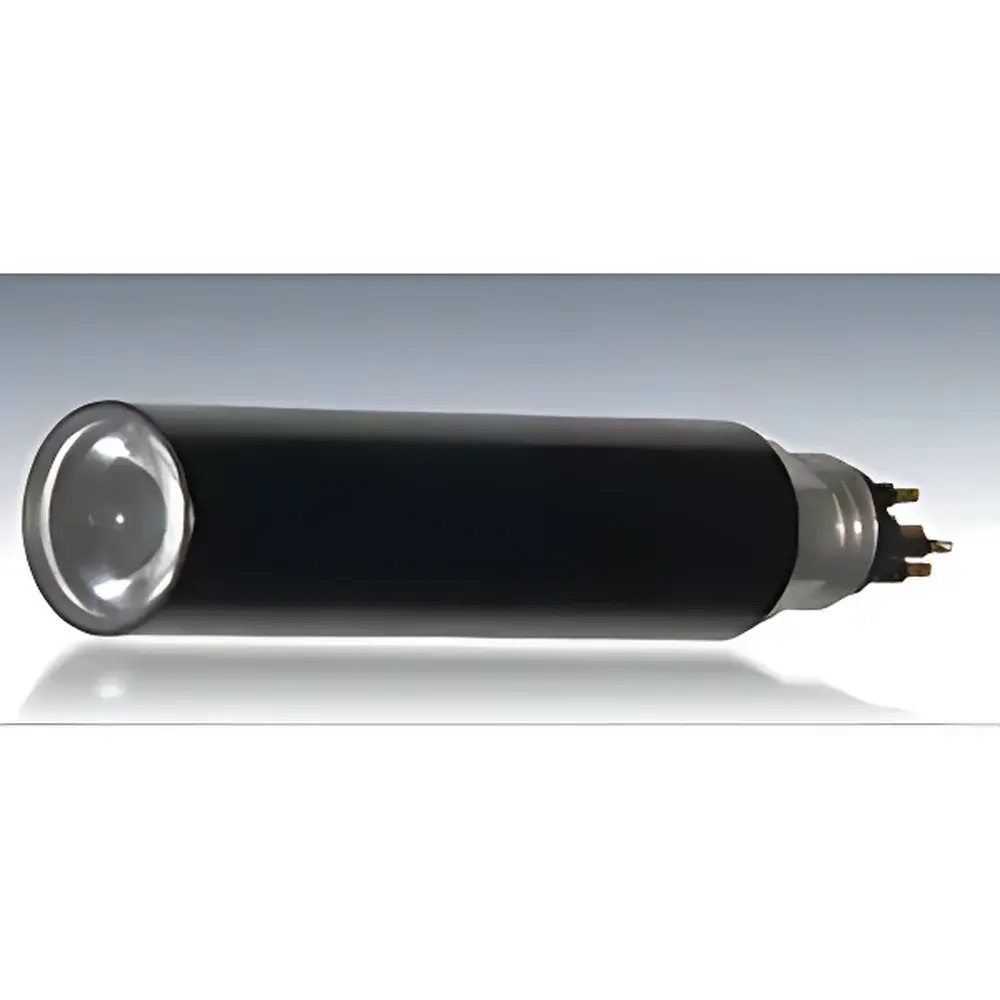
Chelsea Technologies Group Trilux Multi-Parameter Fluorometer
| Origin | UK |
|---|---|
| Manufacturer Type | Distributor |
| Origin Category | Imported |
| Model | Trilux |
| Pricing | Upon Request |
Overview
The Chelsea Technologies Group (CTG) Trilux Multi-Parameter Fluorometer is a compact, field-deployable optical sensor engineered for real-time, in situ quantification of key aquatic biomarkers and optical properties. Operating on the principle of pulsed LED excitation and synchronous fluorescence detection, the Trilux employs three independent, spectrally optimized optical channels to simultaneously measure chlorophyll-a (Chl-a), phycocyanin (PC), and either phycoerythrin (PE) or turbidity—configurable at time of order. Each channel integrates matched excitation/emission optics, temperature-stabilized LEDs, and low-noise photodiode detection with built-in reference monitoring to compensate for LED drift and fouling-induced signal attenuation. Designed for long-term deployment in marine, estuarine, lacustrine, and wastewater environments, the Trilux delivers high reproducibility under variable light conditions through active ambient light suppression and dual-phase lock-in amplification. Its measurement architecture conforms to the physical principles defined in ISO 10260:2021 (Water quality — Determination of chlorophyll-a — In vivo fluorometric method) and supports traceable calibration against NIST-traceable fluorescent standards.
Key Features
- Triple-channel synchronous fluorescence detection with user-selectable third parameter (phycoerythrin or turbidity)
- Integrated reference channel for real-time excitation intensity normalization and drift correction
- Active ambient light rejection via modulated excitation and phase-sensitive detection
- Digital output via RS-232 (standard) or RS-422 (optional); analog 0–5 V output for all three parameters
- User-configurable sampling frequency from 0.1 Hz to 3 Hz, optimized for both profiling and continuous monitoring
- Low-power operation (< 1.2 W typical), suitable for solar-battery or buoy-based deployments
- Dynamic range adjustment per channel via software-controlled gain and integration time
- Compact titanium housing (Ø38 mm × 140 mm) rated to 600 m depth (IP68)
- Factory-calibrated with documented uncertainty budgets traceable to UKAS-accredited standards
Sample Compatibility & Compliance
The Trilux is validated for use in natural and engineered water matrices including seawater, freshwater, brackish systems, and secondary-treated effluents. It exhibits minimal interferences from common dissolved organic matter (DOM) absorbance in the 400–450 nm band due to spectral deconvolution algorithms embedded in firmware. Turbidity measurement (when selected) uses 850 nm near-IR backscatter detection to minimize pigment interference. The instrument complies with EN 14183:2017 (Water quality — Requirements for in situ sensors) and meets mechanical and electrical requirements for CE marking under Directive 2014/30/EU (EMC) and 2014/35/EU (LVD). Data integrity protocols support audit-ready logging aligned with GLP and GMP environmental monitoring frameworks.
Software & Data Management
CTG provides the free, cross-platform Trilux Configuration & Diagnostics Tool (v3.2+) for parameter setup, firmware updates, and real-time telemetry visualization. Raw fluorescence intensities are converted to engineering units (µg/L Chl-a, µg/L PC, RFU PE, FNU turbidity) using factory-applied calibration coefficients stored in non-volatile memory. All outputs include timestamped metadata (UTC time, internal temperature, battery voltage, diagnostic flags). For integration into SCADA or cloud-based platforms (e.g., ThingWorx, AWS IoT Core), the ASCII-based RS-232 protocol includes CRC-16 error checking and supports Modbus RTU mapping upon request. Audit trails and calibration history are exportable as CSV or XML for regulatory submission.
Applications
- Algal bloom early warning systems in reservoirs and coastal zones
- Real-time phytoplankton community structure assessment (cyanobacteria vs. cryptophytes via PC/PE ratio)
- Process control in drinking water treatment plants (pre-oxidation monitoring)
- Buoy-based ecosystem observatories supporting IOOS and EMODnet data streams
- Validation of satellite-derived ocean color products (e.g., Sentinel-3 OLCI)
- Long-term ecological research requiring low-maintenance, high-temporal-resolution bio-optical data
FAQ
Can the Trilux be calibrated in-house without returning to CTG?
Yes—users may perform two-point span calibration using certified reference solutions; full multi-point calibration and verification require CTG’s accredited lab services.
Is the turbidity channel compliant with ISO 7027?
The 850 nm NIR backscatter method satisfies the optical design intent of ISO 7027-1:2016 for formazin-equivalent turbidity, though formal certification applies only to benchtop nephelometers.
What is the minimum detectable Chl-a concentration in clear seawater?
Detection limit is 0.02 µg/L at 1 Hz sampling with 30 s averaging, assuming stable thermal conditions and clean optics.
Does the Trilux support time-synchronized triggering with other CTG sensors (e.g., transmissometers)?
Yes—external TTL trigger input is available via optional accessory cable for coordinated multi-sensor profiling.
How often is anti-fouling maintenance recommended in eutrophic freshwater?
For deployments >30 days in nutrient-rich lakes, CTG recommends quarterly cleaning with enzymatic solution and optical inspection; copper-alloy housings reduce macrofouling incidence by >70% versus stainless steel.







