
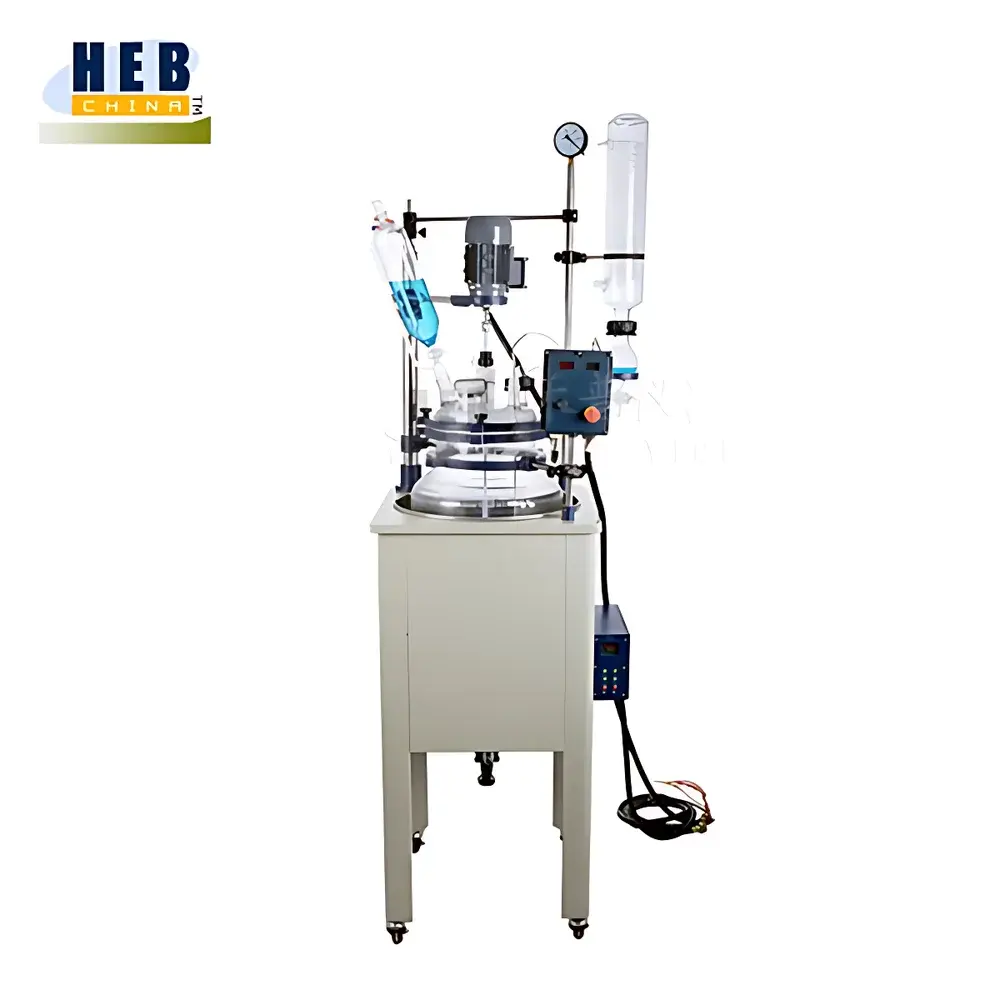
Jihepu EXF-100L Explosion-Proof Single-Layer Glass Reactor
| Brand | Jihepu |
|---|---|
| Origin | Shandong, China |
| Model | EXF-100L |
| Capacity | 100 L |
| Vessel Shape | Cylindrical |
| Working Pressure | Low-pressure |
| Vacuum Degree | 0.098 MPa |
| Operating Temperature Range | −80 °C to +250 °C |
| Stirring Speed | 0–1400 rpm |
| Stirring Motor Power | 370 W |
| Heating Power | 8 kW |
| Voltage/Frequency | Stirring: 220 V / 50 Hz |
| Heating Bath | 380 V / 50 Hz |
| Material (Wetted Parts) | Borosilicate Glass 3.3 + PTFE |
| Frame Material | Cold-Rolled Steel with Anti-Corrosion Coating + Aluminum Alloy |
| Heating Bath Material | 304 Stainless Steel |
| Explosion-Proof Rating | Ex d IIB T4 Gb (IEC 60079-1) |
| Overall Dimensions (W×D×H) | 900 × 770 × 2550 mm |
| Net Weight | 120 kg |
| Certifications | CE-compliant design, conforms to IEC 60079 series for hazardous area equipment |
Overview
The Jihepu EXF-100L Explosion-Proof Single-Layer Glass Reactor is an engineered solution for safe, scalable laboratory-scale synthesis and reaction processes under controlled thermal, vacuum, and inert conditions. Designed for Class II, Group B (hydrogen-adjacent) and Group C (ethylene) hazardous environments, it complies with IEC 60079-1 (flameproof enclosure “d” protection) and integrates a borosilicate glass 3.3 vessel (coefficient of expansion 3.3 × 10⁻⁶ K⁻¹) with full PTFE-wetted components to ensure chemical inertness across acidic, alkaline, and halogenated solvent systems. Unlike jacketed reactors, the EXF-100L employs an external thermostatic oil bath (stainless steel 304 bath pot, 8 kW heating capacity) for uniform conductive heating—enabling precise temperature ramping from −80 °C (with cryogenic coolant circulation) to +250 °C. Vacuum-assisted evaporation and reflux are facilitated via integrated 50# and 40# standard taper ground-glass joints, while the dual-stage agitator (lunar + triple-blade impeller) ensures high-shear mixing and suspension stability in heterogeneous reactions. All electrical subsystems—including motor, frequency converter, and digital control panel—are housed in aluminum alloy flameproof enclosures rated Ex d IIB T4 Gb, suitable for Zone 1 installations per ATEX/IECEx directives.
Key Features
- Explosion-proof architecture: Flameproof motor (370 W), aluminum-clad frequency converter, and intrinsically safe control box with dual digital display (stirring speed and internal temperature)
- Borosilicate glass 3.3 reactor body (Φ465 × 696 mm) with six standardized ports: stirring (Φ60 mm flange), condenser (50# spherical joint), constant-pressure dropping funnel (40# standard taper), vacuum port (34# standard taper), PT100 temperature probe (Φ45 mm flange), and solid feed port (Φ80 mm flange)
- PTFE-lined 304 stainless steel agitator assembly: ceramic bearing support, mechanical seal, and dual-layer impeller (lunar + three-blade) with PTFE-coated blades (Φ17 × 1200 mm shaft, 240 mm span)
- Integrated cooling and reflux system: vertical glass condenser (Φ120 × 600 mm, 0.5 m² surface area) with PTFE-lined inlet/outlet (15 mm OD quick-connect fittings) and adjustable reflux bend with bottom discharge valve (Φ33 mm PTFE plug)
- Dual safety interlocks: thermal fuse on heating circuit and independent overcurrent protection on stirring motor
- Mobility and ergonomics: four lockable casters (350 mm ground clearance), sloped side discharge (34 mm OD hose barb), and drain valve on bath base for rapid coolant exchange
Sample Compatibility & Compliance
The EXF-100L accommodates a broad range of organic, inorganic, and polymerization reactions—including Grignard syntheses, hydrogenations (under H₂ blanket), esterifications, and solvent-based crystallizations—without risk of catalytic leaching or surface adsorption. Its all-glass/PTFE fluid path eliminates metal ion contamination, supporting USP and ISO 10993-12 compatibility for pharmaceutical intermediate development. The reactor meets structural requirements of ASTM E2500 (verification of laboratory equipment) and supports GLP-compliant operation when paired with validated data loggers. While not inherently 21 CFR Part 11 compliant, its analog temperature/vacuum readouts (mechanical gauge + digital display) may be retrofitted with audit-trail-capable controllers for regulated QC environments.
Software & Data Management
The EXF-100L operates as a standalone hardware platform with analog instrumentation (mechanical vacuum gauge, K-type bath sensor, PT100 internal probe) and requires external integration for digital data capture. Users commonly interface the reactor with third-party PID controllers (e.g., Watlow F4T) or SCADA systems via 4–20 mA outputs (available on optional upgrade kits). Temperature and pressure logging can be achieved using calibrated USB thermocouple interfaces (e.g., Omega OM-DAQ-USB-2401) synchronized with LabVIEW or MATLAB. For traceability, manual logbooks remain the default compliance method; electronic records require validation per ALCOA+ principles if deployed in GMP workflows.
Applications
- Process development of active pharmaceutical ingredients (APIs) under reduced-pressure distillation and controlled exotherm management
- Synthesis of lithium-ion battery electrolyte additives requiring anhydrous, oxygen-free handling (compatible with Schlenk line integration)
- Scale-up studies of fine chemical intermediates (10–100 L batch range) prior to pilot-plant transfer
- Education and training in reaction engineering, emphasizing hazard analysis (HAZOP), thermal runaway mitigation, and explosion venting fundamentals
- Material compatibility screening for novel solvents (e.g., fluorinated ethers, deep eutectic solvents) under extended reflux conditions
FAQ
Is the EXF-100L certified for use in Zone 1 classified areas?
Yes—the motor, frequency converter, and control housing carry Ex d IIB T4 Gb certification per IEC 60079-1, permitting installation in Zone 1 (gas group IIB, T4 temperature class) when installed per IEC 60079-14 guidelines.
What vacuum level can be sustained during prolonged operation?
The system achieves and maintains ≤0.098 MPa (≤2 mbar abs) vacuum when coupled with a two-stage rotary vane pump and properly sealed ground-glass joints; actual performance depends on solvent vapor pressure and cold trap efficiency.
Can the reactor be used for hydrogenation reactions?
Yes—provided appropriate gas dispersion impellers and leak-tested H₂ inlet lines are installed; users must verify compatibility of PTFE seals with hydrogen embrittlement at elevated temperatures.
What cooling utilities are required for condenser operation?
A recirculating chiller capable of delivering ≤−10 °C ethylene glycol/water mixture at ≥10 L/min flow rate is recommended for efficient condensation of low-boiling solvents (e.g., diethyl ether, THF).
Does the unit include documentation for IQ/OQ protocol execution?
Factory documentation includes dimensional drawings, material certificates (304 SS, borosilicate glass 3.3), and explosion-proof certification reports; however, site-specific IQ/OQ protocols must be developed by the end user’s validation team in accordance with ISO/IEC 17025 or FDA guidance.



