
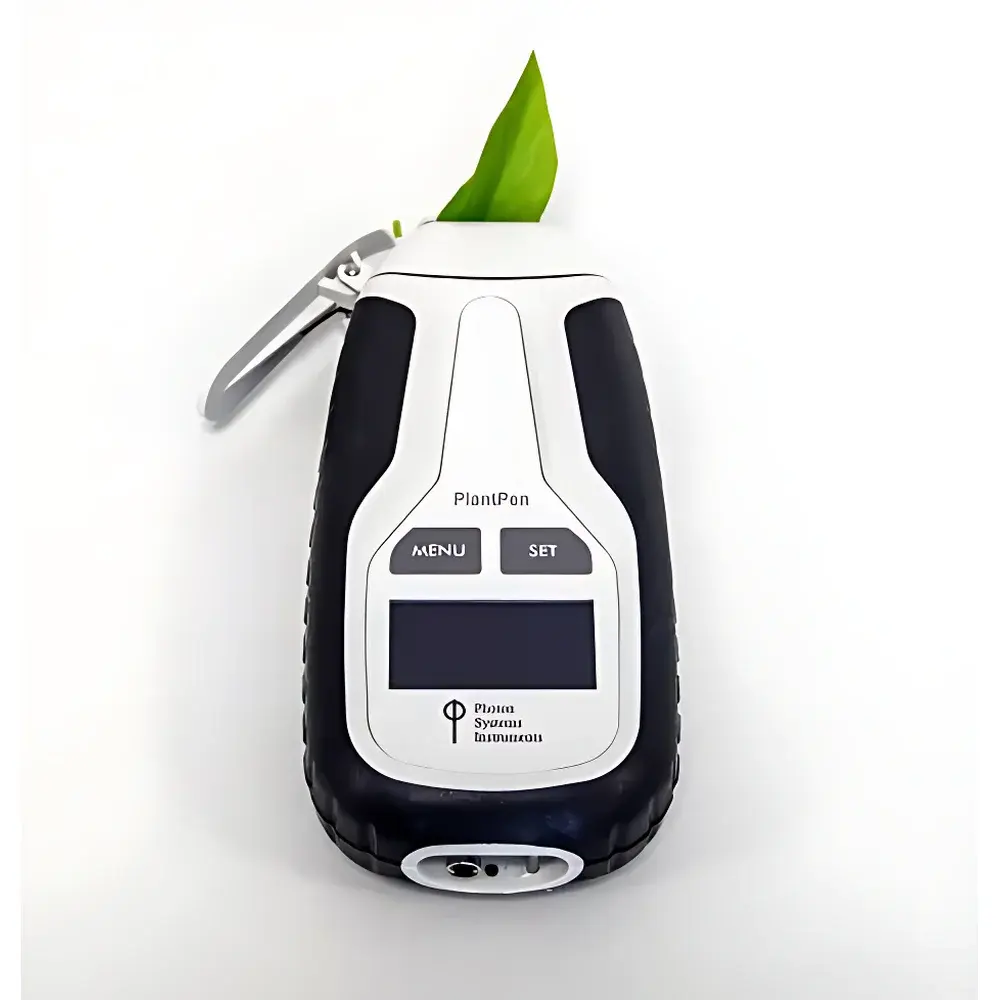
PSI PlantPen Portable Leaf-Clip PRI & NDVI Spectral Index Meter
| Brand | PSI (Photon Systems Instruments) |
|---|---|
| Origin | Czech Republic |
| Model | PlantPen PRI 210 / NDVI 310 |
| Measurement Principle | Dual-wavelength reflectance ratio analysis |
| PRI Band | 531 nm & 570 nm (detection range: 500–600 nm) |
| NDVI Band | 635 nm (red) & 760 nm (NIR) (detection range: 620–750 nm) |
| PRI Formula | (R₅₃₁ − R₅₇₀) / (R₅₃₁ + R₅₇₀) |
| NDVI Formula | (Rₙᵢᵣ − Rᵣₑ ) / (Rₙᵢᵣ + Rᵣₑ ) |
| Data Storage | 100,000 measurements (16 MB internal memory) |
| Connectivity | Bluetooth 1.1 + USB 2.0 |
| Display | Graphical LCD |
| Keypad | Sealed, waterproof two-button interface |
| Power | Rechargeable Li-ion battery (70 h continuous operation, auto-shutdown after 5 min idle) |
| Dimensions | 135 × 65 × 33 mm |
| Weight | 188 g |
| Operating Temp | 0–55 °C |
| Relative Humidity | 0–95% RH (non-condensing) |
| Storage | −10–60 °C, 0–95% RH (non-condensing) |
Overview
The PSI PlantPen is a field-deployable, leaf-clip spectral index meter engineered for rapid, non-destructive quantification of photochemical and structural vegetation indices directly on intact plant foliage. It operates on the principle of dual-band reflectance ratio spectroscopy—measuring wavelength-specific reflectance at precisely defined optical bands and computing standardized spectral indices in real time. Unlike imaging or scanning spectrometers, the PlantPen employs fixed-wavelength, high-stability LEDs and matched photodetectors to deliver laboratory-grade repeatability under variable ambient conditions. Its core measurement paradigms are grounded in established biophysical theory: the Photochemical Reflectance Index (PRI) targets dynamic xanthophyll cycle activity linked to photosynthetic energy dissipation, while the Normalized Difference Vegetation Index (NDVI) serves as a robust proxy for chlorophyll concentration and canopy light absorption efficiency. Designed for ecophysiological fieldwork, the instrument bridges the gap between handheld simplicity and scientific rigor—enabling quantitative assessment of photosynthetic performance, water status, nutrient use efficiency, and abiotic stress responses without sample excision or calibration drift.
Key Features
- Two dedicated configurations: PlantPen PRI 210 (531 nm / 570 nm) and PlantPen NDVI 310 (635 nm / 760 nm), each optimized for spectral fidelity within its target bandpass
- Integrated GPS module with synchronized timestamping—ensuring spatially referenced, audit-ready datasets compliant with FAO and IGBP metadata standards
- Dual communication architecture: Bluetooth 1.1 for real-time remote control and live data streaming; USB 2.0 for bulk export of structured CSV/Excel-compatible files
- Robust mechanical design: IP65-rated sealed keypad, anodized aluminum housing, and temperature-compensated optics for stable operation across 0–55 °C
- Extended field autonomy: 70-hour continuous runtime on a single Li-ion charge, with low-battery warning and automatic power-down after 5 minutes of inactivity
- High-density onboard storage: 16 MB flash memory supporting up to 100,000 indexed measurements with full spectral metadata (time, location, index value, instrument ID)
Sample Compatibility & Compliance
The PlantPen accommodates leaves ranging from 0.5 mm to 4.5 mm in thickness—including broadleaf angiosperms, conifer needles, bryophytes, and lichens—without compression artifacts or edge effects. Its clip geometry ensures consistent illumination geometry (45° incidence / 45° collection) and minimizes shadowing. The instrument adheres to ISO 17025-aligned traceability protocols for optical source stability and detector linearity verification. While not certified for regulatory submission per se, its output indices align with ASTM E2933-22 (Standard Guide for Spectral Reflectance Measurements of Vegetation) and support GLP-compliant experimental workflows when paired with documented SOPs. All firmware and data export modules comply with FDA 21 CFR Part 11 requirements for electronic records and signatures when used in agricultural research trials subject to regulatory review.
Software & Data Management
PlantPen data are managed via PSI’s proprietary PlantPen Control Suite (Windows/macOS), which provides real-time visualization, batch processing, and geospatial overlay capabilities. Each measurement record includes UTC timestamp, WGS84 coordinates (±3 m CEP), instrument serial number, firmware version, and raw reflectance values (Rλ1, Rλ2). Export formats include native .ppd binary (for advanced spectral reprocessing), tab-delimited ASCII, and Excel (.xlsx) with embedded metadata sheets. The software supports automated QA/QC flagging based on signal-to-noise thresholds and user-defined physiological bounds (e.g., PRI 0.9 triggers manual review). Audit trails log all data modifications, user actions, and software updates—meeting ISO/IEC 17025 clause 7.7.2 requirements for data integrity assurance.
Applications
- Early detection of drought-induced photoinhibition through PRI dynamics—tracking diurnal xanthophyll de-epoxidation before visible wilting occurs
- Quantifying nitrogen use efficiency (NUE) gradients across crop canopies using NDVI-derived chlorophyll surrogates correlated with SPAD-502 validation studies
- Comparative stress phenotyping in lichen and bryophyte communities—validating species-specific NDVI decay thresholds during desiccation-rehydration cycles (e.g., Umbilicaria spp. studies)
- Forestry inventory support: rapid screening of canopy vitality in mixed-species stands where traditional NDVI saturates above LAI = 3
- Field-based validation of satellite-derived vegetation indices—providing ground-truth point measurements for Sentinel-2 and Landsat Level-2 products
- Undergraduate and graduate teaching labs: hands-on demonstration of spectral vegetation index theory, light–photosynthesis relationships, and environmental physiology principles
FAQ
Does the PlantPen require external calibration before each use?
No. The instrument performs factory calibration against NIST-traceable reflectance standards. Field recalibration is unnecessary under normal operating conditions; however, users may execute optional dark-current and white-reference checks via the control software every 48 hours in high-UV environments.
Can PRI and NDVI be measured simultaneously on the same leaf?
Not with a single device unit. The PlantPen is configured as either PRI 210 or NDVI 310 at time of manufacture. However, both models share identical ergonomics, software, and data structure—enabling parallel deployment in paired experimental designs.
Is GPS accuracy sufficient for plot-level mapping?
Yes. With SBAS (WAAS/EGNOS) enabled, horizontal accuracy is typically ≤3 m RMS—adequate for subplot identification in field trials, transect-based monitoring, and GIS-integrated phenotyping pipelines.
How does the PlantPen handle specular reflection from waxy or hairy leaf surfaces?
The 45°/45° optical geometry inherently minimizes specular contribution. Additionally, the firmware applies a validated empirical correction factor derived from controlled goniometric reflectance studies on 27 plant species—including Populus tremuloides, Zea mays, and Sphagnum fuscum.
What is the minimum recommended leaf area for reliable measurement?
A fully enclosed leaf area ≥1.2 cm² is required to ensure uniform illumination and avoid edge diffraction errors. Smaller leaves (e.g., young Arabidopsis rosettes) should be measured using the optional micro-clip adapter (sold separately).




