
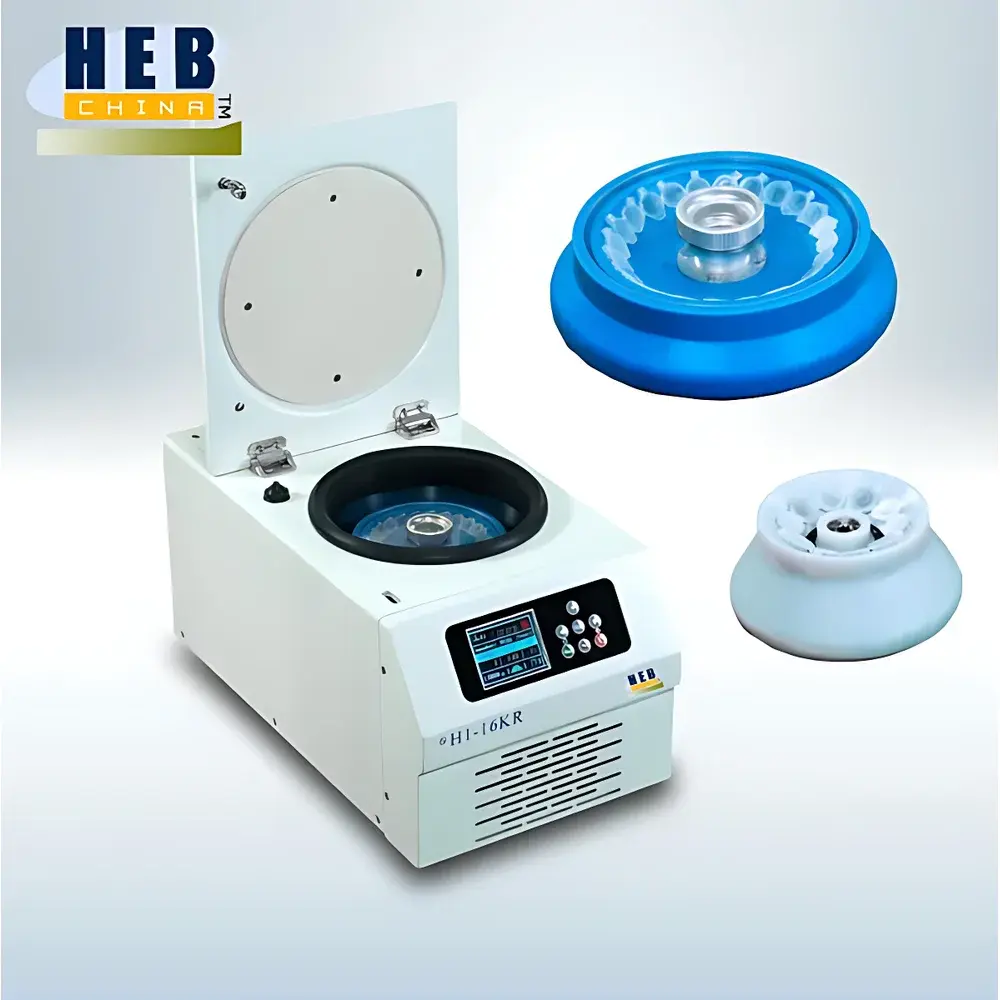
Hebei HOP H1-16KR Benchtop High-Speed Refrigerated Centrifuge
| Brand | Hebei HOP |
|---|---|
| Origin | Shandong, China |
| Model | H1-16KR |
| Max Speed | 16500 rpm |
| Max RCF | 18757 ×g |
| Max Capacity | 12 × 5 mL |
| Temperature Range | −20 °C to 40 °C |
| Temp. Accuracy | ±1.0 °C |
| Timer Range | 1–99 min |
| Acceleration/Deceleration | 10 steps |
| Programs Stored | 40 |
| Noise Level | ≤65 dB(A) |
| Dimensions (W×D×H) | 510×280×270 mm |
| Net Weight | 40 kg |
| Power Supply | AC 220 V ±10%, 50 Hz, 10 A |
| Total Power | 550 W |
Overview
The Hebei HOP H1-16KR is a benchtop high-speed refrigerated centrifuge engineered for precision separation of biological macromolecules—including nucleic acids, proteins, organelles, and viral particles—in resource-constrained or space-limited laboratory environments. Operating on the principle of sedimentation under controlled gravitational force (RCF), the instrument delivers reproducible pelleting and stratification through precise regulation of rotational speed, acceleration/deceleration profiles, and thermal stability. Its compact footprint (510 × 280 × 270 mm) and integrated refrigeration system enable sustained operation at temperatures as low as −4 °C even at maximum speed (16,500 rpm), ensuring sample integrity during extended high-G protocols. Designed for routine use in molecular biology, clinical diagnostics, and academic research labs, the H1-16KR conforms to fundamental mechanical safety and electromagnetic compatibility standards applicable to Class II laboratory equipment under IEC 61010-1.
Key Features
- Robust all-steel construction with stainless-steel centrifuge chamber for corrosion resistance and long-term structural integrity.
- Brushless AC frequency-controlled motor delivering smooth, low-vibration rotation and acoustic performance ≤65 dB(A) at full load.
- High-resolution color LCD interface with real-time display of speed (rpm), relative centrifugal force (RCF), temperature, time remaining, and acceleration/deceleration stage.
- Dynamic parameter adjustment: users may modify speed, temperature, or time during active runs without interrupting the cycle.
- Automatic RCF calculation synchronized with speed input—eliminating manual conversion errors per ISO 21501-4 conventions.
- Programmable control with 40 user-defined protocols, each supporting independent ramp/dwell/brake settings across 10 acceleration and deceleration steps.
- Electronically interlocked safety door with auto-braking and rotor imbalance detection compliant with EN 61000-6-3 EMC requirements.
- High-efficiency eco-refrigeration system using non-ozone-depleting refrigerant; maintains chamber temperature within ±1.0 °C across the full −20 °C to +40 °C setpoint range.
Sample Compatibility & Compliance
The H1-16KR supports standard microcentrifuge tube formats via interchangeable fixed-angle rotors—including configurations for 16 × 1.5/2.2 mL (16,500 rpm / 18,360 ×g), 12 × 5 mL (15,000 rpm / 15,940 ×g), and 24 × 1.5/2.2 mL (14,000 rpm / 18,757 ×g). All rotors are balanced to ISO 15712-1 tolerances and certified for continuous operation under specified RCF limits. The unit meets essential regulatory expectations for biosafety and data traceability: rotor run logs (including date, time, speed, temperature, and program ID) are retained in non-volatile memory and support GLP-aligned recordkeeping. While not FDA 21 CFR Part 11–certified out-of-the-box, its programmable audit trail functionality enables integration into validated workflows where electronic signature and change-control protocols are implemented externally.
Software & Data Management
The H1-16KR operates independently without PC dependency; however, its embedded firmware supports USB export of runtime logs (CSV format) for post-acquisition analysis in Excel or LIMS platforms. Timestamped event records include start/stop times, actual vs. setpoint deviations, fault codes, and rotor identification. No proprietary software installation is required—data files are human-readable and compatible with common laboratory informatics systems. Firmware updates are performed via USB stick following documented version-control procedures, ensuring traceability per ISO/IEC 17025 clause 5.9.
Applications
This centrifuge is routinely deployed in nucleic acid purification workflows (e.g., plasmid prep, RNA isolation), protein fractionation (e.g., membrane vesicle pelleting), PCR setup preparation, serum/plasma separation in clinical chemistry, and small-volume cell harvesting in immunology and virology studies. Its −20 °C to +40 °C temperature flexibility supports both cold-sensitive enzyme preservation and heat-assisted phase separation protocols. Universities utilize it for undergraduate teaching labs requiring robust, intuitive instrumentation; hospitals deploy it in core diagnostic labs where reliability and rapid cooldown between runs improve throughput.
FAQ
What is the minimum operating temperature at maximum speed?
At 16,500 rpm, the chamber maintains ≤−4 °C under standard ambient conditions (25 °C, 50% RH).
Is rotor calibration required before first use?
No—factory-calibrated rotors are supplied with serial-numbered certificates of conformity referencing ISO 15712-1 balance tolerances.
Can the centrifuge be operated without refrigeration?
Yes; temperature can be set to “ambient” or any value between −20 °C and 40 °C, including 25 °C for room-temperature protocols.
How is imbalance protection implemented?
Vibration sensors continuously monitor radial displacement; if threshold deviation exceeds 0.15 mm RMS, the system initiates immediate deceleration and displays error code E07.
Are third-party rotors supported?
Only Hebei HOP–certified rotors are validated for mechanical and thermal compatibility; use of non-approved accessories voids warranty and compromises safety certification.



