
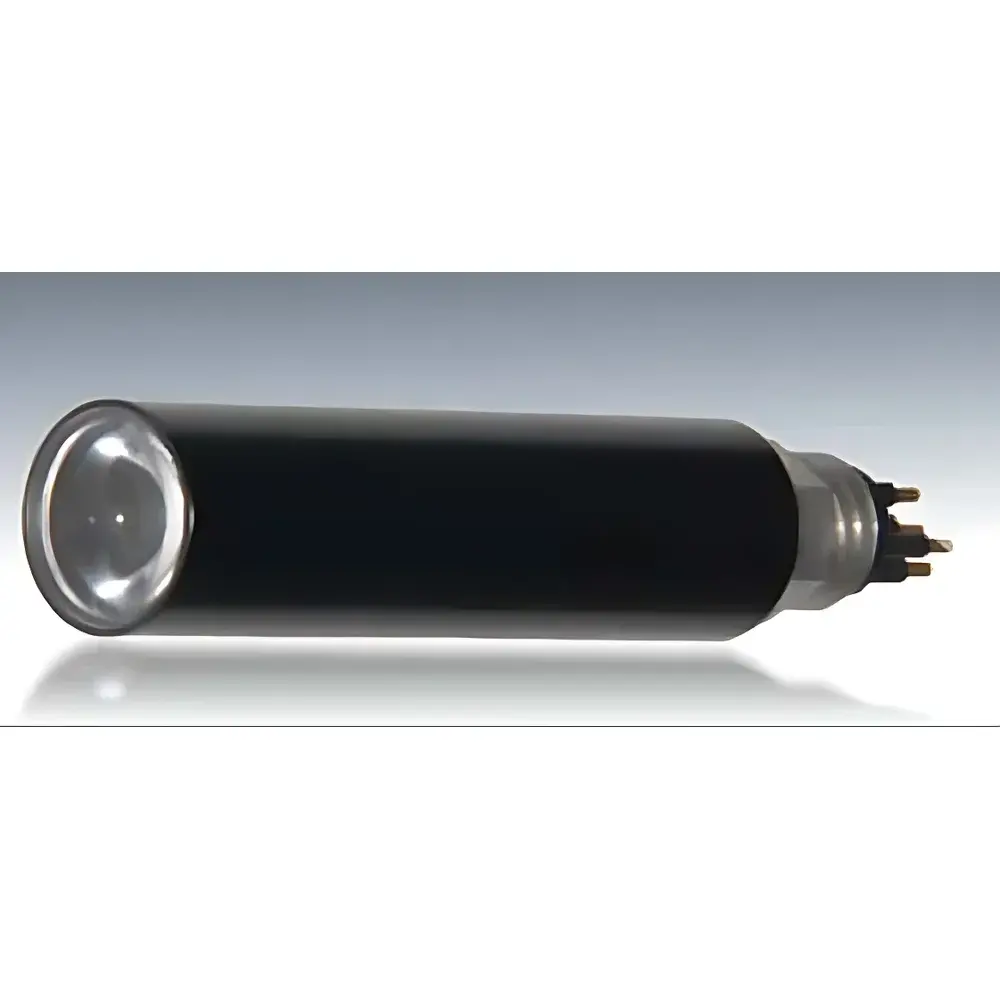
Chelsea TriLux Multi-Parameter Fluorometer
| Brand | Chelsea |
|---|---|
| Origin | UK |
| Manufacturer Type | Authorized Distributor |
| Origin Category | Imported |
| Model | TriLux |
| Price | Upon Request |
Overview
The Chelsea TriLux Multi-Parameter Fluorometer is a compact, submersible optical sensor engineered for high-sensitivity, in situ fluorescence and turbidity measurements in aquatic environments. Based on solid-state LED excitation and precision photodiode detection, the TriLux operates on the principle of selective fluorophore excitation and emission band isolation—enabling simultaneous, real-time quantification of three optically distinct parameters within a single housing. Its core measurement architecture leverages calibrated, narrow-band excitation wavelengths (470 nm for chlorophyll a, 530 nm for phycoerythrin, 610 nm for phycocyanin, and 685 nm for both chlorophyll a emission and turbidity backscatter) coupled with wavelength-matched detection filters to minimize spectral crosstalk and environmental interference. Designed for deployment across diverse platforms—including fixed-point moorings, vertical profiling systems, towed bodies, and ROV/AUV payloads—the TriLux delivers laboratory-grade fluorescence resolution in a pressure-rated (600 m), low-power (<1 W @ 12 V DC), and field-rugged form factor.
Key Features
- Triple-parameter simultaneous measurement: Chlorophyll a (standard) + two user-selectable channels from phycoerythrin, phycocyanin, or turbidity
- Factory-calibrated chlorophyll a channel spanning 0–100 µg/L (acetone-extracted equivalent); turbidity channel calibrated to 0–100 FTU
- Adjustable dynamic range via GUI-controlled LED excitation intensity—preserving factory calibration through integrated reference LED monitoring
- Dual-output interface: RS232 digital output + 0–5 V analog output (RS422 or SDI-12 available as optional configurations)
- Optimized optical design with built-in reference excitation monitoring and ambient light suppression circuitry for daylight operation
- Low detection limit: 0.1% of full-scale range (e.g., 0.1 µg/L for chlorophyll a at 100 µg/L span)
- Compact cylindrical form factor: 26.5 mm diameter × 105 mm length (140 mm including MCBH-6-MP-SS connector); air weight: 100 g
- Pressure-rated housing (acetal C) certified to 600 m depth; operating voltage: 11–25 V DC
Sample Compatibility & Compliance
The TriLux is validated for direct immersion in marine, brackish, and freshwater matrices without sample pre-treatment. Its optical path is insensitive to moderate biofouling due to hydrophobic surface treatment and self-cleaning flow dynamics during towing or profiling deployments. While not a certified reference method per se, TriLux data aligns with ASTM D3731 (Standard Test Method for Chlorophyll a in Water by Fluorometric Measurement) and supports compliance workflows under EPA Method 445.0 and ISO 10260 for phytoplankton pigment estimation. The instrument’s analog and digital outputs are compatible with SCADA, data loggers, and telemetry systems conforming to IEC 61131-3 and Modbus RTU protocols. All firmware and GUI operations maintain audit-trail-ready metadata (timestamp, LED intensity setting, gain state), facilitating GLP-aligned field data collection.
Software & Data Management
The TriLux is operated via a Windows-based Graphical User Interface (GUI) that enables real-time visualization, time-series logging, and configuration control—including sampling frequency (0.1–3 Hz), LED drive level, and output scaling. The GUI stores all calibration coefficients and sensor-specific correction factors in non-volatile memory, ensuring traceability across deployments. Raw data exports are provided in CSV format with embedded engineering units (µg/L, FTU, mV) and metadata headers compliant with CF Metadata Conventions v1.8. For integration into larger observatory networks, the RS232/RS422 serial protocol supports ASCII command-response framing with configurable baud rates (up to 115.2 kbps) and hardware handshaking. Optional firmware updates preserve backward compatibility and extend support for emerging fluorescence standards such as phycoerythrobilin quantification in cyanobacterial blooms.
Applications
- In situ chlorophyll a profiling for phytoplankton biomass assessment in oligotrophic and eutrophic waters
- Dual-pigment discrimination (phycoerythrin vs. phycocyanin) to identify cyanobacterial genera (e.g., Microcystis vs. Trichodesmium) in bloom monitoring programs
- Turbidity-correlated particle load estimation in sediment transport studies and dredging impact assessments
- Real-time dye tracing experiments for hydrodynamic model validation
- Long-term unattended monitoring on moored buoys, gliders, or autonomous surface vehicles (ASVs)
- Process control feedback in aquaculture recirculation systems and wastewater effluent monitoring
FAQ
What is the recommended calibration interval for field-deployed TriLux sensors?
Chelsea Technologies recommends annual recalibration against NIST-traceable standards or secondary reference materials (e.g., extracted chlorophyll a in acetone) when used in regulatory or research-critical applications.
Can the TriLux be deployed in turbid estuarine environments without signal saturation?
Yes—the user-adjustable LED intensity and wide dynamic range (0–100 µg/L chlorophyll a equivalent) allow optimization for high-scatter conditions; however, optical window cleaning is advised for deployments exceeding 30 days in silt-laden water.
Is the GUI software compatible with Linux or macOS?
The native GUI is Windows-only; however, raw serial data streams (ASCII) are platform-agnostic and can be parsed using Python, MATLAB, or LabVIEW on any OS.
Does the TriLux meet FDA 21 CFR Part 11 requirements for electronic records?
While the TriLux itself is not a regulated medical device, its timestamped, immutable CSV logs—when collected via validated acquisition software—can satisfy ALCOA+ principles for GxP-aligned environmental monitoring when paired with procedural controls.
How does the built-in reference LED ensure long-term calibration stability?
The reference LED monitors excitation source drift in real time; firmware applies compensatory gain adjustments to maintain signal linearity without altering stored calibration coefficients—enabling stable performance over thermal and aging cycles.







