
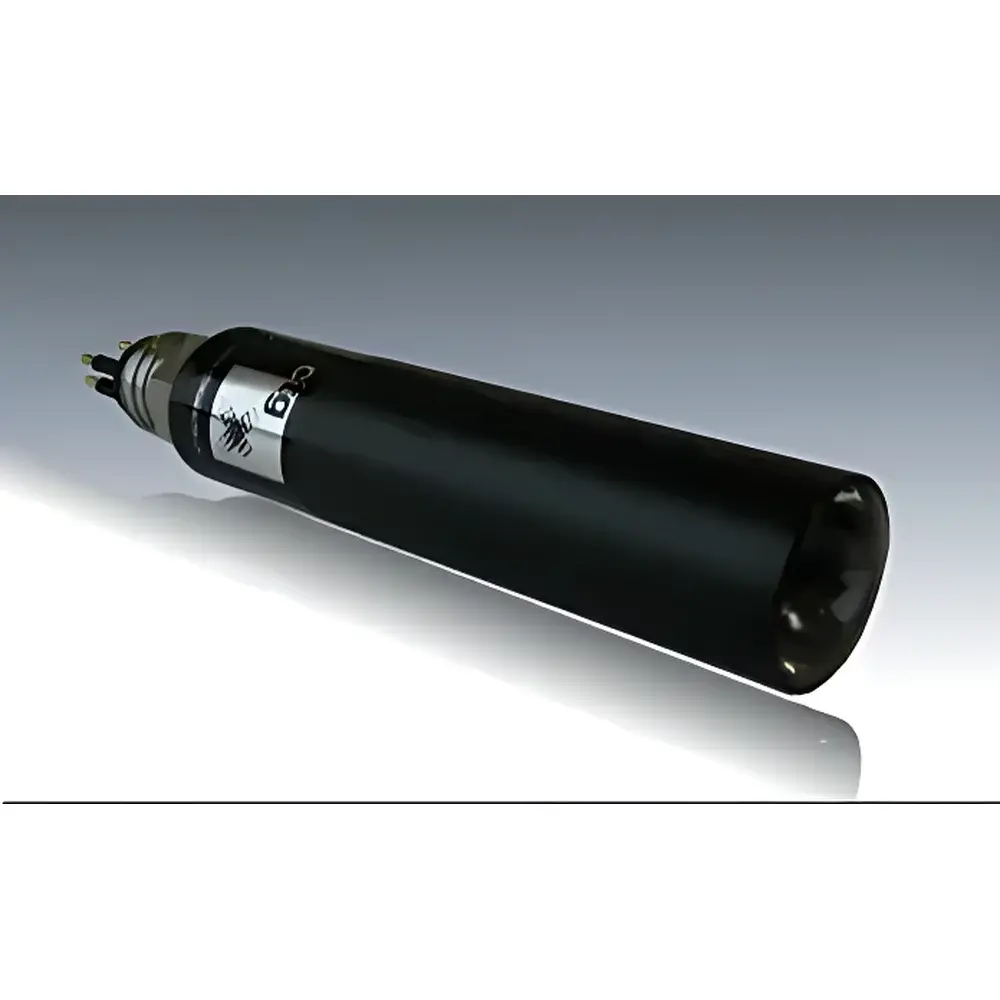
Chelsea UniLux Single-Parameter Fluorescence Sensor
| Brand | Chelsea |
|---|---|
| Origin | United Kingdom |
| Manufacturer | Chelsea Technologies Group Ltd. (CTG) |
| Model | UniLux |
| Output Options | RS232 + 0–5 V analog (RS422 or SDI-12 optional) |
| Excitation Wavelength | User-selectable per fluorophore |
| Detection Limits | Chlorophyll a < 0.01 µg/L |
| Dynamic Range | 0–100 µg/L (fluorophores), 0–100 FTU (turbidity) |
| Sampling Frequency | 0.1–3 Hz (user-adjustable) |
| Dimensions | Ø26.5 mm × 105 mm (140 mm including connector) |
| Weight in Air | 100 g |
| Pressure Rating | 600 m |
| Housing Material | Acetal |
| Operating Voltage | 11–25 V DC |
| Power Consumption | 1 W @ 12 V DC |
| Interface | MCBH-6-MP-SS |
Overview
The Chelsea UniLux is a compact, submersible single-parameter fluorescence sensor engineered for high-sensitivity, field-deployable quantification of naturally occurring and tracer fluorophores in aquatic environments. Based on precision LED-excited fluorescence detection with built-in reference photodiode compensation, the UniLux operates on the principle of selective excitation and emission wavelength matching—enabling accurate, interference-resistant measurement of chlorophyll a, phycocyanin, phycoerythrin, fluorescein, or rhodamine WT. Its optical architecture minimizes solar-induced background noise through active excitation intensity control and internal referencing, ensuring stable performance under variable ambient light conditions—including direct sunlight exposure during surface profiling or buoy-mounted deployments. Designed for integration into fixed-point monitoring stations, autonomous underwater vehicles (AUVs), remotely operated vehicles (ROVs), towed bodies, and vertical profilers, the UniLux delivers laboratory-grade reproducibility in a pressure-rated (600 m), low-power (1 W), and lightweight (100 g) package.
Key Features
- Submersible acetal housing rated to 600 m depth with MCBH-6-MP-SS wet-mateable connector
- User-selectable excitation wavelength optimized per target fluorophore (e.g., 470 nm for chlorophyll a, 590 nm for phycoerythrin)
- Digital RS232 output and factory-calibrated 0–5 V analog output (RS422 or SDI-12 available as options)
- Adjustable sampling frequency from 0.1 Hz to 3 Hz via embedded firmware or GUI
- Dynamic range tuning via software-controlled LED drive intensity—preserving NIST-traceable calibration through real-time reference diode feedback
- Low-turbidity breakthrough capability with integrated turbidity channel (0–100 FTU, LOD < 0.02 FTU)
- Power-efficient operation: 1 W at 12 V DC; compatible with battery-, solar-, or mains-powered platforms
- Onboard temperature compensation and non-linear signal correction algorithms for enhanced long-term stability
Sample Compatibility & Compliance
The UniLux is validated for use in marine, estuarine, lacustrine, and potable water matrices across salinities up to 40 PSU and temperatures from 0 °C to 40 °C. Its optical design complies with ISO 10260:2022 (water quality — determination of chlorophyll a by fluorescence) and supports method validation under EPA Method 445.0 (in vivo chlorophyll a). While not certified for regulatory reporting without site-specific calibration verification, the sensor meets the instrumental performance criteria outlined in ASTM D7212 – 18 (standard test method for chlorophyll a in water by fluorescence). All factory calibrations are traceable to CTG’s UKAS-accredited (ISO/IEC 17025) photometric reference standards. The device supports GLP-compliant data logging when paired with compliant acquisition systems, and its digital outputs facilitate audit-ready timestamping and metadata embedding.
Software & Data Management
The UniLux is supported by Chelsea’s Windows-based UniLux GUI—a configuration, visualization, and data logging application enabling real-time plotting, parameter adjustment (LED intensity, sampling interval, zero offset), and export to CSV or MATLAB-compatible formats. The GUI maintains full calibration history, records instrument status flags (e.g., saturation, low signal, temperature drift warning), and allows user-defined scaling to engineering units (µg/L, mg/m³, RFU). For OEM integration, ASCII protocol documentation and register maps for RS232/RS422 are provided under NDA. No proprietary drivers are required; communication uses standard serial protocols compatible with Campbell Scientific CR-series loggers, National Instruments DAQ systems, and custom Python/C++ applications. Firmware updates are performed in-field via serial interface without hardware modification.
Applications
- Real-time chlorophyll a monitoring in eutrophication studies and algal bloom early-warning systems
- Phycobiliprotein-based cyanobacterial biomass tracking in reservoirs and drinking water sources
- Dye tracing experiments for hydrodynamic modeling and groundwater/surface water interaction studies
- Vertical profiling of phytoplankton distribution using CTD-mounted or ROV-integrated configurations
- Process control in aquaculture recirculation systems and wastewater treatment bioreactors
- Long-term moored deployments on buoys and coastal observatories requiring low power and high reliability
- Calibration transfer between benchtop fluorometers and in situ sensors via co-located deployment protocols
FAQ
Is the UniLux suitable for freshwater and seawater applications?
Yes—the sensor is calibrated and validated across a salinity range of 0–40 PSU and operates reliably in both freshwater lakes and marine environments.
Can I change the measured fluorophore after purchase?
Yes—optical filters and excitation LEDs are pre-configured per order, but the firmware and GUI support reconfiguration for any supported fluorophore if hardware components are swapped per CTG service guidelines.
Does the UniLux meet FDA 21 CFR Part 11 requirements?
The UniLux itself is not a standalone Part 11 system; however, when integrated with compliant data acquisition software featuring electronic signatures, audit trails, and secure user access, it contributes to Part 11–aligned workflows in pharmaceutical or food safety water testing.
What maintenance is required in long-term deployments?
No routine optical cleaning is needed for typical deployments ≤3 months; biofouling mitigation is achieved via optional copper-alloy shrouds or periodic wiper mechanisms. CTG recommends post-deployment optical window inspection and factory recalibration every 12 months or after exposure to abrasive sediments.
How is factory calibration preserved during dynamic range adjustment?
The UniLux uses an internal reference photodiode to monitor LED output in real time; all gain adjustments are mathematically compensated to maintain absolute concentration accuracy relative to the original NIST-traceable calibration curve.







