
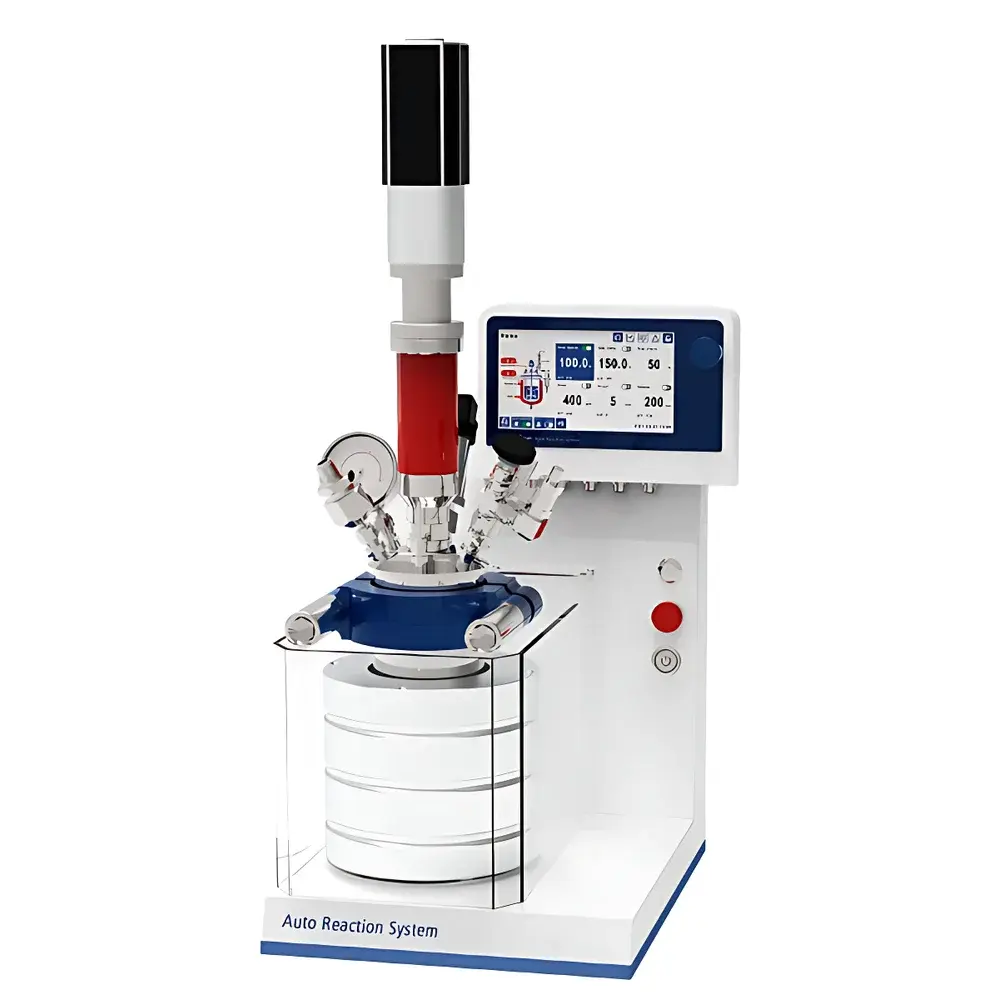
ChemTron BR-100/300 Touchscreen High-Pressure Reactor
| Brand | ChemTron |
|---|---|
| Origin | Germany |
| Model | BR-100/300 |
| Material | SS316Ti or Hastelloy C |
| Max Operating Pressure | 200 bar |
| Max Temperature (bare) | 300 °C |
| Max Temperature (PTFE-lined) | 230 °C |
| Internal Volume | 75–225 mL |
| Sealing | Quick-release clamp with LC-KEY safety interlock |
| Stirring | Bottom-mounted magnetic stirrer (BR-100) / Top-mounted magnetic coupling stirrer (BR-300) |
| Safety Features | Burst disc, pressure relief valve (optional), nitrogen leak-tested, 1.6× pressure certification |
| Heating | Optional electric heating jacket |
| Cooling | Integrated cooling ring with solenoid valve |
| Compliance | Designed per PED 2014/68/EU, ASME BPVC Section VIII Div. 1 (as-built configuration) |
Overview
The ChemTron BR-100/300 Touchscreen High-Pressure Reactor is an engineered solution for controlled synthesis, catalytic screening, hydrogenation, oxidation, and supercritical fluid reactions under rigorously defined thermal and mechanical conditions. Based on Couette-type flow dynamics and pressure-retentive vessel architecture, the system operates on sealed-batch principles—ensuring stoichiometric integrity, gas-phase mass balance control, and reproducible kinetic profiling. Constructed from high-purity SS316Ti or Hastelloy C alloys, the reactor integrates PTFE-lined variants to extend chemical compatibility without compromising structural integrity. All units comply with the Pressure Equipment Directive (PED 2014/68/EU) and are factory-certified at 1.6× maximum allowable working pressure (MAWP) using nitrogen leak testing per ISO 15848-1. The touchscreen HMI enables real-time monitoring of pressure, temperature, stirring speed, and safety status—fully traceable for GLP/GMP-aligned workflows.
Key Features
- Quick-release clamping system with LC-KEY mechanical interlock—physically prevents pressurized lid opening per EN ISO 13857 safety standards
- Dual-material construction: corrosion-resistant SS316Ti or Hastelloy C body; optional PTFE liner (chemically inert up to 230 °C, compatible with HF, aqua regia, and strong oxidizers)
- Redundant pressure safety: standard rupture disc + optional pressure relief valve, analog/digital pressure transducer, and calibrated Bourdon-tube gauge
- Thermal management: integrated cooling ring with fast-response solenoid valve for exothermic quenching; electric heating jacket (optional) supports ramp rates up to 10 °C/min with ±1 °C stability
- Stirring architecture: BR-100 employs bottom-mounted magnetic drive (max. 1200 rpm); BR-300 uses top-entry magnetic coupling (max. 800 rpm, torque-rated for viscous media)
- Modular port configuration: 5–6 standardized 8 mm tube ports (G¼” internal thread), including dedicated thermowell, pressure tap, vent, and auxiliary feed lines
Sample Compatibility & Compliance
The BR-100/300 accommodates heterogeneous slurries, gas–liquid interfaces, and solid-catalyzed reactions across pH 0–14 and redox potentials up to +1.8 V vs. SHE. PTFE-lined variants eliminate metal leaching in pharmaceutical intermediate synthesis (aligned with ICH Q5D and USP elemental impurity controls). Non-lined Hastelloy C configurations support chlorination, fluorination, and high-temperature sulfidation processes per ASTM D7467 and ISO 15136-1. All pressure-containing components undergo 100% ultrasonic thickness verification and hydrostatic proof testing. Documentation includes EU Declaration of Conformity, material test reports (EN 10204 3.1), and FAT/SAT protocols compliant with FDA 21 CFR Part 11 data integrity requirements.
Software & Data Management
The embedded touchscreen controller logs timestamped pressure, temperature, stirring speed, and alarm events to internal non-volatile memory (10,000+ cycle retention). Export formats include CSV and PDF reports with digital signatures. Optional ChemTron DataLink software enables remote supervision via Ethernet/Wi-Fi, synchronized multi-reactor scheduling, and audit trail generation meeting ALCOA+ principles. All firmware updates are cryptographically signed and validated pre-installation. Data encryption (AES-256) and role-based user access (admin/operator/guest) satisfy ISO/IEC 27001 Annex A.8.2.3 requirements for laboratory information systems.
Applications
- Catalytic hydrogenation of unsaturated organics (e.g., nitroarenes, alkenes) under 10–100 bar H₂
- Hydrothermal synthesis of MOFs and nanomaterials (180–250 °C, 40–120 bar)
- Supercritical CO₂ extraction and impregnation (Tc = 31.1 °C, Pc = 73.8 bar)
- Electrochemical reaction screening with integrated reference electrode ports
- Process safety testing (ARC, RC1e) for thermal runaway evaluation per CCPS Guidelines
- API crystallization under controlled supersaturation and gas sparging
FAQ
What pressure and temperature certifications apply to the BR-100/300?
All units are CE-marked per PED 2014/68/EU and certified to 200 bar MAWP at 300 °C (bare metal) or 230 °C (PTFE-lined), with full traceability to EN 13445-3 design calculations.
Can the reactor be integrated into automated synthesis platforms?
Yes—standard Modbus RTU (RS-485) and optional Ethernet/IP interfaces enable bidirectional communication with third-party PLCs and robotic liquid handlers.
Is PTFE lining chemically resistant to hydrofluoric acid?
PTFE exhibits full resistance to HF across all concentrations and temperatures ≤230 °C; however, long-term exposure above 200 °C may induce gradual creep deformation—validated per ASTM D570.
How is stirring torque maintained at elevated pressures?
Magnetic couplings are rated for continuous operation at 200 bar with torque transmission efficiency >92% across the full speed range, verified via DIN 28139 torque calibration.
Does the system support GMP-compliant electronic record keeping?
Yes—the controller meets FDA 21 CFR Part 11 requirements for electronic signatures, audit trails, and data immutability when configured with ChemTron DataLink v3.2 or later.



