
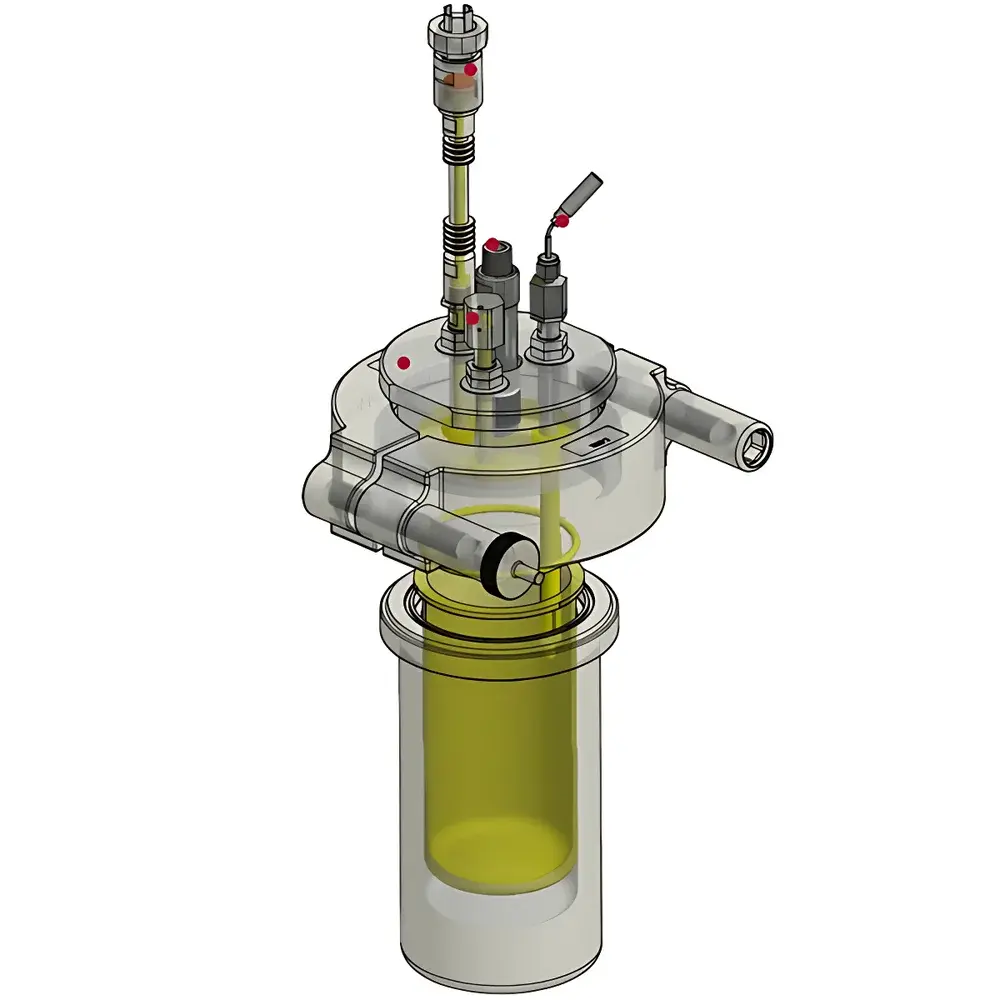
ChemTron DB-300 Standard High-Pressure Reaction Vessel System
| Brand | ChemTron |
|---|---|
| Origin | Germany |
| Model | DB-300 |
| Working Volume | 300 mL |
| Construction Material | 316Ti Stainless Steel with Full PTFE Lining |
| Maximum Operating Pressure | 200 bar |
| Sealing Materials | PTFE / FKM (Viton) / FFKM (Kalrez) O-rings |
| Temperature Range | Up to 300 °C |
| Compliance | Designed for GLP/GMP-aligned laboratory synthesis workflows |
Overview
The ChemTron DB-300 Standard High-Pressure Reaction Vessel System is an engineered solution for controlled, scalable chemical synthesis under elevated pressure and temperature conditions. Based on Couette-type pressure containment architecture and compliant with ASME BPVC Section VIII Div. 1 design principles (adapted for laboratory-scale vessels), the DB-300 integrates robust mechanical integrity with chemically inert fluid-contact surfaces. Its core configuration features a 300 mL working volume vessel constructed from ASTM A240 316Ti stainless steel — selected for enhanced resistance to intergranular corrosion during thermal cycling — fully lined with sintered, high-purity PTFE (polytetrafluoroethylene) on both the inner wall of the reactor body and the underside of the lid. This dual-lining strategy eliminates metallic exposure to reactive media, enabling compatibility with aggressive reagents including hydrofluoric acid, fuming nitric acid, halogenated solvents, and alkali metal suspensions. The system operates within a certified pressure envelope up to 200 bar (as verified by integrated 200 bar pressure transducer), with rupture disc protection rated at 100 bar (Monel alloy, PFA-coated, traceable certification included). Designed for benchtop deployment in synthetic organic chemistry, catalysis research, and materials precursor development labs, the DB-300 meets functional requirements aligned with ISO 17025 method validation frameworks and supports audit-ready documentation when paired with BTC-3000 temperature controllers.
Key Features
- Quick-clamp closure mechanism: Tool-free, hand-tightened sealing ring enables repeatable torque application without wrenches or calibration tools — ensuring consistent gasket compression and leak-tight performance across >5,000 operational cycles.
- Full PTFE wetted-path design: Includes PTFE-lined vessel interior, lid face, dip tube for thermocouple insertion, and all internal valve seats and flow channels — eliminating galvanic corrosion and adsorption artifacts.
- Multi-material sealing options: Interchangeable O-rings in PTFE (for low-temp/low-pressure inert service), FKM (Viton®; compatible with hydrocarbons and moderate oxidizers), and FFKM (Kalrez®; validated for >250 °C and strong oxidizers such as peroxides and chlorine derivatives).
- Modular interface standardization: All external ports conform to G3/8″ parallel thread (DIN 2999), permitting rapid attachment of gas manifolds, sampling loops, reflux condensers, or inline IR cells without custom adapters.
- Integrated safety architecture: Factory-installed rupture disc (100 bar Monel, PFA-protected), vent valve with manual bleed capability, and pressure relief path routed through PTFE-lined exhaust tubing (550 bar rating, ID 9 mm).
- Thermal management readiness: Compatible with BHM-300 electrical heating jacket (600 W, 50–300 °C range, overheat cut-off), requiring BTC-3000 programmable controller for PID-regulated ramp/soak profiles compliant with USP & ASTM E2894 thermal stability testing protocols.
Sample Compatibility & Compliance
The DB-300 accommodates heterogeneous, multiphase, and gas-liquid-solid reaction systems typical in hydrogenation, hydrothermal synthesis, supercritical fluid processing, and electrochemical precursor preparation. Its PTFE-lined geometry minimizes surface catalytic effects and ensures quantitative recovery of volatile or sticky intermediates (e.g., organolithium species, metal carbonyls, or polymeric oligomers). All wetted components comply with FDA 21 CFR 177.1550 for fluoropolymer food-contact equivalence, and pressure-bearing parts are CE-marked per PED 2014/68/EU Annex I essential safety requirements. Documentation packages include material certifications (EN 10204 3.1), burst test reports, and traceable calibration certificates for pressure and temperature sensors — supporting GLP audits and regulatory submissions under ICH M7 and Q5C guidelines.
Software & Data Management
While the base DB-300 operates manually, it is natively compatible with ChemTron’s optional BTC-3000 digital controller and ChemControl™ LabSuite software suite. This integration provides time-stamped, encrypted logging of pressure (0–200 bar, ±1% FS), temperature (−20 to +300 °C, Type K thermocouple, ±0.5 °C), and actuator status (valve positions, stirrer RPM if equipped). Data export adheres to ASTM E2500-17 for electronic records, includes digital signature fields, and supports 21 CFR Part 11 compliance when deployed with role-based user authentication and audit trail activation. Raw datasets are stored in .CSV and .XML formats for direct import into MATLAB, Python (Pandas), or LIMS platforms.
Applications
- Catalytic hydrogenation of unsaturated pharmaceutical intermediates under H₂ pressures up to 100 bar
- Hydrothermal synthesis of metal–organic frameworks (MOFs) and perovskite nanocrystals at 180–220 °C
- High-pressure oxidation of lignin model compounds using O₂ or air
- Supercritical CO₂-assisted polymerization of acrylic monomers
- In situ FTIR monitoring via dedicated quartz viewport accessory (optional)
- Batch-wise evaluation of catalyst deactivation kinetics under realistic process conditions
FAQ
What is the maximum allowable working pressure for the DB-300 system?
The vessel is rated for continuous operation up to 200 bar, with mechanical overpressure protection provided by a certified 100 bar rupture disc.
Can the DB-300 be used with corrosive fluorinating agents such as ClF₃ or BrF₃?
Yes — the full PTFE lining and Kalrez® O-rings provide validated compatibility; however, pre-use thermal conditioning and strict moisture exclusion protocols must be followed per ChemTron Technical Note TN-DB300-FX.
Is third-party calibration of the pressure sensor supported?
Yes — the 200 bar transducer uses a standard 4–20 mA output signal and may be recalibrated using NIST-traceable deadweight testers; calibration certificate is supplied with each unit.
Does the system support automated stirring?
Stirring is not included in the base DB-300 set but can be added via optional magnetic coupling drive (max. 800 rpm, 50 N·cm torque) or top-entry mechanical stirrer (seal-compatible with PTFE/Kalrez® shaft packing).
Are spare PTFE liners available as consumables?
Yes — part number BR300 Insert PTFE is stocked globally; liner replacement requires no special tools and takes <90 seconds with trained personnel.



