
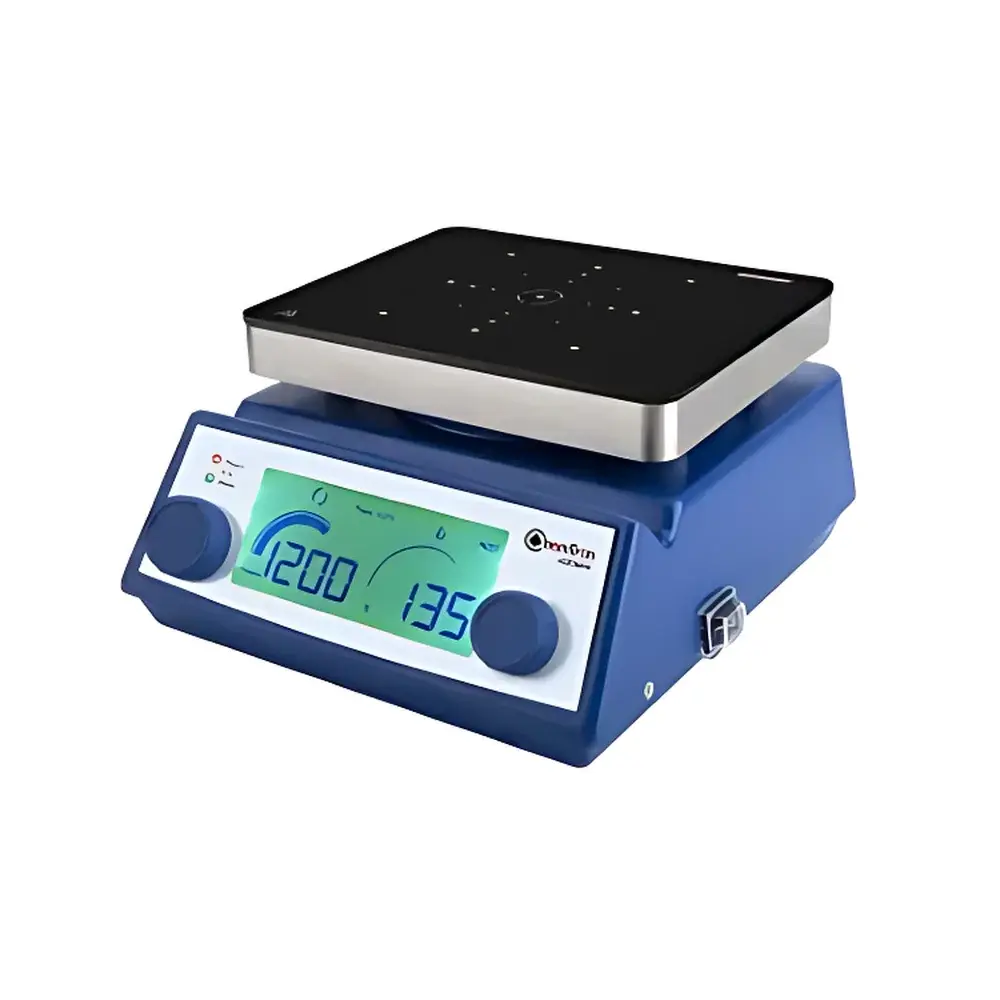
ChemTron HSP240 Series Heating Magnetic Stirrers
| Brand | ChemTron |
|---|---|
| Origin | Germany |
| Model | HSP240-AH / HSP240-H / HSP240-AR / HSP240-R |
| Stirrer Type | Magnetic Stirrer |
| Speed Range | 100–1500 rpm |
| Temperature Range | 50–450 °C |
| Max. Set Temperature (ceramic-glass) | 450 °C |
| Max. Set Temperature (aluminum-ceramic enamel) | 320 °C |
| External PT100 Support | Yes |
| Temperature Stability (with PT100) | ±2 °C |
| Safety Temp. Range | 50–500 °C (adjustable) |
| Over-Temp. Protection Range | 10–50 °C (adjustable) |
| Heating Power | 800 W |
| Display | LCD |
| Interface | USB |
| Timer Range | 1–1999 min or continuous |
| Heater Surface | SCHOTT® ceramic glass (H/R models) or aluminum-ceramic enamel (AH/AR models) |
| Heater Dimensions | 180 × 180 mm (AH/H) or Ø135 mm (AR/R) |
| Dimensions (W×H×D) | 225 × 215 × 115 mm |
| Power Supply | 220 V / 50 Hz |
Overview
The ChemTron HSP240 Series Heating Magnetic Stirrers are precision-engineered laboratory instruments designed for simultaneous temperature-controlled heating and magnetic agitation of liquid samples in sealed or open vessels. Based on the principle of electromagnetic induction, these stirrers generate a rotating magnetic field beneath the heater plate to drive ferromagnetic stirring bars—enabling contactless, contamination-free mixing without mechanical shafts or seals. The series integrates infrared radiation heating (via SCHOTT® DURAN® ceramic glass plates) or resistive conduction heating (via aluminum-ceramic enamel surfaces), delivering rapid thermal response and uniform heat distribution across the platform. Engineered for reproducibility and operational safety in regulated environments, the HSP240 platform supports GLP-compliant workflows through programmable PID control, adjustable overtemperature cutoffs, and real-time parameter logging via USB interface.
Key Features
- Four model variants optimized for distinct thermal and material compatibility requirements: HSP240-H and HSP240-R feature SCHOTT® ceramic glass plates enabling up to 450 °C surface temperature and efficient infrared energy transfer; HSP240-AH and HSP240-AR utilize aluminum-ceramic enamel surfaces rated to 320 °C, ideal for opaque or metallic containers where optical transparency is not required.
- Intelligent 3-stage PID temperature control algorithm dynamically adjusts power output based on real-time feedback from internal sensors or externally connected Pt100 probes—ensuring ±2 °C stability when used with calibrated external sensing.
- Programmable safety parameters include user-defined maximum operating temperature (50–500 °C range) and independent overtemperature protection threshold (10–50 °C above setpoint), meeting IEC 61010-1 requirements for Class II laboratory equipment.
- LCD display simultaneously shows actual and set values for temperature, speed, and timer—enhancing process visibility during extended heating/stirring protocols.
- Integrated USB port enables bidirectional communication with Windows-based PC software for remote operation, automated data capture, audit trail generation, and export of time-stamped CSV logs—supporting 21 CFR Part 11 readiness when deployed with appropriate system validation documentation.
- High-torque motor delivers consistent rotational performance from 100 to 1500 rpm, compatible with ChemTron’s full line of chemically inert, PTFE-coated stirring bars—including high-shear elliptical and cross-shaped geometries for viscous or heterogeneous media.
Sample Compatibility & Compliance
The HSP240 series accommodates standard round-bottom flasks (up to 2 L), beakers, crystallization dishes, and reaction vials with diameters matching the heater surface geometry (180 × 180 mm square or Ø135/Ø145 mm circular). Its non-magnetic ceramic glass and enamel surfaces ensure compatibility with aggressive solvents, strong acids (e.g., concentrated HNO₃, H₂SO₄), and halogenated reagents under controlled conditions. All models conform to EN 61326-1 (EMC for laboratory use) and EN 61010-1:2010+A1:2019 (safety requirements for electrical equipment). Optional Pt100 probe integration allows direct sample temperature measurement per ASTM E220 and ISO 17025 traceability guidelines—critical for method validation in pharmaceutical QC labs and materials synthesis R&D.
Software & Data Management
The included PC software provides full instrument control—including ramp/soak profiles, speed modulation synchronized with temperature steps, and event-triggered logging (e.g., “start recording at 80 °C”). Data files include timestamps, operator ID fields, and checksum-verified metadata—facilitating review during internal audits or regulatory inspections. Export formats include .csv and .xlsx; raw binary logs support third-party analysis tools. Firmware updates are delivered via secure HTTPS download, and configuration backups can be stored locally or on network drives—aligning with GxP data integrity principles (ALCOA+).
Applications
- Controlled synthesis of metal-organic frameworks (MOFs) requiring precise thermal ramping and homogeneous nucleation.
- Dissolution testing of solid dosage forms per USP , with simultaneous stirring and bath-equivalent temperature maintenance.
- Preparation of calibration standards for ICP-MS and AAS, where matrix homogeneity and thermal stability directly impact accuracy.
- Accelerated aging studies of polymer blends and composites under elevated temperature and shear stress.
- Enzymatic digestion protocols in molecular biology workflows demanding low-vibration agitation and narrow thermal tolerance (±1 °C).
FAQ
Can the HSP240 operate without an external temperature sensor?
Yes—the unit functions with built-in plate temperature sensing. However, for accurate sample temperature control—especially in low-thermal-conductivity vessels or viscous media—external Pt100 connection is strongly recommended.
Is the USB interface compatible with macOS or Linux systems?
The native software is Windows-only (Windows 10/11, 64-bit), but serial command protocols are documented and accessible via Python or LabVIEW using virtual COM port emulation.
What is the maximum flask size supported on the Ø135 mm heater surface?
Optimal performance is achieved with vessels ≤100 mm in diameter; larger flasks may experience uneven heating or reduced stirring efficiency due to magnetic field dispersion.
Does the device support automatic shutdown after timer completion?
Yes—upon reaching the programmed duration, heating and stirring cease, and the display enters standby mode while retaining last-used settings.
Are spare parts such as heater plates or control boards available for field replacement?
All major subassemblies—including ceramic glass plates, aluminum-ceramic enamel tops, and main PCBs—are stocked globally and supplied with full service documentation and RoHS-compliant certifications.



