
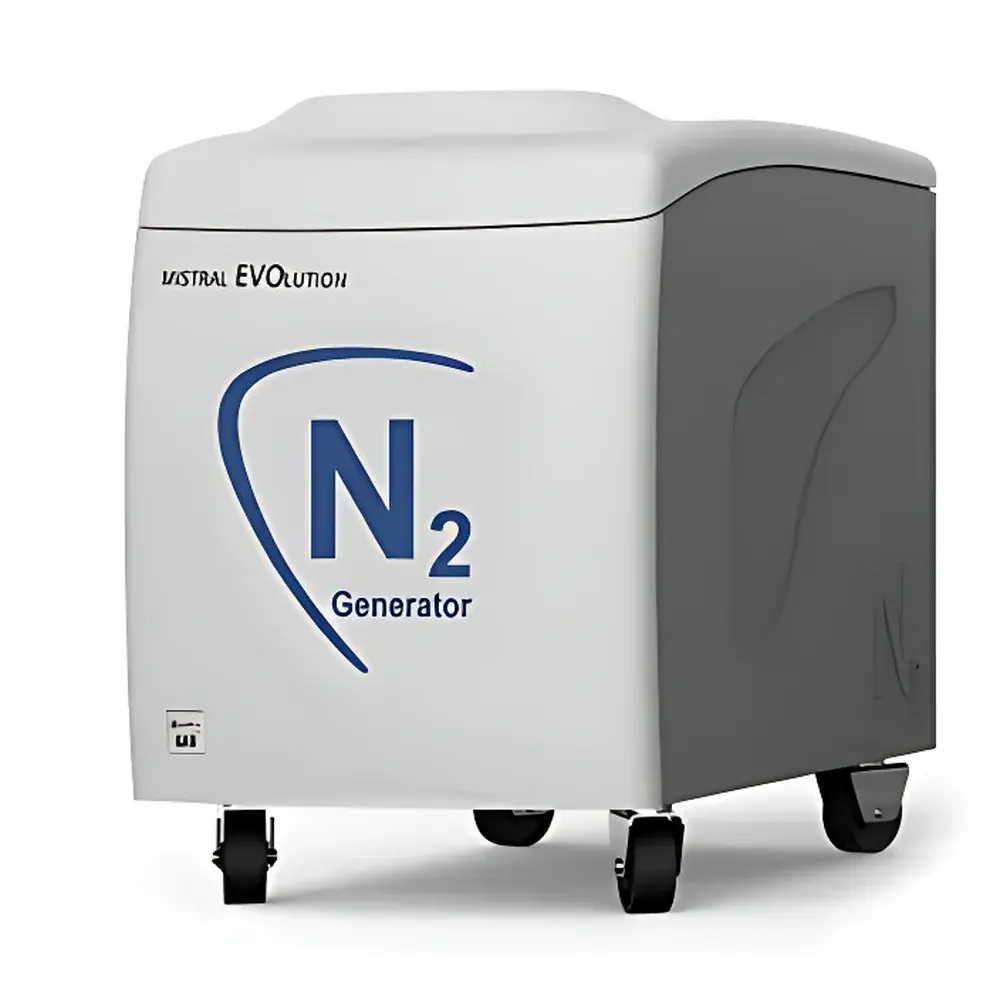
ChemTron MISTRAL EVO Nitrogen Generator
| Brand | ChemTron |
|---|---|
| Origin | Germany |
| Model | MISTRAL EVO |
| Output Flow Rate | 10–40 L/min |
| Output Pressure | 8 bar (116 psi) |
| Nitrogen Purity | 97–99.9% |
| Power Supply | 110 V / 60 Hz or 230 V / 50 Hz |
| Weight | 90 kg |
| Power Consumption | 1800 W |
| Pressure Stability | ±0.1 bar (±0.5%) |
| Display | Graphical LCD (128 × 64 px) |
| Protection Class | IP2X |
| Operating Temperature | 15–40 °C |
| Sound Pressure Level | <60 dB(A) |
| Alarm Relay | 250 VAC, max 16 A |
| Gas Outlet | 1/4" compression fitting or 6 mm push-to-connect |
| Dimensions (L × D × H) | 482 × 835 × 641 mm |
| Certifications | CE |
Overview
The ChemTron MISTRAL EVO Nitrogen Generator is an integrated, on-site nitrogen supply system engineered for continuous, reliable operation in analytical laboratories requiring high-purity inert gas. It employs Compressed Air Purification and Separation by Adsorption (CPSA)—a variant of pressure swing adsorption (PSA)—to separate nitrogen from ambient compressed air. This process selectively retains oxygen, carbon dioxide, water vapor, and trace hydrocarbons on carbon molecular sieve (CMS) beds while allowing high-purity nitrogen to pass through. Unlike cryogenic or membrane-based systems, CPSA delivers stable purity across variable flow demands without requiring external air compressors or dew-point dryers. The MISTRAL EVO integrates dual-head, oil-free low-pressure air compressors, eliminating dependency on facility-supplied compressed air and reducing infrastructure complexity. Designed for seamless integration with LC/MS, LC/MS/MS, GC carrier gas, solid-phase extraction (SPE), and sample evaporation systems, it provides a certified alternative to high-pressure nitrogen cylinders and liquid nitrogen dewars—reducing logistical overhead, safety risks, and long-term operating costs.
Key Features
- Integrated dual-head oil-free air compressors—no external air source required; designed for >20,000 hours MTBF
- CPSA separation technology with multi-stage pre-filtration (coalescing, activated carbon, desiccant) ensuring consistent 97–99.9% N₂ purity
- Two operational modes: direct-flow mode for immediate demand response; buffer-tank mode enabling intermittent compressor cycling—extending CMS bed life and reducing energy consumption
- Real-time graphical LCD display (128 × 64 px) showing nitrogen pressure, flow rate, internal temperature, CMS saturation status, and maintenance countdowns
- Comprehensive safety monitoring: dual independent pressure sensors, thermal cut-off, condensate level detection with automatic drain activation (active at >80% purity setting), and audible/visual alarms with relay output (250 VAC / 16 A)
- Three analog pressure gauges for visual verification of intake, intermediate, and outlet pressures—supporting GLP-compliant manual audit trails
- Compact footprint (482 × 835 × 641 mm) with castor wheels for under-bench installation and repositioning; IP2X-rated enclosure suitable for standard laboratory environments
- Auto-restart function after power interruption—configurable via front-panel settings to comply with lab-specific power recovery protocols
Sample Compatibility & Compliance
The MISTRAL EVO is compatible with all standard nitrogen-dependent instrumentation requiring flow-stable, oil-free, low-particulate gas—including electrospray ionization (ESI) and atmospheric pressure chemical ionization (APCI) sources, GC carrier lines, purge-and-trap systems, and inert-atmosphere glove boxes. Its output meets ASTM D6349-20 specifications for instrument-grade nitrogen and complies with ISO 8573-1:2010 Class 2:2:2 for particulate, moisture, and oil content when operated within specified ambient conditions (15–40 °C, non-condensing humidity). The unit carries CE marking per Directive 2014/30/EU (EMC) and 2014/35/EU (LVD), confirming conformity with essential health and safety requirements for electrical equipment. While not inherently 21 CFR Part 11 compliant, its event-logged alarm history, user-accessible service records, and deterministic pressure/flow behavior support validation under GxP frameworks when deployed with documented IQ/OQ protocols.
Software & Data Management
The MISTRAL EVO operates as a standalone hardware platform with no proprietary software dependency. All operational parameters—including runtime hours, CMS regeneration cycles, alarm events, and sensor diagnostics—are stored in non-volatile memory and accessible via the front-panel interface. For integration into centralized lab infrastructure, the relay alarm output can interface with building management systems (BMS) or SCADA platforms using dry-contact signaling. Optional analog 4–20 mA outputs (available upon request) enable remote pressure and flow telemetry. Audit-ready documentation—including CE declaration of conformity, electrical schematics, and maintenance log templates—is supplied with each unit to facilitate compliance with ISO/IEC 17025, GLP, and internal QA procedures.
Applications
- LC/MS and LC/MS/MS mobile phase nebulization and drying gas supply
- GC carrier and detector make-up gas (with optional inline hydrocarbon trap)
- Inert blanketing during solvent evaporation (e.g., TurboVap®, CentriVap®)
- Sample preparation workflows including solid-phase extraction (SPE) and nitrogen blow-down
- Calibration gas dilution systems requiring stable, low-oil nitrogen base gas
- Long-duration unattended analyses where cylinder replacement poses workflow disruption or safety concerns
FAQ
What nitrogen purity levels are achievable at maximum flow?
At 40 L/min output, the MISTRAL EVO maintains ≥98% N₂ purity; purity increases to ≥99.5% at flows ≤25 L/min, depending on ambient temperature and inlet air quality.
Is external cooling or ventilation required?
No dedicated HVAC is needed; the unit requires only 150 mm clearance on all sides for passive convection and operates safely up to 40 °C ambient temperature.
How often must the CMS beds be replaced?
Under typical lab use (8 h/day, 5 days/week), CMS life exceeds 3 years; the onboard counter triggers a service alert at 25,000 operating hours or detected saturation drift.
Can the generator be connected to multiple instruments simultaneously?
Yes—provided total demand remains within rated flow and pressure specifications; use stainless steel or electropolished tubing with proper pressure-drop calculations and point-of-use regulators.
Does the unit meet requirements for regulated pharmaceutical QC labs?
It supports GMP-aligned operation when included in a validated gas distribution system; full qualification (IQ/OQ/PQ) must be performed per site-specific protocols and USP guidance.



